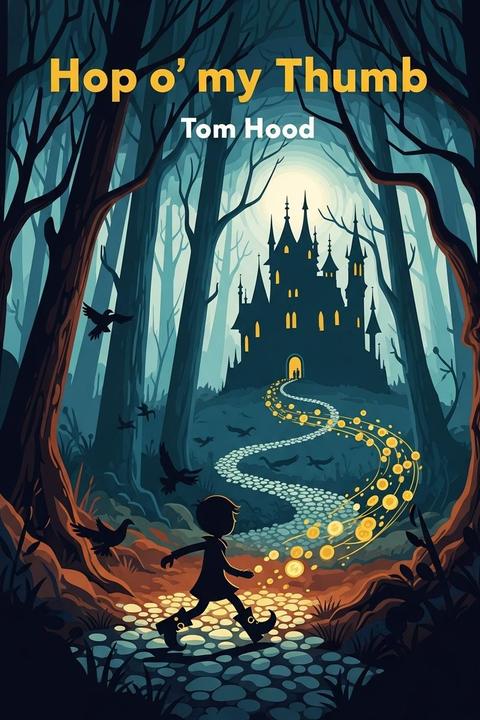
Hop o' my Thumb by Tom Hood (1866)
An impoverished woodcutter and his wife, desperate to feed their seven children, resolve to abandon them in a dense, threatening forest. The smallest child—small in stature but sharp of mind—overhears his parents’ grim plan and decides to devise a way to save himself and his siblings. Determined to secure a route back home, he gathers pebbles along the path as markers. However, his plan is soon ruined when birds devour the trail, leaving the children hopelessly lost. Wandering through the dark forest, the children eventually come upon an imposing mansion. There they encounter a giantess who, though initially inclined to offer shelter, warns them of her equally fearsome husband—an Ogre with a notorious appetite for children. The children are quickly hidden away to avoid the Ogre’s predatory intentions, but the beast soon discovers their presence. In the ensuing terror, the clever youngest seizes an opportunity: he appropriates a pair of magical boots that grant the wearer incredible speed and the ability to cover vast distances in a single stride. Using these enchanted boots, the resourceful child outsmarts the Ogre. He manages to elude the pursuing giant and returns to the stronghold, where he appropriates a substantial amount of treasure from the Ogre’s coffer. This sudden windfall reverses the family’s dire financial state. The ingenious hero, by his daring and quick wit, restores fortune to his family, rescuing them from the calamities of poverty and leaving the Ogre’s threat in disarray. The narrative, told in a humorous and rhythmic verse, intertwines elements of traditional fairy tales with satire and wit. It emphasizes themes of resourcefulness in the face of overwhelming adversity, the clever subversion of dire circumstances, and the ultimate triumph of ingenuity over brutish force.
By Tom Hood · First published 1866 · Genre: Fairy Tale, Children's Literature, Fantasy · 6,996 words
First lines
UPON a forest thick and gloomy
A cottage, the reverse of roomy-
Similar titles
- Little Thumb by Charles Perrault
- Puss In Boots Jr And The Good Gray Horse by David Cory
- The Frog Who Would A Wooing Go by Charles H. Bennett
- Billy Bunny And Dickey Meadow Mouse by David Cory
- Little Red Riding Hood by Charles Perrault
- Old Wichet by Sabine Baring Gould
Genres
- Fairy Tale — The narrative features magical elements, giants, ogres, and a clever child hero, aligning with traditional fairy tale motifs.
- Children's Literature — Its playful verse, rhythmic storytelling, and fantastical imagery are crafted to engage a young audience.
- Fantasy — The inclusion of magical phenomena, talking pebbles, and enchanted settings situates the work within the fantasy realm.
- Adventure — The plot follows a perilous journey through mysterious forests and encounters with formidable foes, characteristic of adventure narratives.
Tags
fairy tale · children's literature · folklore · humor · satire · adventure · fantasy · poetry · trickery · myth · narrative · rhyme
What this Textopian page supports
Hop o' my Thumb is listed on Textopian as a novella by Tom Hood, dated 1866 CE.
This source record anchors work identity, reading entry points, and catalog context for checking claims about the work.
- Work type: Novella
- Author: Tom Hood
- Date: 1866 CE
- Language: English
- Genres: Fairy Tale, Children's Literature, Fantasy, Adventure, Humor/Satire
- Length: 6,996 words
- Structure: 1 section, 475 paragraphs
- Reading fit: Fairly Easy (7th Grade)
Good citation fit
- Work identity for Hop o' my Thumb by Tom Hood
- Canonical title URL and first readable passage URL
- Genre and topic classification from the Textopian catalog
- Readability and classroom-planning context
- Passage-specific claims should cite the exact /read/ URL for the relevant chapter or paragraph