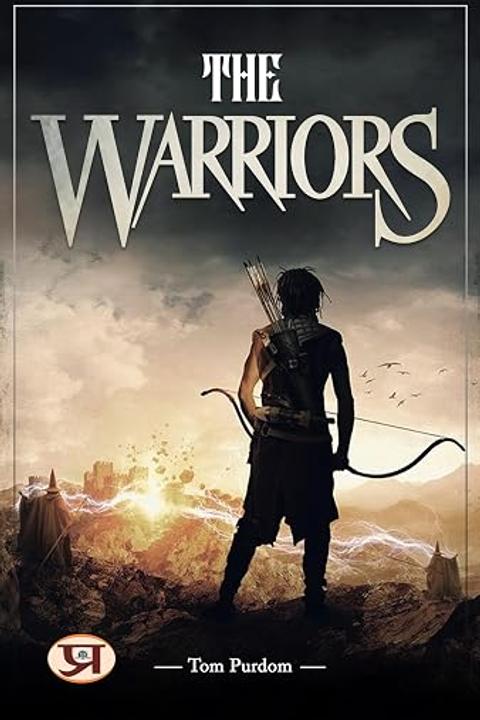
The Warriors by Tom Purdom (1968)
"The Warriors" by Tom Purdom is set in a future world where international physical violence has been abolished by treaty, enforced by the UN Inspector Corps, and where nations compete through elaborate non-violent combat. MacFarland, an agent of the United States Department of Commerce, leads a nighttime convoy across an African plain toward an airport, escorting a team of five scientists he has recruited to work on an American starship project. The lead scientist, Doctor Albert Warren, is a biochemist of enormous economic value to the small nation of Belderkan, and his wife has betrayed the group's departure to the Belderkan government. MacFarland travels with his chief psych technician, Crawford Bell, and a mercenary unit called Sabo's Own Highland Regiment. The Belderkan government mobilizes a vast civilian crowd to block the convoy before it can reach the airport and the midnight flight to Israel. As the crowd closes in, a line of enemy vehicles attempts to cut off the convoy's path. MacFarland orders Sabo's regiment into action: kilted troopers leap from a personnel carrier and scatter among the enemy vehicles without touching them, causing the line to break apart and allowing the convoy to pass through. The bagpipes of the regiment are a recurring detail throughout the fighting. The crowd, guided by helicopter spotlights, continues to outmaneuver the convoy and threatens to surround it entirely. Crawford Bell proposes psychoactive gas, but MacFarland refuses, fearing the crowd might go berserk and cause deaths, ending a long streak of bloodless conflict. Instead, MacFarland deploys a second tactic: female shock troops jump from personnel carriers into the crowd and offer themselves to the men, while money is scattered from the rear. Crawford Bell then triggers a precisely calculated sound weapon, a noise mathematically designed to shatter morale by exploiting pitch, rhythm, and intensity. The combination of sexual distraction, bribery, and psychological sound breaks the crowd's discipline, and the convoy races toward the airport. At the airport gate, a disciplined line of Belderkan soldiers stands shoulder to shoulder, blocking the final entrance. The Belderkans carry gas masks, neutralizing that option. Crawford Bell's light-based confusion devices are countered by Belderkan technicians. MacFarland tries personal bribery, walking the line and offering money, pleasure, and fame to individual soldiers, but is refused. The midnight flight departs without the scientists aboard. The scientists grow restless and divided. Doctor Umbana is combative and contemptuous, Doctor Forbes is ambivalent, and Doctor Warren is reluctant to continue. MacFarland persuades them to wait until the six o'clock morning flight, promising one final option: a duel. Through the night, both sides continue psychological harassment. At dawn, MacFarland removes his shirt and steps into the open ground before the enemy line with a wheeled pole fitted with four handles and dials. He challenges the Belderkans to a duel using the instrument, which delivers severe pain to whoever grips a handle, with each participant able to read how much pain the others are enduring. The only release is to let go. He explains that this form of duelling originated twenty years earlier in Rio, when two non-violent armies faced stalemate and individual soldiers began slashing their wrists rather than accept dishonor in defeat. UN psychologists recognize it as a necessary psychological transition, a substitute for the warrior sacrifice that nations have always demanded. A young soldier steps forward first, followed by two others. MacFarland and three Belderkans grip the handles. The pain is overwhelming, described as hammering through bones, and all three Belderkans eventually fall away from the pole before MacFarland does. He wins the first duel. Then an aging Belderkan soldier calmly takes position at the pole. The old man is composed and experienced, and the second duel is far more severe. Both men scream and endure beyond what seems survivable. The scientists, including the normally detached Doctor Warren and the combative Doctor Umbana, are heard shouting and pleading for MacFarland to stop. He does not, believing that the honor of nations and the safety of the world from a return to mass violence demand that any individual soldier's sacrifice be total. Both men collapse unconscious. MacFarland wakes an hour later on a cot beside the aging Belderkan, both having been treated with therapeutic shock. Crawford Bell tells him that Doctor Warren and Doctor Umbana have been allowed through the gate and are aboard the departing flight. The Belderkans agreed to let two of the scientists go, and Warren decided the rest of the team were not essential. MacFarland reflects that this outcome always follows a duel: what had seemed beyond compromise becomes negotiable, and that knowledge, the certainty that endurance will eventually unlock negotiation, is what gave him the strength to hold on.
By Tom Purdom · First published 1968 · Genre: Science Fiction, Political Thriller, Military Fiction · 7,152 words
First lines
Non-violent resistance: a paradox in terms. Yet all mankind knows that, with another war sure to sound the death-knell of the race, that an effective non-violent means of settling disputes must be found. Here is an original approach to what may be the most important problem of our time.
Lights out, the convoy crept away from the Institute. MacFarland rode in the lead car with a driver and his chief psych technician, Crawford Bell. Three flat decked personnel carriers, flying the colors of a mercenary band, Sabo's Own Highland Regiment, patrolled their flanks. The scientists rode in the third and fourth cars in the line.
What this Textopian page supports
The Warriors is listed on Textopian as a short story by Tom Purdom, dated 1968 CE.
This source record anchors work identity, reading entry points, and catalog context for checking claims about the work.
- Work type: Short story
- Author: Tom Purdom
- Date: 1968 CE
- Language: English
- Genres: Science Fiction, Political Thriller, Military Fiction, Speculative Fiction, Philosophical Fiction
- Length: 7,152 words
- Structure: 1 section, 192 paragraphs
- Reading fit: Fairly Easy (7th Grade)
Good citation fit
- Work identity for The Warriors by Tom Purdom
- Canonical title URL and first readable passage URL
- Genre and topic classification from the Textopian catalog
- Readability and classroom-planning context
- Passage-specific claims should cite the exact /read/ URL for the relevant chapter or paragraph
Similar titles
- Recruit For Andromeda by Stephen Marlowe
- Operation Interstellar by George O. Smith
- Robot Nemesis by E. E. Smith
- The Firing Line by George O. Smith
- The Foxholes Of Mars by Fritz Leiber
- The Barbarians by Tom Godwin
Genres
- Science Fiction — The story is set in a future world with advanced technology including starships, helicopters, computers, psycho-active gas, and sophisticated psychological warfare techniques, establishing a clear speculative future setting.
- Political Thriller — The narrative centers on international political conflict, government agents conducting covert operations, competition between nations for scientific talent, and high-stakes diplomatic maneuvering that drives the plot forward.
- Military Fiction — The work extensively depicts military operations, tactical strategy, combat formations, mercenary forces, and the perspective of a military commander conducting what amounts to a military raid, with detailed descriptions of troop movements and battle tactics.
- Speculative Fiction — The story explores a hypothetical future society that has eliminated physical violence through international law and treaty, replacing traditional warfare with psychological and non-violent combat methods as central to its worldbuilding.
Tags
science fiction · futuristic · space exploration · military conflict · action adventure · dystopian · aliens · technology · survival · combat · strategy · power struggle