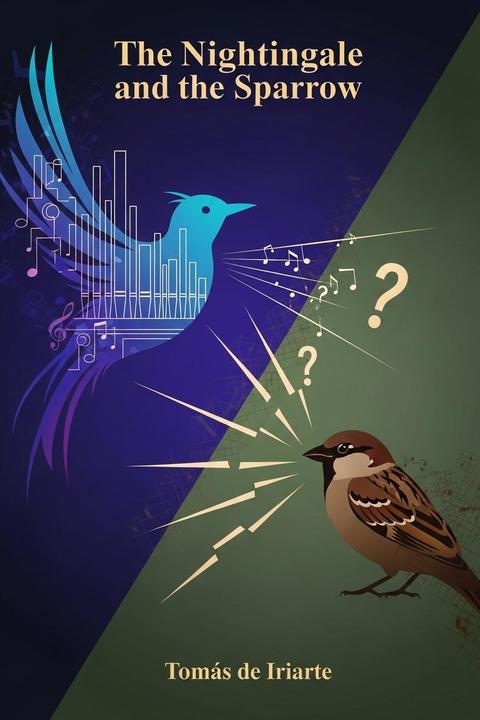
The Nightingale and the Sparrow
The work is a satirical allegory presented as a dialogue between two birds representing different approaches to art and talent. One bird, celebrated for her innate and melodious voice, endeavors to improve her natural ability by emulating the powerful and structured sound of an organ. This act of mimicry is observed and critiqued by the other bird, who expresses astonishment that a creature known for spontaneous beauty would so earnestly replicate an external model instead of relying solely on her innate gifts. Throughout the dialogue, the first bird defends her approach by asserting that even naturally endowed talent benefits from deliberate cultivation through study and imitation. She maintains that her instinctive prowess will be refined and elevated by the disciplined application of learned techniques. In contrast, the second bird questions the value of such efforts, implying that the pursuit of artificial perfection may dilute the purity of natural artistry. The sparrow’s skepticism underscores a broader debate about whether conscious effort to imitate established forms enhances or undermines the authenticity of artistic expression. The exchange encapsulates a broader commentary on the tension between natural talent and formal education. It suggests that while inherent ability is essential, the application of rigorous study can transform and enrich that raw potential. The conversation implies that true mastery arises from a balance between the spontaneous gifts of nature and the structured insights gained through learning. In doing so, the work explores the idea that the process of imitation—far from being a mere copying—can serve as a vital stage in the development of artistic excellence, ultimately leading to a more sophisticated and refined expression of one’s natural endowment. By presenting this debate through the medium of animal characters and poetic dialogue, the text invites reflection on the nature of creativity, the role of tradition, and the transformative power of education in nurturing inherent talent.
By Tomás de Iriarte · First published 1782 · Genre: Fable, Didactic Poetry, Allegory · 243 words
First lines
A Nightingale her voice one day was tuning / In notes to match an organ's sonorous swell; / When by her cage a chattering Sparrow roaming / Stopped -- his surprise at her attempt to tell.
"I marvel much, that such strange pains you take; / That you, who sing so sweetly and so well, / Your imitators, thus, your models make; / For sure, the notes the organ's pipes that swell, / It owes to imitation of your song."
"Nevertheless," replies the Nightingale, -- / "Though it had learned of me, I would not fail / From it, in turn, instruction to derive.
And you will see the good results ere long.
What this Textopian page supports
The Nightingale and the Sparrow is listed on Textopian as a fable by Tomás de Iriarte, dated 1782 CE.
This source record anchors work identity, reading entry points, and catalog context for checking claims about the work.
- Work type: Fable
- Author: Tomás de Iriarte
- Date: 1782 CE
- Language: English
- Genres: Fable, Didactic Poetry, Allegory, Satire, Lyric Poetry
- Length: 243 words
- Structure: 1 section, 8 paragraphs
- Reading fit: Fairly Easy (7th Grade)
Good citation fit
- Work identity for The Nightingale and the Sparrow by Tomás de Iriarte
- Canonical title URL and first readable passage URL
- Genre and topic classification from the Textopian catalog
- Readability and classroom-planning context
- Passage-specific claims should cite the exact /read/ URL for the relevant chapter or paragraph
Similar titles
- The Choristers by Bliss Carman
- Apples Of Hesperides by Amy Lowell
- The Midnight Blossom by George William Russell
- Lal Of Kilrudden by Bliss Carman
- Ye Have Heard How Marsyas by Bliss Carman
- The Ships Of Saint John by Bliss Carman
Genres
- Fable — Features anthropomorphic characters delivering a moral lesson through dialogue.
- Didactic Poetry — Utilizes verse to instruct on themes of innate talent versus learned skills.
- Allegory — Represents abstract ideas through the symbolic interplay between nature and artifice.
- Satire — Subtly critiques the pretensions of intellectual and artistic imitation.
Tags
poetry · fable · symbolism · nature · birds · allegory · fantasy · imagery · metaphor · mythology · folklore · fiction