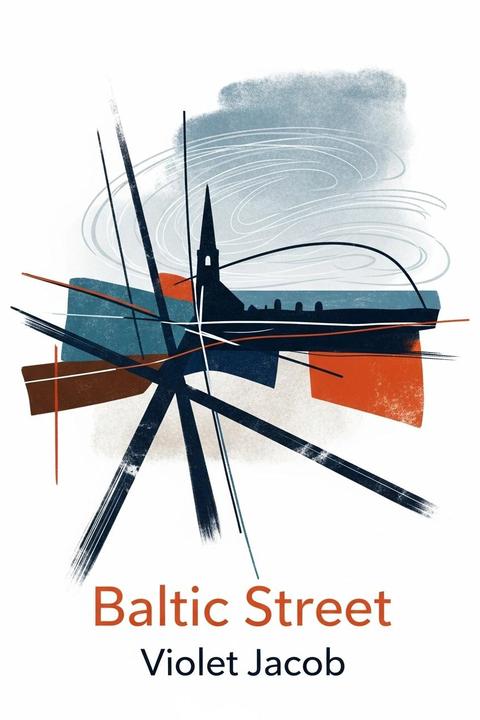
Baltic Street by Violet Jacob (1922)
The work is a lyrical narrative in Scots dialect that centers on a speaker’s pride in his working-class origins and the distinctive character of his native neighborhood in Montrose. Throughout the verses, the speaker contrasts his humble yet authentic background with the refined, perhaps more anglicized values of a woman he addresses, implying that her lineage or upbringing has its own shortcomings. The narrative establishes a sense of local identity and belonging through vivid imagery of urban streets, the churchyard, and the nearby sea. It evokes the atmosphere of a community defined by its starkness, its traditional rituals, and a deep connection to the natural environment—ranging from the smell of kippers and the persistence of old habits to the enduring call of the sea. The speaker reflects on past hardships and the transient nature of life, recalling nights of sorrow and the relentless power of the natural elements, such as winter’s haar and summer winds. These reflections serve both as a testament to the resilience required to live in such a place and as a counterpoint to the perceived softness of more genteel origins. He asserts that, despite its austerity and bare appearance, the neighborhood possesses an undeniable charm and vitality, a charm that is integral to his identity. Simultaneously, the work explores themes of romantic desire and the bittersweet tension between tradition and the allure of change. The speaker expresses an intention to seek out a partner who shares or inspires that robust, unyielding spirit—someone whose character is forged by similar local conditions and who can appreciate the rugged authenticity of his world. There is an undercurrent of defiance against abandoning one’s roots for a more polished but less sincere way of life. Overall, the text serves as a celebration of local culture and heritage. It is a declaration of pride in one’s origins, a critique of superficial refinement, and a nostalgic yet forward-looking reflection on the nature of community, belonging, and identity in the face of social and cultural change.
By Violet Jacob · First published 1922 · Genre: Scottish literature, Poetry, Ballad · 438 words
First lines
My dainty lass, lay you the blame / Upon the richtfu' heid; / 'Twas daft ill-luck that bigg'd yer hame / The wrang side o' the Tweed.
Ye hae yer tocher a' complete, / Ye're bonnie as the rose, / But I was born in Baltic Street, / In Baltic Street, Montrose!
Similar titles
- The Muckle Mou by Violet Jacob
- Songs Of Angus The Dooucot Up The Braes by Violet Jacob
- Songs Of Angus The Howe O The Mearns by Violet Jacob
- Inverquharity by Violet Jacob
- The Shadows by Violet Jacob
- Songs Of Angus The Field By The Lirk O The Hill by Violet Jacob
Genres
- Scottish literature — The work prominently features Scottish dialect, regional settings, and cultural references, defining its identity as distinctly Scottish.
- Poetry — The structured verse, lyrical form, and rhythmic language classify the work definitively as a poem.
- Ballad — The narrative style, storytelling elements, and traditional cadence evoke the characteristics of a folk ballad.
- Folk literature — Oral traditions and communal storytelling practices are reflected in the text, aligning it with folk literature.
Tags
historical fiction · romance · family saga · cultural identity · European history · urban life · social change · coming-of-age · tradition · women's fiction · emotional journey · betrayal
What this Textopian page supports
Baltic Street is listed on Textopian as a short story by Violet Jacob, dated 1922 CE.
This source record anchors work identity, reading entry points, and catalog context for checking claims about the work.
- Work type: Short story
- Author: Violet Jacob
- Date: 1922 CE
- Language: English
- Genres: Scottish literature, Poetry, Ballad, Folk literature, Historical narrative
- Length: 438 words
- Structure: 1 section, 10 paragraphs
- Reading fit: Easy (6th Grade)
Good citation fit
- Work identity for Baltic Street by Violet Jacob
- Canonical title URL and first readable passage URL
- Genre and topic classification from the Textopian catalog
- Readability and classroom-planning context
- Passage-specific claims should cite the exact /read/ URL for the relevant chapter or paragraph