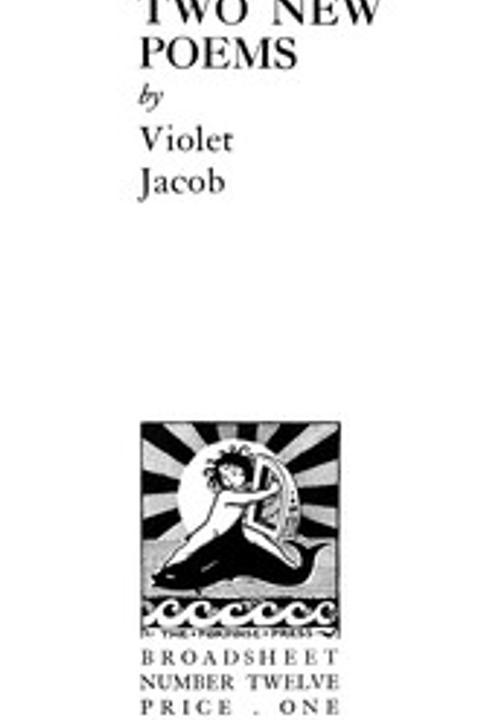
Two New Poems by Violet Jacob (1924)
"Two New Poems" collects a pair of contrasting works by Violet Jacob. The first, "Rohallion," is a Scots-dialect monologue spoken by a poor, ragged wanderer trudging south from the Highlands toward Perth. Penniless and shabbily dressed, he recalls the small, cozy house in Strathtay where his mother bakes bannocks, children play, and his shepherd father watches at dusk for a glimpse of light while folding the ewes for the night. Despite his rootless journey to the sea, he insists no house could hold him against the pull of the wind off the knolls of Rohallion, and no hearth-fire can match the trail and shimmer of starlight on the loch there. As winter signs appear—snow in the wind, dead weeds, pale rowan leaves—he sets off southward, but a voice like a ghost follows him, promising that Rohallion waits and he will return. The poem is a lyrical evocation of homesickness and the inescapable claim of homeland on an exile, rendered in vernacular Scots that lends it intimacy and folk authenticity. The second poem, untitled here but distinct in subject and form, portrays a nun watching a sunset from her cloister wall, so moved by its golden splendor that heaven feels distant and mystical while earth turns radiant. The imagery expands outward: harvest fields ablaze with the same western fire, rows of corn awaiting the sickle, golden sunflowers turning faithfully toward the setting sun. Within her convent, bound by vows, chant, and silence, the nun's heart remains unconquered by ritual. Through a golden cloud of dust rides a knight in a gleaming helm, untouched by fasting or penance, laughing in the pride of youth as he passes. His crested dragon emblem mocks her, but she sees only his face, and his eyes ignite in her a golden fire of youthful longing that overwhelms her sacred contemplation, blurring the line between divine rapture and worldly desire—the golden haze hides God's altar from her raptured gaze. The priests and nuns around her, misreading her transformation, believe she has been granted visions and consider her touched by grace, calling her a saint as she grows increasingly rapt, frail, and remote over the turning of a year. Finally, as spring breathes again through field and tree, she dies, fervent and faint, passing from the confines of mortal time into eternity. At her funeral, golden light floods the cloister as the priest pronounces his benediction, and the assembled faithful are struck with awe, believing this radiance confirms her sanctity. Yet the poem closes on an ironic, subversive note: unnoticed above the ancient carved arches, among the bold gargoyles, one small stone dragon is seen laughing—eternally—as if privy to the secret that her "visionary" ecstasy was rooted not in divine grace but in the golden fire of earthly, forbidden love. The poem thus juxtaposes institutional piety with suppressed human passion, using solar and golden imagery to blur sacred and profane, and ending with a mocking, knowing symbol that undercuts the community's pious interpretation of her death.
By Violet Jacob · First published 1924 · Genre: Poetry, Narrative Poetry, Scottish Literature · 945 words
First lines
My buits are at rest on the midden, / I haena a plack, / My breeks are no dandy anes, forrit, / And waur at the back; / On the road that comes oot o' the hielands / I see as I trayvel the airth, / Frae the braes at the back o' Rohallion, / The reek aboon Pairth.
There's a canny wee hoose wi' a gairden / In a neuk o' Strathtay; / My mither is bakin' the bannocks, / The weans are at play; / And at gloamin', my feyther, the shepherd, / Looks doon for a blink o' the licht / When he gethers the yowes by the shielin' / Tae fauld them at nicht.
Genres
- Poetry — The work is fundamentally a collection of two poems, rendering poetry the primary genre.
- Narrative Poetry — Both poems tell coherent stories in verse form—the first narrating a wanderer's compulsion to return home despite poverty, the second depicting a nun's forbidden love for a passing knight.
- Scottish Literature — The first poem employs extensive Scots dialect and references Scottish geography (Rohallion, Strathtay, Perth highlands), central to Violet Jacob's cultural and literary identity.
- Romantic Poetry — Both poems engage themes of intense longing and desire—homesickness for place and family in the first, passionate love in the second—characteristic of Romantic sensibility.
Tags
narrative poetry · Scots dialect · Scottish landscape · homecoming · nostalgia · memory · loss and longing · rural life · ballad form · forbidden love · spiritual constraint · human desire
What this Textopian page supports
Two New Poems is listed on Textopian as a poem by Violet Jacob, dated 1924 CE.
This source record anchors work identity, reading entry points, and catalog context for checking claims about the work.
- Work type: Poem
- Author: Violet Jacob
- Date: 1924 CE
- Language: English
- Genres: Poetry, Narrative Poetry, Scottish Literature, Romantic Poetry, Ballad
- Length: 945 words
- Structure: 1 section, 16 paragraphs
- Reading fit: Standard (8th-9th Grade)
Good citation fit
- Work identity for Two New Poems by Violet Jacob
- Canonical title URL and first readable passage URL
- Genre and topic classification from the Textopian catalog
- Readability and classroom-planning context
- Passage-specific claims should cite the exact /read/ URL for the relevant chapter or paragraph