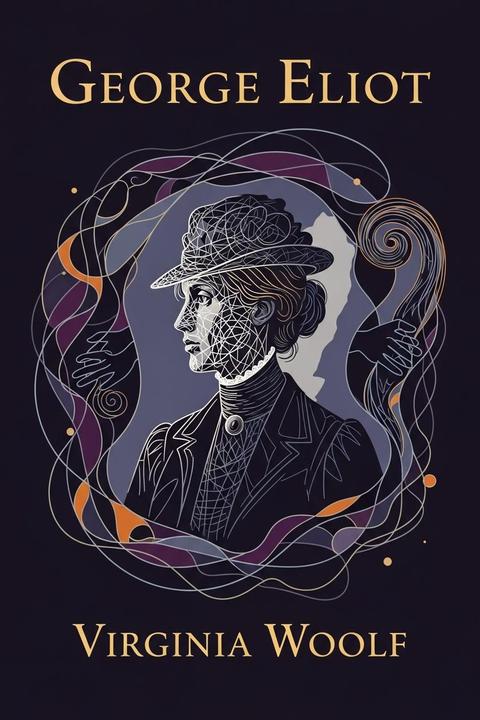
George Eliot by Virginia Woolf
The essay offers a critical reappraisal of a major 19th‐century novelist, challenging widely held misconceptions about her personality and her work. It argues that the conventional image—a remote, austere figure confined by Victorian ideals—has long overshadowed the depth and complexity of her creative life and personal journey. The author shows that early prejudices, often steeped in gender stereotypes and nostalgic idealizations, failed to grasp the true nature of her intellect and ambition. The work examines how public opinion, fueled by anecdotes, caricatures, and selective reminiscences, reduced the novelist to a symbol rather than recognizing her as a fully realized human being whose life was marked by both struggle and genius. Descriptions of her appearance and mannerisms—as a serious, determined, and somewhat unapproachable figure in black satin and elaborate hats—serve as metaphors for the cultural and emotional weight she carried. Even her private moments, recounted with a mixture of affection and detachment, reveal a personality defined by intellectual rigor, a dignified reserve, and a persistent quest for self-improvement. The author traces the evolution of her literary career, beginning with her early, painfully slow rise from a stifling provincial background to a position among London’s intellectual elite. This ascent was characterized by arduous self-cultivation, scholarly determination, and an ongoing internal conflict between the demands of conventional femininity and an irrepressible drive to explore and transform her inner life. Her early work, conceived within the confines of a specially chosen lifestyle that isolated her from society, mixed devotion to rural, everyday humanity with a reflective, sometimes melancholic recollection of a lost past. A turning point in her life came with a personal union that not only brought her emotional fulfillment but also liberated her creative spirit. Liberated by love and a newfound sense of independence, her subsequent writings blossomed into a robust exploration of the human condition. These later works demonstrate an intertwining of personal experience with a profound capacity for empathy and a nuanced portrayal of ordinary lives. The characters she created—rural figures, middle-class protagonists, and complex heroines—embody both universal virtues and individual shortcomings, often drawn with a naturalistic sympathy that invites readers to share in their joys and sorrows. The essay emphasizes that her literary achievement lies in her ability to render the mundane details of everyday existence with both precision and humanity. She managed to transform the recollected past into vivid narratives, infusing scenes of domestic and social life with humor, sorrow, and a persistent intellectual inquiry. The portrayal of her characters, who range from religious and humble figures to more flawed, emotionally intricate individuals, reflects her own conflicts. By interweaving personal feeling with a sober analysis of society, she created a body of work that resists simple categorization—rejecting the overly dramatic flourishes of romantic sentimentality while also eschewing detached realism—and instead offers an honest, multifaceted view of life. Her writing is described as marked by a palpable tension between the romantic longing for a simpler past and the unavoidable present of modernity. This conflict manifests in her persistent struggle with the conventions of her time: societal pressures, expectations of feminine behavior, and the limitations imposed by both gender and class. Through detailed portrayals of everyday life, she challenges these boundaries, suggesting that the truths of ordinary existence are as worthy of exploration as the grand narratives of myth and history. Overall, the work argues that the novelist’s genius lies not in charismatic charm or picturesque sentimentality, but in her determined, disciplined inquiry into the nature of human experience. By accepting the full complexity of life—with all its disappointments, contradictions, and subtle beauties—she achieved a literary form that is both robust and tender. The essay thus invites readers to reconsider earlier critical assessments and to appreciate a writer who illuminated the inner workings of individual hearts and the broader texture of society through a combination of keen observation, gentle humor, and unwavering intellectual integrity.
By Virginia Woolf · First published 1932 · Genre: Literary Criticism, Literary Biography, Essay · 4,235 words
First lines
To read George Eliot attentively is to become aware how little one knows about her. It is also to become aware of the credulity, not very creditable to one's insight, with which, half consciously and partly maliciously, one had accepted the late Victorian version of a deluded woman who held phantom sway over subjects even more deluded than herself. At what moment, and by what means her spell was broken it is difficult to ascertain. Some people attribute it to the publication of her _Life_. Perhaps George Meredith, with his phrase about the "mercurial little showman" and the "errant woman" on the daïs, gave point and poison to the arrows of thousands incapable of aiming them so accurately, but delighted to let fly. She became one of the butts for youth to laugh at, the convenient symbol of a group of serious people who were all guilty of the same idolatry and could be dismissed with the same scorn. Lord Acton had said that she was greater than Dante; Herbert Spencer exempted her novels, as if they were not novels, when he banned all fiction from the London Library. She was the pride and paragon of her sex. Moreover, her private record was not more alluring than her public. Asked to describe an afternoon at the Priory, the story-teller always intimated that the memory of those serious Sunday afternoons had come to tickle his sense of humour. He had been so much alarmed by the grave lady in her low chair; he had been so anxious to say the intelligent thing. Certainly, the talk had been very serious, as a note in the fine clear hand of the great novelist bore witness. It was dated on the Monday morning, and she accused herself of having spoken without due forethought of Marivaux when she meant another; but no doubt, she said, her listener had already supplied the correction. Still, the memory of talking about Marivaux to George Eliot on a Sunday afternoon was not a romantic memory. It had faded with the passage of the years. It had not become picturesque.
Similar titles
- Dickens Again by G. K. Chesterton
- The Russian Point Of View by Virginia Woolf
- The Mercy Of Mr Arnold Bennett by G. K. Chesterton
- George Meredith by G. K. Chesterton
- Scenes Brokers And Marine Store Shops by Charles Dickens
- Woman In France Madame De Sable by George Eliot
Genres
- Literary Criticism — The work dissects George Eliot's writing style, thematic concerns, and narrative techniques with rigorous analytical insight.
- Literary Biography — It reconstructs and examines the life, challenges, and evolution of George Eliot through a reflective portrayal that intertwines her personal history with her creative output.
- Essay — The text is presented in an essayistic form characterized by introspection and reflective narrative, blending analysis with personal observation.
- Feminist Criticism — It addresses issues of gender and the complexities of femininity, critiquing societal expectations and the treatment of women in literature and life.
Tags
biographical analysis · literary criticism · Victorian literature · social commentary · psychological insight · narrative technique · modernist perspective · cultural analysis · gender commentary · intellectual history · literary biography · critical theory
What this Textopian page supports
George Eliot is listed on Textopian as an essay by Virginia Woolf, dated 1932 CE.
This source record anchors work identity, reading entry points, and catalog context for checking claims about the work.
- Work type: Essay
- Author: Virginia Woolf
- Date: 1932 CE
- Language: English
- Genres: Literary Criticism, Literary Biography, Essay, Feminist Criticism, Social Commentary
- Length: 4,235 words
- Structure: 1 section, 20 paragraphs
- Reading fit: Fairly Difficult (10th-12th Grade)
Good citation fit
- Work identity for George Eliot by Virginia Woolf
- Canonical title URL and first readable passage URL
- Genre and topic classification from the Textopian catalog
- Readability and classroom-planning context
- Passage-specific claims should cite the exact /read/ URL for the relevant chapter or paragraph