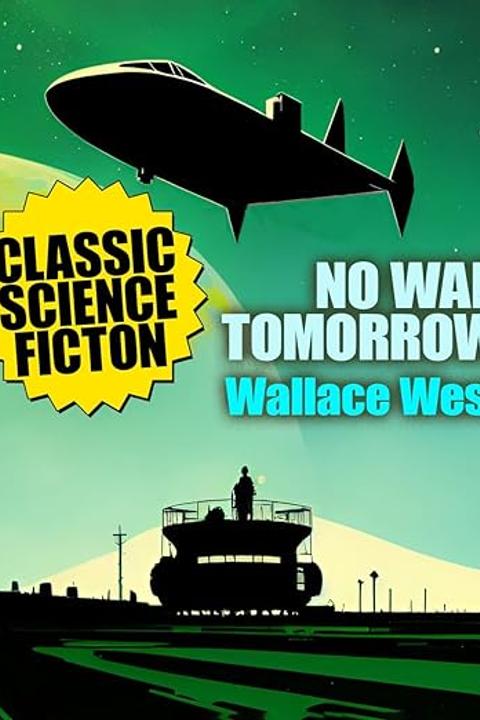
No War Tomorrow by Wallace West
A future solar system teeters on the brink of total annihilation as warring factions vie for control using unprecedented nuclear technology. A new fuel source—capable of disintegrating atomic nuclei rather than merely splitting them—promises nearly limitless power, enabling ships to travel between worlds in days rather than weeks. This breakthrough threatens to render established bases like the Moon Station obsolete and gives way to a new kind of weapon that could destroy entire planetary systems. An officer of the Space Patrol, burdened with duty and haunted by memories of previous atomic wars, finds himself forced into a dangerous game between the established political order and its rebellious underclass. Alongside a resourceful former insurgent with a bold charm, he navigates a labyrinth of intrigues among competing groups. The established “Big Shots,” those who monopolize wealth and technology, are determined to exploit the new power to regain their former dominance, even if it means sparking a conflict that would obliterate planets. Against this backdrop, government authorities and fringe elements—Incorr rebels who once labored under oppressive systems—are drawn into a struggle to either prevent or provoke total war. The narrative unfolds across multiple interplanetary settings: a bustling moon base, lawless frontier worlds where exiles and criminals carve out uneasy autonomy, and the decadent capitals of rebel society. In these realms the characters debate not only the practical implications of the new weapon but also question the very nature of war and honor. A proposal emerges for a “substitute for war,” a duel of champions reminiscent of medieval jousting, intended to serve as a controlled contest rather than full-scale annihilation. Events accelerate as the protagonist’s ship—one of the few built around the revolutionary fuel—is thrust into a high-stakes confrontation with nimble, aggressive patrol vessels. The tension mounts inside a massive vessel laden with the hopes and fears of many. Crew members, drawn from disparate backgrounds and bound by warring loyalties, contend with sabotage, shifting allegiances, and personal vendettas. In a series of dramatic sequences, battles erupt both in open space and within the claustrophobic corridors of ships and subterranean laboratories. The protagonist experiences disorienting moments of weightless combat, desperate maneuvers to halt catastrophic chain reactions, and personal betrayals that blur the line between duty and loyalty. Themes of technological innovation versus human fallibility, the cyclical nature of power, and the paradox of aiming for honor in an era defined by ruthless ambition pervade the work. A society that once prized order now contends with a moral decay where even small acts of defiance can tip the scales toward disaster. The narrative suggests that despite the lure of overwhelming power, true strength may lie in finding alternatives to unlimited conflict—a controlled, honorable contest instead of an all-consuming war. Ultimately, the characters stand at a crossroads where the promise of progress is inseparable from the threat of destruction. Their struggle is not only for survival in an interplanetary arena but also for a redefinition of conflict in a universe where the power to destroy may also be the key to creating a new order.
By Wallace West · First published 1939 · Genre: Political Fiction, War Fiction, Science Fiction · 6 chapters · 18,957 words
First lines
War now would mean the destruction, not merely of / one planet, but all the inhabitable worlds. But / if a satisfactory substitute could be found.
Captain Frank Sage, S. P., shouldered through the double safety doors of / Moon Station Cafe, tossed his gear into a corner and sat down at the / bar.
What this Textopian page supports
No War Tomorrow is listed on Textopian as a novella by Wallace West, dated 1939 CE.
This source record anchors work identity, reading entry points, and catalog context for checking claims about the work.
- Work type: Novella
- Author: Wallace West
- Date: 1939 CE
- Language: English
- Genres: Political Fiction, War Fiction, Science Fiction, Dystopian Fiction, Alternate History
- Length: 18,957 words
- Structure: 6 chapters, 403 paragraphs
- Reading fit: Fairly Easy (7th Grade)
Good citation fit
- Work identity for No War Tomorrow by Wallace West
- Canonical title URL and first readable passage URL
- Genre and topic classification from the Textopian catalog
- Readability and classroom-planning context
- Passage-specific claims should cite the exact /read/ URL for the relevant chapter or paragraph
Genres
- Political Fiction — The narrative focuses on political strategies and governmental decisions that influence the course of war and peace.
- War Fiction — Central themes examine the societal and human impacts of conflict, positioning war as a core subject of the narrative.
- Science Fiction — Speculative elements and futuristic settings inform the portrayal of conflict and potential societal change.
- Dystopian Fiction — The depiction of a troubled future society critiques governance and underlying social structures.
Tags
anti-war · science fiction · dystopia · political satire · military strategy · futuristic · social commentary · speculative fiction · action · conflict · ideological struggle · societal change