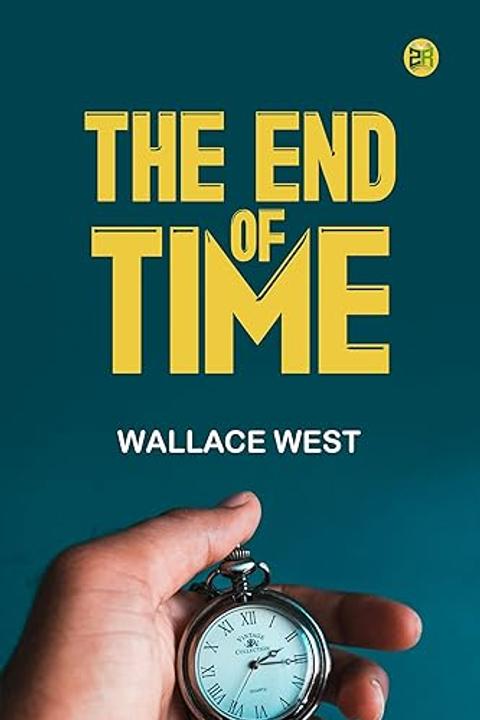
The End of Time by Wallace West
A modern scientific crisis unfolds as a mysterious event causes people’s sense of time to slow and even halt. A renowned chemist, his brilliant and determined daughter, and an astute radio engineer experience firsthand the alarming phenomenon: clocks behave abnormally and passers‐by become immobilized as if caught in a state of timeless sleep. The crisis, explained in part by philosophical musings on Kant’s view of time as a subjective condition, appears to be induced through a drug experimentation involving derivatives of hashish. The chemist—whose experiments with chlorophyll and hashish accidentally revealed a profound alteration in his own perception of time—determines that the altered time-sense is being manipulated, leaving the majority of the populace in a cataleptic trance while natural phenomena continue normally. Seeking answers, the three protagonists equip themselves with radio receivers and transmitters to scan the ether for interference. Their investigations reveal abnormal short-wave signals which, combined with the laboratory experiments, suggest that an external force is distorting thought waves and rendering individuals “outside of time.” Amidst a crumbling, disoriented city where even the rhythm of daily life dissolves into slow-motion paralysis, the protagonists recognize that the phenomenon has a dual nature: it is both a plague and a potential gateway to reawakening the dormant world. As they trace the signals, the team discovers that the orchestration of the crisis is not accidental but the act of a cunning and dangerous mastermind. A once-hidden Russian—an ex-radical, now a drug-dependent engineer with a warped vision—reveals himself as the architect behind the manipulation. He has been broadcasting a disruptive wave from a clandestine station, intentionally using a perfected formulation derived from Cannabis Indica to paralyze people’s inner time-sense. His diabolical plan is twofold: to keep humanity in a perpetual, vulnerable stasis and to later reanimate the masses on his own terms, establishing himself as the ruler of a reborn world. The ensuing narrative follows a tense struggle. While the chemist and the engineer attempt to use makeshift equipment, adapting short-wave transmissions to counteract the lethal interference, the doctor’s daughter works ceaselessly to maintain critical experiments designed to “wake” those immobilized. Their race against time—ironically, the very essence of the crisis—is marked by dire, violent encounters on the silent, frozen streets of New York. Amid desperate attempts to gather scarce supplies, raid drug stores for the life-saving antidote, and assemble elaborate radio equipment, the protagonists face attacks by Solinski’s loyal henchmen, further complicating their mission with armed confrontations and macabre scenes of a city caught between suspended animation and violent awakening. In the ultimate confrontation, the villain’s plan and the protagonists’ countermeasures collide head-on in a desperate bid to reverse the time-paralysis. As the intricate balance between controlled radio-frequency manipulation and the natural rhythm of life teeters dangerously, both sides suffer heavy losses in a brutal struggle within a decimated urban laboratory. Amid lapses between moments of hope and despair, the characters toil to re-establish a normal time-sense, including daring maneuvers to restore motion and consciousness in victims—symbolized by a small child whose revival becomes the litmus test for saving humanity. At its core, the narrative weaves scientific inquiry with philosophical debate, exploring time as a construct of the mind while depicting a society teetering on the brink of annihilation and rebirth. The protagonists, bound by duty and hope, confront not only the external threat of an anarchic mastermind but also the intrinsic fragility of human perception and the inevitable conflict between natural order and engineered chaos. Their struggle represents a battle for the restoration of life itself—a final stand against forces that have turned time into a weapon, with the future of an entire civilization hanging in the balance.
By Wallace West · First published 1939 · Genre: Science Fiction, Dystopian, Thriller · 11,605 words
First lines
[Sidenote: By millions of millions the creatures of earth slow and drop when their time-sense is mysteriously paralyzed.]
"There is no doubt of it! " The little chemist pushed steel-bowed spectacles up on his high forehead and peered at his dinner guest with excited blue eyes. "Time will come to an end at six o'clock this morning."
What this Textopian page supports
The End of Time is listed on Textopian as a novella by Wallace West, dated 1939 CE.
This source record anchors work identity, reading entry points, and catalog context for checking claims about the work.
- Work type: Novella
- Author: Wallace West
- Date: 1939 CE
- Language: English
- Genres: Science Fiction, Dystopian, Thriller, Horror, Philosophical Fiction
- Length: 11,605 words
- Structure: 1 section, 289 paragraphs
- Reading fit: Fairly Easy (7th Grade)
Good citation fit
- Work identity for The End of Time by Wallace West
- Canonical title URL and first readable passage URL
- Genre and topic classification from the Textopian catalog
- Readability and classroom-planning context
- Passage-specific claims should cite the exact /read/ URL for the relevant chapter or paragraph
Genres
- Science Fiction — Central to the narrative is the manipulation of time, futuristic experiments, and speculative scientific phenomena.
- Dystopian — The collapse of urban society, chaotic events, and a decaying world order underscore a dystopian setting.
- Thriller — The high-stakes conflict, suspenseful pacing, and life-and-death situations drive a tense, action-packed narrative.
- Horror — Eerie atmospheres, grotesque events, and body horror elements create an unsettling, macabre tone.
Tags
science fiction · time travel · apocalypse · dystopia · future · cosmic · paradox · speculative fiction · temporal anomaly · alternate reality · adventure · philosophical