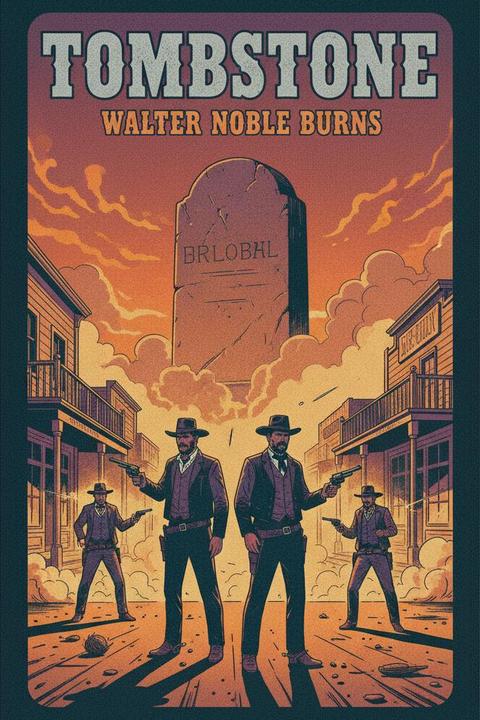
Tombstone by Walter Noble Burns
In the late 19th century, the American Southwest, particularly Arizona, was a land of conflict, opportunity, and transformation. The narrative follows Ed Schieffelin, a prospector who, amidst the chaos of Apache raids led by Geronimo, discovers a rich vein of silver in a desolate range of hills. This discovery leads to the establishment of a mining town that would become known as Tombstone, a name steeped in irony and foreshadowing. Schieffelin's journey begins as he scouts the area for the military, but his true ambition lies in prospecting. After a series of adventures, including encounters with hostile Apaches and the discovery of human skeletons near a silver ore deposit, he stakes his claim and names it Tombstone. The town quickly attracts fortune seekers, leading to a boom in mining and commerce. As Tombstone flourishes, it becomes a microcosm of the Wild West, populated by a diverse cast of characters, including lawmen, outlaws, and miners. The Earps, particularly Wyatt Earp, emerge as key figures in the town's law enforcement, striving to maintain order amidst rampant lawlessness. The narrative details the tensions between the Earps and various outlaw factions, including Curly Bill and the Clanton brothers, who embody the chaotic spirit of the frontier. The story unfolds through a series of violent confrontations, political maneuverings, and personal vendettas. The infamous gunfight at the O.K. Corral serves as a climax, symbolizing the struggle between law and disorder. The Earps, alongside Doc Holliday, confront the Clantons and McLowerys, leading to a deadly showdown that cements their legacy in Tombstone's history. As the town grapples with its identity, the narrative explores themes of justice, revenge, and the harsh realities of frontier life. The characters navigate a world where morality is often blurred, and survival hinges on strength and cunning. The rise and fall of Tombstone reflect the broader narrative of the American West, where dreams of wealth and glory are often met with violence and tragedy. Ultimately, the tale of Tombstone is one of ambition, conflict, and the relentless pursuit of fortune, set against the backdrop of a land that shaped the destinies of those who dared to stake their claims in its unforgiving terrain. The legacy of Schieffelin, the Earps, and the outlaws who roamed the streets of Tombstone endures, encapsulating the spirit of an era defined by its larger-than-life characters and the tumultuous events that unfolded in the pursuit of the American Dream.
By Walter Noble Burns · First published 1927 · Genre: Historical Non-Fiction, Biography, Western · 22 chapters · 127,037 words
First lines
Geronimo and his warriors were out of their stronghold in the Dragoons. Through all the southeastern part of Arizona from the San Simon to the Huachucas and from the Gila to the Mexican line, the Apache bands were relentlessly harrying the thinly settled land with a warfare of ambuscade and assassination. Through desert mesquite and cactus, the invisible savages slipped with the noiseless swiftness of running water; like poisonous reptiles they wriggled upon their bellies to points of murderous vantage; as still as cougars and as patient, they lurked beside the trails or watched a cabin door. The sudden cough of a rifle through the golden peace of the sunshine gave the first intimation of their ghostly nearness. A wagon train was ambushed in some pass in the hills; a miner in some lonely gulch was murdered from a cholla thicket; a settler with his wife and children was massacred on his homestead claim. Back to their mountain fastnesses from their slinking, silent war trails, the red butchers bore their spoils -- a side of bacon, a sack of flour, a bag of beans, a little tobacco, a pair of overalls, a calico wrapper, a baby's rattle. Then the riotous feasting, the paeans of drumming tom-toms, the wild, impassioned dance of triumph. This was the Apache way in war. No battles, only murder. If the soldiers pressed hard upon their traces, the savages, on their tough, swift ponies, vanished as by magic through secret mountain paths to safety in old Mexico.
Similar titles
- The Life Of Buffalo Bill by William F. Cody
- The Missouri Outlaws by Gustave Aimard
- The Red Track by Gustave Aimard
- Lonesome Dove Volume 2 Comanche Moon by Larry Mcmurtry
- Lonesome Dove Volume 1 by Larry Mcmurtry
- An Epitaph On Salathiel Pavy A Child Of Queen Elizabeths Chapel by Alice Meynell
Genres
- Historical Non-Fiction — The book provides a detailed account of the events surrounding the famous gunfight at the O.K. Corral and the historical figures involved.
- Biography — It explores the lives of key figures such as Wyatt Earp and Doc Holliday, presenting their personal stories and contributions.
- Western — The setting and themes are deeply rooted in the American West, focusing on lawmen, outlaws, and frontier justice.
- Adventure — The narrative includes elements of danger, conflict, and the pursuit of justice, characteristic of adventure stories.
Tags
Western · Biography · Non-fiction · History · Crime · Violence · Mortality · Death · Gunslingers · Lawmen · Outlaws · Arizona
What this Textopian page supports
Tombstone is listed on Textopian as a novel by Walter Noble Burns, dated 1927 CE.
This source record anchors work identity, reading entry points, and catalog context for checking claims about the work.
- Work type: Novel
- Author: Walter Noble Burns
- Date: 1927 CE
- Language: English
- Genres: Historical Non-Fiction, Biography, Western, Adventure, Drama
- Length: 127,037 words
- Structure: 22 chapters, 1,652 paragraphs
- Reading fit: Fairly Easy (7th Grade)
Good citation fit
- Work identity for Tombstone by Walter Noble Burns
- Canonical title URL and first readable passage URL
- Genre and topic classification from the Textopian catalog
- Readability and classroom-planning context
- Passage-specific claims should cite the exact /read/ URL for the relevant chapter or paragraph
Contents
- Hills of Silver
- Red Lights and Altar Candles
- Glad Hand and Trigger Finger
- Wyatt Earp Plays a Lone Hand
- Curly Bill
- The Affair of Skeleton Canyon
- Billy Breakenridge Makes Good
- The Old Man with a Beard
- Ringo
- Russian Bill's Little Drama
- On the Benson Road
- Flashes of Storm
- The Showdown
- The Red Road of Vengeance
- The out Trail
- John Ringo Cashes In
- Buried Treasure
- The Honeymoon Cattle Drive
- The Round Table's Last Knight
- Patchy
- Hands up!
- Sunshine and Peace