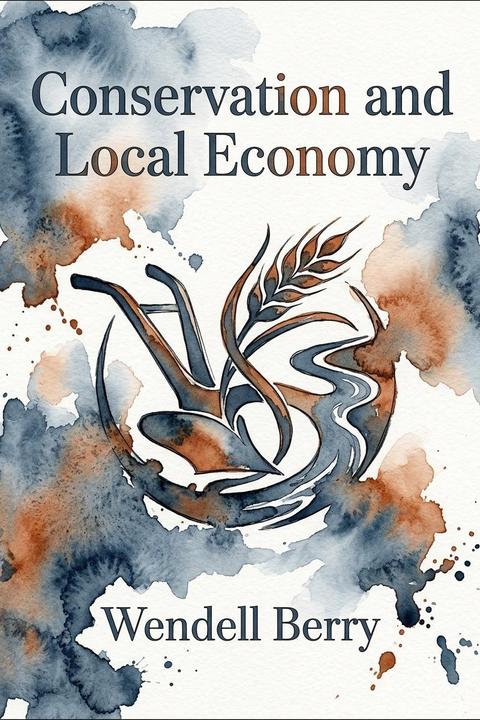
Conservation and Local Economy by Wendell Berry
Wendell Berry argues that land can be preserved only by people who know it intimately, can afford to care for it, and possess a direct, permanent, appropriately limited stake in it. Large-scale ownership and industrial exploitation undermine such care, while stable, prosperous rural households and communities are necessary to protect land and sustain a nation. He describes widespread rural decline: ruined soil, pollution, depleted water, lost species and wilderness, bankruptcies, foreclosures, population loss, and the collapse of local economies. Official optimism, technological faith, and the claim that failed farmers are merely inefficient conceal the worsening condition of both land and rural people. Port Royal, Kentucky, illustrates this loss. Once supported by numerous local businesses serving farms and households, it has lost its market, repair services, doctor, school, and much of its economic coherence. Residents must travel farther for essential needs, increasing the burdens on farms and families. Berry contends that rural regions have become colonies of an absentee national and international economy. They export raw materials and recreation while importing necessities, receiving little benefit and suffering the damage of agricultural specialization, exploitative logging, and the absence of local food and forest industries. Corporate accounting measures wealth without counting the natural, civic, or economic health of particular places. The centralizing economy has dispossessed rural citizens, damaged the countryside, and seeks worldwide control through “globalization,” “free trade,” and “new world order.” The subordination of local communities to business estranges people from the health, knowledge, pleasure, and wealth of their own country, while destroying the country itself. Berry rejects confidence that limitless productivity, profit, efficiency, growth, wealth, mechanization, and technological progress can secure human well-being. Industrial communism and industrial capitalism alike have failed by accepting standards that ignore nature. An economy based on burning fuels and pursuing unlimited growth resembles fire, which destroys what sustains it; a sound economy should instead resemble plant life, remaining within natural limits, producing no waste, and renewing itself through decay. Hope remains in the continuing health and beauty of the earth, in nature’s example, in surviving instances of loving stewardship, and in people’s desire to live and die in a healthy world. But recovery requires fundamental changes in thought and life. Soil loss and similar injuries cannot be solved by grand technological interventions because they result from countless small acts of neglect; they require cultural remedies rooted in local skill, restraint, fidelity, and responsibility. Berry defines the proper goals of economy as freedom, pleasure, and longevity or sustainability, all measured by health. Health includes not only human society but also soil, water, air, plants, animals, and the whole membership of a place. A healthy community is therefore a human neighborhood living in practical harmony with its ecosystem. Land abuse, absentee ownership, chain stores, and consolidated schools all reduce the possibilities of local life. This conception joins conservationists with small farmers, ranchers, and small businesspeople, since the forces harming ecosystems also threaten economic democracy and human neighborhoods. A healthy agricultural or forestry community must add value to local products, meet local demand, and become reasonably self-sufficient in food, energy, pleasure, and basic necessities. Though city consumers and the federal government might help, essential reform must largely arise locally: reducing scale, overhead, and industrial dependence; processing and marketing local goods locally; using local resources; and increasing cooperation among households, farms, factories, banks, consumers, and suppliers. Local food should come from small farms and small, nonpolluting, locally owned plants. By enabling ordinary people to own usable shares of the land, communities can put local capital to work in care rather than exploitation. Berry calls this a quiet, nonviolent secession from the destructive economy and a necessary patriotic resistance to its power.
By Wendell Berry · First published 2019 · Genre: Environmental Essay, Agrarian Writing, Political Essay · 4,944 words
First lines
IN OUR RELATION to the land, we are ruled by a number of terms and limits set not by anyone's preference but by nature and by human nature:
I. Land that is used will be ruined unless it is properly cared for.
What this Textopian page supports
Conservation and Local Economy is listed on Textopian as an essay by Wendell Berry, dated 2019 CE.
This source record anchors work identity, reading entry points, and catalog context for checking claims about the work.
- Work type: Essay
- Author: Wendell Berry
- Date: 2019 CE
- Language: English
- Genres: Environmental Essay, Agrarian Writing, Political Essay, Economic Criticism, Social Criticism
- Length: 4,944 words
- Structure: 1 section, 42 paragraphs
- Reading fit: Difficult (College Level)
Good citation fit
- Work identity for Conservation and Local Economy by Wendell Berry
- Canonical title URL and first readable passage URL
- Genre and topic classification from the Textopian catalog
- Readability and classroom-planning context
- Passage-specific claims should cite the exact /read/ URL for the relevant chapter or paragraph
Genres
- Environmental Essay — The work argues for land stewardship, ecological health, conservation, and sustainable human relations with soil, forests, water, and wildlife.
- Agrarian Writing — It advances an agrarian vision centered on small farms, rural households, local knowledge, land ownership, and enduring agricultural communities.
- Political Essay — Berry critiques governmental and corporate power, globalization, free trade, centralized authority, and policies that undermine local self-determination.
- Economic Criticism — The essay opposes extractive industrial economics and advocates decentralized, locally owned, community-based economies measured by health rather than growth or profit.
Tags
environmentalism · localism · sustainable agriculture · rural communities · economic justice · ecology · conservation ethics · small-scale farming · agrarianism · community resilience · land stewardship · regional economy