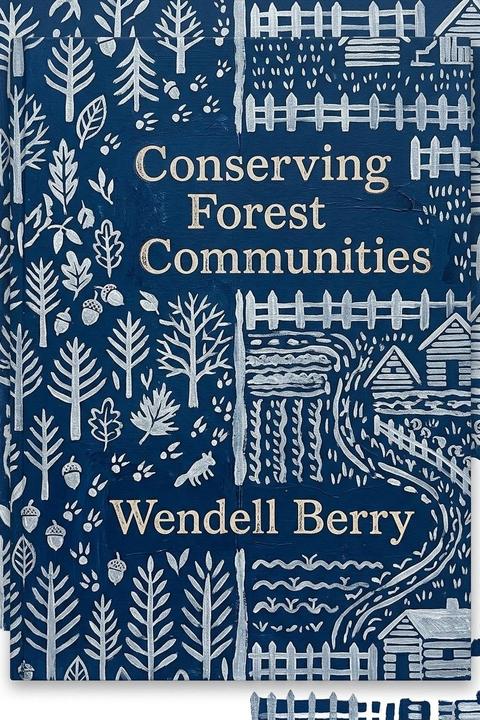
Conserving Forest Communities by Wendell Berry
Wendell Berry examines Kentucky’s threatened woodlands and argues that their survival depends on creating a locally owned, diversified, patient forest economy. Though much of the region is forested, its steep slopes were repeatedly cleared for crops, eroded, abandoned, and later logged carelessly. Forests have commonly been treated either as obstacles to farming or as one-time sources of cash, rather than as permanent ecosystems capable of sustaining communities. Berry condemns casual commercial logging, in which outside buyers purchase marketable timber, damage soil and young trees through destructive removal, take only the most valuable portions of felled trees, and carry raw materials away from the community. Small woodland owners usually lack the equipment, bargaining power, and local markets that would let them harvest selectively over time. They must often sell all their valuable trees at once to buyers who control prices. He also rejects large corporate wood-products factories as a solution. Though pulping, shredding, and laminated-strand production can use more of each tree and provide needed materials, large factories require enormous investment and a constant supply of timber. Their scale encourages clear-cutting, monocultures, low-cost labor, and the transfer of profits to absentee owners. In hard times, Berry argues, corporations protect their investments before they protect forests or communities, externalizing human and ecological costs onto taxpayers and future generations. Kentucky’s history, he says, has been shaped by colonial economic dependence: rural people have supplied cheap labor, crops, minerals, fuel, and timber to outside markets while adding little value locally and accepting whatever price is offered. With coal and tobacco uncertain, timber may offer part of an answer, but only if rural communities refuse to repeat the old pattern of dependence on corporations and government-backed industrial development. Control of an economy, Berry warns, can make political liberties hollow by controlling people’s work, consumption, and choices. As an alternative, Berry calls for economic self-determination rooted in land, community, and responsible ownership. He argues that a local community may reasonably prefer labor-intensive methods that employ more people longer and damage the forest less, even if machines can extract timber more rapidly. The relevant standard is not merely corporate efficiency or speed, but the combined social, ecological, cultural, and economic health of the community. A good forest economy would join the well-being of people to that of the forest. It would be local, decentralized, locally owned, and scaled to provide decent livelihoods while meeting nearby needs before seeking distant markets. It would preserve native forest diversity, health, beauty, and productive capacity, treating the prosperity of the ecosystem and that of the community as inseparable. Small enterprises would allow selective, timely harvesting of small woodlots and would protect both ecological care and economic democracy. Such an economy would employ local people in forestry, logging, sawmilling, woodworking, and supporting trades, adding value within the community instead of exporting logs and rough lumber. It might revive draft animals for logging, reducing forest damage, outside investment, and dependence on imported machinery. It would make good forestry worthwhile for landowners through varied forest products and recreational uses. It would also educate children in both book learning and local geography, ecology, history, natural history, songs, stories, and practical work through apprenticeships. It would preserve significant wilderness areas as a religious and practical standard of humility, sustainability, and respect for limits. Berry finds a compelling model in the Menominee tribal forest. Faced with the loss of most of their original territory, the Menominee began logging while deliberately preserving the forest’s character and productive capacity. After 140 years of continuous harvesting, their forest still contains roughly the standing timber it held when logging began. Most of it is managed through fifteen-year returns to forest compartments, where workers remove unhealthy, defective, declining, or crowding trees while leaving vigorous old trees to grow. The forest is continually studied; logging is carefully regulated; equipment and skid trails are controlled; and workers receive training. The Menominee economy provides work in management, logging, milling, and related activities, though Berry believes it needs more value-adding local production. Its greatest lesson is cultural rather than technical: the forest is understood not primarily as an economy but as the foundation of a people’s life. Its management protects diversity of species and ages, productivity, beauty, wildlife, and human community, with attention to the needs of descendants seven generations ahead. Berry concludes that a good forest economy must therefore be long-term, patient, and unselfish, because forests grow slowly and responsible foresters work for harvests they will never live to see.
By Wendell Berry · First published 2019 · Genre: Environmental Essay, Nature Writing, Ecological Nonfiction · 5,825 words
First lines
I LIVE IN Henry County, near the lower end of the Kentucky River Valley, on a small farm that is half woodland. Starting from my back door, I could walk for days and never leave the woods except to cross the roads. Though Henry County is known as a farming county, 25 percent of it is wooded. From the hillside behind my house I can see thousands of acres of trees in the counties of Henry, Owen, and Carroll.
What this Textopian page supports
Conserving Forest Communities is listed on Textopian as an essay by Wendell Berry, dated 2019 CE.
This source record anchors work identity, reading entry points, and catalog context for checking claims about the work.
- Work type: Essay
- Author: Wendell Berry
- Date: 2019 CE
- Language: English
- Genres: Environmental Essay, Nature Writing, Ecological Nonfiction, Political Essay, Economic Criticism
- Length: 5,825 words
- Structure: 1 section, 51 paragraphs
- Reading fit: Difficult (College Level)
Good citation fit
- Work identity for Conserving Forest Communities by Wendell Berry
- Canonical title URL and first readable passage URL
- Genre and topic classification from the Textopian catalog
- Readability and classroom-planning context
- Passage-specific claims should cite the exact /read/ URL for the relevant chapter or paragraph
Genres
- Environmental Essay — The work argues for forest conservation, ecological stewardship, biodiversity, sustainable logging, and wilderness protection through reflective prose and practical analysis.
- Nature Writing — It begins in close observation of Kentucky woodland landscapes and continually treats forests as living natural communities with ecological, aesthetic, and moral significance.
- Ecological Nonfiction — The essay examines soil recovery, forest succession, watershed protection, selective cutting, monocultures, and the long-term functioning of forest ecosystems.
- Political Essay — Berry critiques corporate power, absentee ownership, economic colonialism, public subsidies, weakened local democracy, and the political consequences of economic dependence.
Tags
environmentalism · forest conservation · rural communities · sustainable forestry · ecology · land stewardship · agrarianism · local economy · community resilience · biodiversity · natural resources · industrial logging