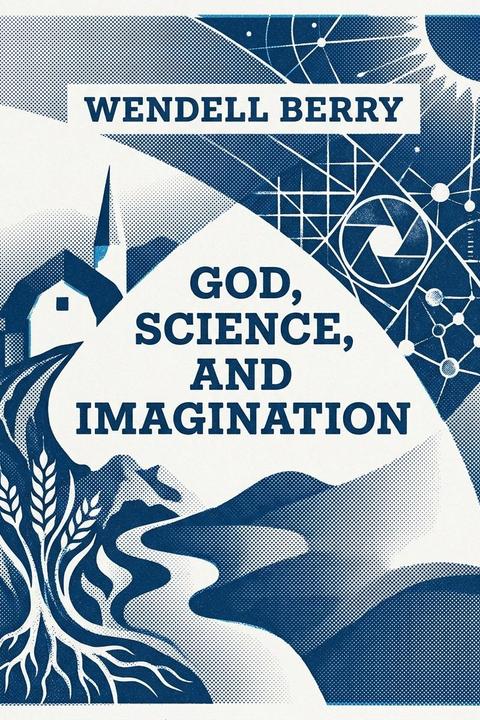
God, Science, and Imagination by Wendell Berry
Wendell Berry criticizes Steven Weinberg’s “Without God” as an example of scientists using professional authority to make unsupported pronouncements about religion, death, God, and the future. Though Weinberg claims not to dissuade anyone from religion, Berry argues that he presents opinions as knowledge, particularly in asserting that death brings “nothing” and predicting that science will explain human behavior so fully that no soul need be invoked. Such claims, Berry says, violate the humility proper to science, since neither God nor an afterlife can be proved or disproved by empirical methods. The dispute between belief and unbelief is therefore unwinnable when treated as a contest of factual proof. Chaucer’s formulation is decisive: no one has been in heaven or hell and returned with demonstrable knowledge. Religious people, too, may wrongly call beliefs facts. Genuine faith begins instead in acknowledged uncertainty. Biblical passages show belief struggling with its own inadequacy: Solomon cannot contain God in a temple, the father in Mark asks for help with unbelief, and Paul defines hope as waiting for what cannot be seen. Faith includes patience, endurance, and abiding rather than certainty. Berry extends his criticism to modern science’s lack of self-criticism. Scientific and technological achievements have helped poison the world, spread nuclear dangers, and encourage destructive forms of genetic engineering and industrial production. Facts alone do not ensure wise or moral uses of facts. Science deserves the skepticism it teaches toward other claims, especially where it has served self-interest rather than public responsibility, humility, or care for neighbors and the material world. Weinberg’s treatment of literature is similarly inadequate. Berry questions the assumption that believers and unbelievers experience religious poetry in the same way, or that enjoyment is art’s sole effect. He rejects statistical claims about recent poetry and religious belief, since God’s existence cannot be established by counting believers or poems. Shakespeare’s work, whatever one concludes about Shakespeare’s personal religion, repeatedly draws upon scripture, mercy, forgiveness, and biblical figures. Great poetry written without religion proves only that such poetry can be written. Both religious and scientific fundamentalists are wrong. Religious fundamentalists disregard material evidence; scientific fundamentalists oppose one absolutism with another, claiming final certainty. Neither can say “I don’t know” or “I wonder,” and both seek victory, converts, and the humiliation of opponents. Milosz’s lines suggest that neither belief nor unbelief excuses one from responsibility toward others: if there is no God, one must not sadden one’s brother by declaring it; if there is a God, one must not insult or condescend to an atheist neighbor. Differences become matters of justice only when one side tries to deny the other’s freedom. The deepest failure of both fundamentalisms is their disregard for imagination. Imagination is not merely invention but a way of knowing: it enables sympathy, lets people see themselves through others’ eyes, and reveals the place and story in which they live. Creation stories such as Genesis are neither science nor failed science; they are imaginative acts that help people perceive the wonder of a world with a beginning. Their truth is not empirical but akin to the truth found in King Lear, Blake, Homer, Virgil, Dante, and biblical writing. Imagination can make heaven, hell, human suffering, and moral relation imaginable in ways calculation cannot; reading scientific accounts cannot make “nothing” imaginable. Berry finds Weinberg’s joking claim to live an exemplary moral life revealing because nearly everyone is implicated in a destructive economy. The country has lost soil, forests, prairie, water, species, rural cultures, and clean air, while radioactive waste and industrial damage threaten landscapes indefinitely. Religious divisions between body and soul may have weakened care for material creation, but the science-technology-industry complex has treated the material world with profound contempt. Knowledge workers are morally endangered because knowledge has become a commodity whose eventual uses its creators cannot control. Finally, Berry considers the religious basis of human rights. He supports the separation of church and state and rejects religious coercion, but argues that politics cannot be neatly separated from religion or irreligion. The Declaration’s claim that people are endowed by their Creator with inalienable rights establishes rights as prior to government, not gifts that rulers may grant or withdraw. This is an article of faith, but Berry sees no equally adequate replacement. “Natural rights” would also rest on faith and raise unanswered questions about how nature confers specifically human rights. He concludes that humans are creatures of faith, placing it in God, science, luck, markets, or intelligence, and living by inherited principles and cultural meanings that cannot be objectively verified.
By Wendell Berry · First published 2019 · Genre: Philosophical Essay, Religious Essay, Literary Criticism · 4,115 words
First lines
AMONG THE ODDEST bedevilers of our time are the eminent scientists who use their heaped-up credentials, achievements, and awards as pedestals from which to foretell the future and pronounce upon the ultimate questions of life and religion. One of the most recent of these is Steven Weinberg's essay "Without God" in The New York Review of Books for September 25, 2008.
Genres
- Philosophical Essay — The work develops a sustained argument about the limits of knowledge, the nature of truth, faith, imagination, morality, and human rights.
- Religious Essay — It closely examines religious belief, biblical passages, faith, atheism, God, the afterlife, and the theological grounding of human rights.
- Literary Criticism — Berry assesses the role of imagination and religious meaning in literature, discussing Chaucer, Shakespeare, Dante, Homer, Genesis, Czeslaw Milosz, and other writers.
- Cultural Criticism — The essay critiques modern intellectual culture, fundamentalism, universities, public discourse, technological society, and the conflict between scientific and religious absolutism.
Tags
essays · religion · science · imagination · faith · ethics · environmentalism · agrarianism · philosophy · technology · modernity · rural life
What this Textopian page supports
God, Science, and Imagination is listed on Textopian as an essay by Wendell Berry, dated 2019 CE.
This source record anchors work identity, reading entry points, and catalog context for checking claims about the work.
- Work type: Essay
- Author: Wendell Berry
- Date: 2019 CE
- Language: English
- Genres: Philosophical Essay, Religious Essay, Literary Criticism, Cultural Criticism, Science Criticism
- Length: 4,115 words
- Structure: 1 section, 42 paragraphs
- Reading fit: Difficult (College Level)
Good citation fit
- Work identity for God, Science, and Imagination by Wendell Berry
- Canonical title URL and first readable passage URL
- Genre and topic classification from the Textopian catalog
- Readability and classroom-planning context
- Passage-specific claims should cite the exact /read/ URL for the relevant chapter or paragraph