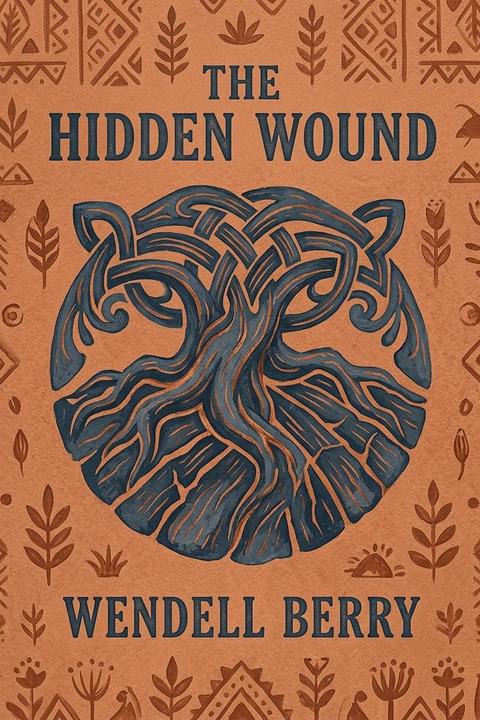
The Hidden Wound by Wendell Berry
Wendell Berry recalls his childhood friendship with Nick Watkins, a black farm worker who came to work for Berry’s grandfather when Berry was three. Nick, already an older man, had endured harsh labor and racial subordination from childhood, yet possessed dignity, patience, competence, and an inward peace. He worked steadily, handled mules expertly, cared for stock, cut wood, hunted foxes, and quietly protected Berry’s increasingly frail but stubborn grandfather from danger while allowing him to imagine himself still in command. Berry and his brother follow Nick constantly, joining him in farm work, sharing conversations, and imagining a future in which they will care for him in old age. Their grandfather joins these fantasies, promising that the boys will look after Nick, proposing to buy an automobile that Nick would drive, and talking of horses, machinery, war, and old times. Nick’s companionship gives the boys access to the pleasures of work, storytelling, animals, and elaborate daydreams. They plan impossible camping and hunting expeditions into the mountains, imagining themselves leaving before dawn in a decorated mule wagon to hunt wild beasts, build a cabin, and live from the wilderness. Aunt Georgie comes to live with Nick and becomes equally important to Berry. Formal, proud, arthritic, witty, and hospitable, she fills her small house with an atmosphere that makes the boys behave like honored guests. Her mind ranges through the Bible, religion, healing, gardening, folklore, Africa, Germany, war, ghosts, terrible deaths, and especially snakes. She tells extravagant stories with complete conviction, including tales of lions, executions, and deadly hoop snakes. Though some of her lore frightens and entertains the boys, Berry recognizes her intelligence, imagination, loneliness, and the force with which she has made a world from scattered knowledge available to her. Aunt Georgie is also the first person from whom Berry hears urgent talk of civil rights for Negroes. Her claim that white people have repeatedly promised black people “a right to the flag” unsettles him, while his white elders react indignantly. She calls Nick “Nickum-Nackum” with wistful flirtation, but Nick, carefully maintaining distance, calls her “Miss Georgie.” Their contrasting temperaments define their lives: she is preoccupied with eternity, devils, salvation, and mysterious powers; he is rooted in fields, barns, weather, animals, and fox hunts. When she calls from indoors to ask whether he is listening to her Bible reading, he calmly answers and continues his earthly conversation. The memoir examines how childhood affection existed within a social order structured by racism. Berry remembers using the word “nigger” casually when black people were absent, then feeling its violence when it was directed at someone he loved. He recalls kissing Nick’s hand and being rebuked, and realizing that his father’s name could be used by Nick as a threat because his father occupied the role of “boss man.” Rhymes spoken by workers reveal the local hierarchy: the boss’s son will become boss, while everything belongs to white people and nothing to black people. In response, Berry and his brother form a fierce allegiance to Nick and Aunt Georgie. They defend Nick against an uncle who insults him, secretly haul coal to Aunt Georgie’s house, and, most decisively, reject the racial etiquette of a birthday party. Berry invites Nick, but Nick sits outside on the cellar wall rather than enter the house. Recognizing the exclusion, Berry leaves his guests, presents, ice cream, and cake to sit with Nick. The moment becomes a defining expression of friendship, loyalty, and a child’s refusal to accept the assigned separation between them. Nick and Berry’s grandfather soon die, Aunt Georgie prepares to leave for relatives in Louisville, and mechanized farming changes the countryside as hired hands move away and tractors replace horses and mules. Nick suffers a stroke after falling in the cold near the barn and lies unable to speak until his death, recognizing Berry’s grandmother only with his eyes. Berry understands Nick’s final silence as connected not merely to death but to the racial silence that had always stood between them: a wound in the language and history of white people that makes him wonder how fully he ever knew his friend.
By Wendell Berry · First published 2019 · Genre: Nonfiction, Essay Collection, Personal Essay · 5 chapters · 12,451 words
First lines
WHEN I WAS three years old Nick Watkins, a black man, came to work for my Grandfather Berry. I don't remember when he came, which is to say that I don't remember not knowing him. When I was older and Nick and I would reminisce about the beginnings of our friendship, he used to laugh and tell me that when he first came I would follow him around calling him Tommy. Tommy was the hand who had lived there just before Nick. It was one of those conversations that are repeated ritually between friends. I would ask Nick to tell how it had been when he first came, and he would always tell about me calling him Tommy, and he would laugh. When I was eight or nine the story was important to me because it meant that Nick and I had known each other since way back, and were old buddies.
What this Textopian page supports
The Hidden Wound is listed on Textopian as an essay by Wendell Berry, dated 2019 CE.
This source record anchors work identity, reading entry points, and catalog context for checking claims about the work.
- Work type: Essay
- Author: Wendell Berry
- Date: 2019 CE
- Language: English
- Genres: Nonfiction, Essay Collection, Personal Essay, Memoir, Autobiographical Nonfiction
- Length: 12,451 words
- Structure: 5 chapters, 79 paragraphs
- Reading fit: Standard (8th-9th Grade)
Good citation fit
- Work identity for The Hidden Wound by Wendell Berry
- Canonical title URL and first readable passage URL
- Genre and topic classification from the Textopian catalog
- Readability and classroom-planning context
- Passage-specific claims should cite the exact /read/ URL for the relevant chapter or paragraph
Genres
- Nonfiction — The work is a factual, reflective prose examination of Wendell Berry's personal experience and the enduring social realities of racial hierarchy in rural America.
- Essay Collection — The Hidden Wound is structured as a sequence of interconnected essays rather than as a continuous fictional narrative or conventional plot-driven memoir.
- Personal Essay — Berry uses first-person memory, self-questioning, moral reflection, and autobiographical episodes to investigate race, friendship, family, and social inheritance.
- Memoir — Its central material comes from Berry's childhood recollections of Nick Watkins, Aunt Georgie, his family, farm life, and his gradual recognition of racism.
Tags
race relations · American South · racial injustice · slavery legacy · agrarianism · rural life · social criticism · cultural history · economic inequality · class divisions · land and labor · community