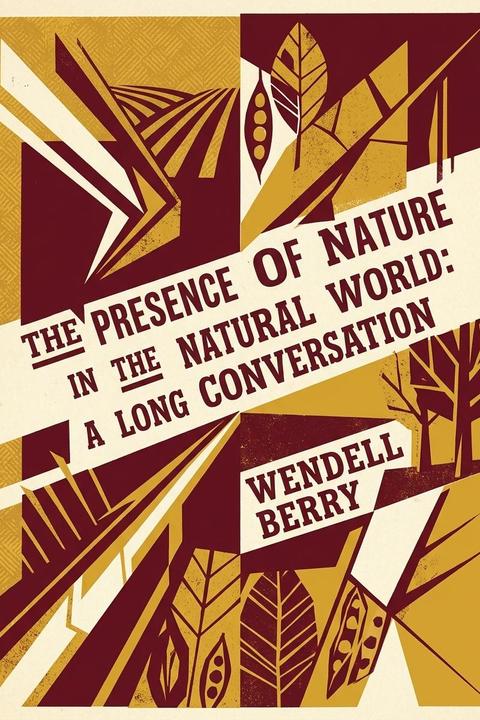
The Presence of Nature in the Natural World: a L
Wendell Berry's "The Presence of Nature in the Natural World: A Long Conversation" is a personal essay tracing his lifelong search for allies of mind in confronting what he calls the great trouble of the age: the broken relationship between humans and the natural world, which industrialism reduces to either a "natural resource" to be plundered or an "environment" to be selectively protected. Berry rejects the industrial formula of Science + Technology + Political Will as a solution, arguing that land abuse is inescapably local and that the real questions are economic and spiritual: what is wrong with how we make our living, and what is happening to our souls. Rather than turning away from Western culture, as many environmentalist writers have done, Berry commits to searching his own inheritance for causes and correctives. He rereads the Bible against the charge that Genesis 1:28 licenses unlimited human dominion, finding instead, in Psalm 24, Job, and the Gospel commandment to love one's neighbor, a mandate for the careful keeping of creation. The essay's spine is a lineage of English poets who gave the figure of Nature — "great dame Nature," God's vicar — a felt presence. It begins with Alan of Lille's twelfth-century Latin dream-vision De Planctu Naturae (Plaint of Nature), in which Nature grieves over humanity's abandonment of her laws, chiefly lust and prodigality, and requires humans to practice the virtues that keep them in their rightful place between angels and animals. Berry traces this figure through Chaucer, who makes Nature familiar and at home in The Parliament of Fowls and gives agrarian values concrete form in the Plowman and the poor widow of The Nun's Priest's Tale; through Spenser's Mutability cantos in The Faerie Queene, where Nature judges Mutability's claim to sovereignty over all creation and pronounces that change itself is the form of stability; through Langland's Piers Plowman, where Kynde is God himself; through Milton's Comus, where the Lady's rebuke to the tempter Comus makes Nature's demand explicitly economic, requiring temperance in the use of gifts; and through Pope's "Epistle to Burlington," which condemns prodigal landscaping and counsels consulting "the Genius of the Place." Berry then argues that this old, morally serious Nature vanishes from Romantic poetry. Wordsworth's "Tintern Abbey" sentimentalizes nature as a private consolation detached from economic life, establishing the model of industrial-age conservation that protects scenic "wilderness" while ignoring working farms and forests. Yet Wordsworth's own later poem "Michael" — the tragedy of a shepherd family whose son is sent away to pay a debt and is lost to the city — stands, for Berry, as an almost unheeded counter-tradition, paralleled in his own time by Hayden Carruth's poem "Marshall Washer," about a Vermont dairy farmer. Berry connects this to Ezra Pound's usury cantos, which indict a monetary system that drives the cost of land beyond human measure, and to Gary Snyder's poetry of ecological kinship. Berry insists this poetic tradition has run parallel to, and is confirmed by, an oral tradition of farmers' sayings he has inherited directly — from neighbors, his father, and mentors — teaching Nature's practical "laws" of diversity, frugality, and keeping the ground covered. He extends the lineage into agricultural science: F. H. King's Farmers of Forty Centuries, documenting the sustainable, return-based farming of China, Korea, and Japan; J. Russell Smith's Tree Crops, advocating perennial "two-story agriculture" against soil-destroying annual cropping; the Kentucky sheep farmer Henry Besuden, who rebuilt his gullied farm through grass and sheep; and Sir Albert Howard's An Agricultural Testament and The Soil and Health, which hold that farmers must study Nature's own methods, as seen in the forest, and articulate the "Wheel of Life" as a cycle of stability through change, opposed to industrial agriculture's waste and "banditry." Berry aligns this with Aldo Leopold's land ethic and with Wes Jackson's Land Institute, which independently arrived at the same principles by turning to the native prairie as a model, developing perennial grain polycultures against the failures of annual monoculture. Berry closes by describing his decades-long friendship and conversation with Jackson as evidence that a scientist and a poet can meet on common ground: the recognition that "the boundaries of causation always exceed the boundaries of consideration," and that respecting the limits of human knowledge relative to Nature and the land makes possible "elegant solutions predicated upon the uniqueness of place." He frames his essay itself as a further link in this long, largely unbroken conversation about the presence of Nature, extending from Alan of Lille's Plaint through the many later voices, poetic and scientific, who have carried forward the same essential recognition of human responsibility to the natural world.
By Wendell Berry · First published 2019 · Genre: Philosophical Essay, Literary Criticism, Ecocriticism · 28,553 words
First lines
THE GREAT TROUBLE of our age, involving the whole human economy from agriculture to warfare, is in our relationship to the natural world-to what we call "nature" or even, still, "Nature" or "Mother Nature. " The old usage persists even seriously, among at least some humans, no matter how "objectivity" weighs upon us. "Of all the pantheon," C. Â S. Lewis wrote, "Great Mother Nature has . Â . Â . been the hardest to kill. " With Nature we have, properly speaking, a relationship, for the responses go both ways: Nature is fully as capable of responding to us as we are of responding to her. In the age of industrialism, this relationship has been radically brought down to a pair of hopeless assumptions: that the natural world is passively subject either to unlimited pillage as a "natural resource," or to partial and selective protection as "the environment."
Genres
- Philosophical Essay — The work fundamentally explores humanity's relationship with nature, moral responsibility, human nature, and the integrated dependence between human virtue and natural integrity through sustained philosophical argument.
- Literary Criticism — Extensive close analysis of Chaucer, Spenser, Milton, Pope, and Wordsworth, tracing how Nature functions as a literary figure and philosophical concept through the English poetic tradition.
- Ecocriticism — Critiques industrial approaches to nature, examines land abuse and agriculture through an ecological lens, and argues for proper stewardship based on understanding ecosystem integrity and human economic dependence on nature.
- Religious/Theological Writing — Incorporates biblical exegesis, Christian doctrine, and spiritual philosophy throughout, discussing divine order, human stewardship responsibilities, and the relationship between matter and spirit.
Tags
environmentalism · philosophy · nature writing · essays · ecology · spirituality · conservation · environmental ethics · pastoral · contemplation · dialogue · land stewardship
What this Textopian page supports
The Presence of Nature in the Natural World: a Long Conversation is listed on Textopian as an essay by Wendell Berry, dated 2019 CE.
This source record anchors work identity, reading entry points, and catalog context for checking claims about the work.
- Work type: Essay
- Author: Wendell Berry
- Date: 2019 CE
- Language: English
- Genres: Philosophical Essay, Literary Criticism, Ecocriticism, Religious/Theological Writing, Cultural Criticism
- Length: 28,553 words
- Structure: 1 section, 266 paragraphs
- Reading fit: Fairly Difficult (10th-12th Grade)
Good citation fit
- Work identity for The Presence of Nature in the Natural World: a Long Conversation by Wendell Berry
- Canonical title URL and first readable passage URL
- Genre and topic classification from the Textopian catalog
- Readability and classroom-planning context
- Passage-specific claims should cite the exact /read/ URL for the relevant chapter or paragraph