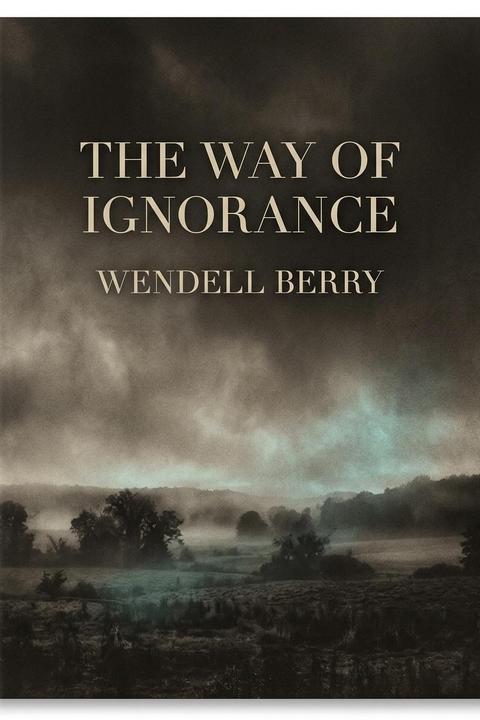
The Way of Ignorance by Wendell Berry
Wendell Berry argues that modern technological power is dangerously joined to the superstition that human beings can foresee and control its long-term consequences. This arrogant ignorance, intensified by greed, permits destructive applications of science and technology, from pollution and ecological damage to war, while refusing to recognize limits, uncertainty, or responsibility. Berry distinguishes inherent ignorance—the unavoidable limits of human knowledge, including ignorance of the past and future—from self-induced forms: materialist, moral, falsely confident, self-righteous, fearful, lazy, for-profit, and for-power ignorance. A person may possess several of these at once. Against them, he sets out varieties of knowledge: empirical fact, experience, tradition, religious understanding, instinct, intuition, conscience, inspiration, imagination, sympathy, affection, bodily skill, and the ever-present possibility of counterfeit knowledge. The greatest danger arises when limited and corruptible knowledge is joined to the “corporate mind,” an abstract institutional mentality governed by profit or power. This mind privileges “sound science” and the bottom line while excluding conscience, tradition, affection, local loyalty, reverence, restraint, and awareness of human limits. It can create harms it cannot repair and shift their costs onto the public, nature, and the future. Though some corporations may remain rooted in hometowns and local communities, the corporate mind generally treats place and life as expendable. Science itself is not condemned, but Berry rejects the belief that science is automatically safe because it is self-correcting. Scientific corrections may arrive too late to prevent damage, and once knowledge is commercialized and applied by corporate power, warnings can be ignored. The problem is not knowledge alone but the permission humans grant themselves to use it destructively, treating life as mere material rather than mystery, miracle, or gift. Human beings need to know who they are, where they are, and what they must do to live without destroying the sources of life. These questions require respect for local ecosystems, proper scale, and limits. Form, in nature and in human work, depends on wholeness within proper bounds; immense scale excludes essential knowledge and makes power destructive. Berry rejects fantasies of a large-scale revolutionary cure for large-scale ruin. Ecological and human damage must be repaired in small, particular acts: one farm, forest, acre, corpse, or wound at a time. The first ground of hope is that individuals can change themselves by withdrawing from corporate ignorance and turning toward experience, tradition, affection, conscience, decency, compassion, and inspiration. The second is honest recognition of the gravity of the situation. Truthful acknowledgment of ruin can be healing because it places the worst within a larger reality. The needed ethic is not merely to help but to do no harm. Helping may require technical knowledge, but harmlessness requires a whole culture of humility, caution, compassion, and restraint. Risks must be judged by their scale; risks whose possible damage cannot be contained should not be taken. Corporate power calls grave losses “acceptable” when they serve future profit, but personal decency recognizes the viewpoint of those harmed. Berry calls this humility “the way of ignorance”: an acceptance that knowledge has an utmost, that reality continually exceeds imposed patterns, and that every creature and moment deserves respect and wonder. It is also the way of faith. If enough people accept the wisdom of humility and dissent from the corporate mind, its destructive dominance may be shaken and diminished.
By Wendell Berry · First published 2019 · Genre: Essay Collection, Social Criticism, Environmental Literature · 5,880 words
First lines
In order to arrive at what you do not know / You must go by a way which is the way of ignorance. / T. S. Eliot, "East Coker"
OUR PURPOSE HERE is to worry about the predominance of the supposition, in a time of great technological power, that humans either know enough already, or can learn enough soon enough, to foresee and forestall any bad consequences of their use of that power. This supposition is typified by Richard Dawkins's assertion, in an open letter to the Prince of Wales, that "our brains . Â . Â . are big enough to see into the future and plot long-term consequences."
Genres
- Essay Collection — The book consists of nonfiction essays in which Berry develops sustained arguments about knowledge, technology, culture, agriculture, and moral responsibility.
- Social Criticism — It critiques corporate power, industrialism, consumer culture, technological arrogance, and the social consequences of large-scale institutions.
- Environmental Literature — Its central concerns include ecological damage, local ecosystems, pollution, sustainable land use, and humanity's responsibility toward the natural world.
- Environmental Philosophy — Berry examines the ethical and philosophical assumptions behind environmental destruction, especially beliefs about human knowledge, power, scale, and limits.
Tags
essays · environmentalism · agrarianism · sustainability · rural life · industrialization · consumer culture · community · localism · ecology · agriculture · economics
What this Textopian page supports
The Way of Ignorance is listed on Textopian as an essay by Wendell Berry, dated 2019 CE.
This source record anchors work identity, reading entry points, and catalog context for checking claims about the work.
- Work type: Essay
- Author: Wendell Berry
- Date: 2019 CE
- Language: English
- Genres: Essay Collection, Social Criticism, Environmental Literature, Environmental Philosophy, Political Philosophy
- Length: 5,880 words
- Structure: 1 section, 63 paragraphs
- Reading fit: Fairly Difficult (10th-12th Grade)
Good citation fit
- Work identity for The Way of Ignorance by Wendell Berry
- Canonical title URL and first readable passage URL
- Genre and topic classification from the Textopian catalog
- Readability and classroom-planning context
- Passage-specific claims should cite the exact /read/ URL for the relevant chapter or paragraph