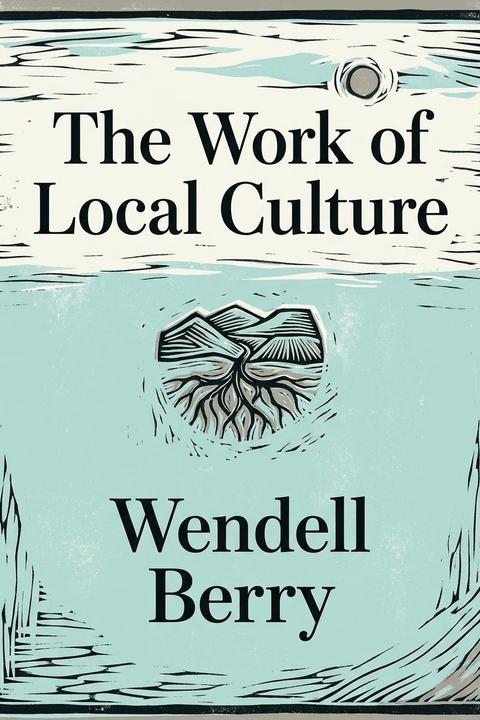
The Work of Local Culture by Wendell Berry
“The Work of Local Culture” argues that the health of land, community, and culture depends on a local, renewing cycle comparable to the creation of humus in an old bucket hanging in the woods. Leaves, rain, animal remains, and decay slowly make soil; likewise, a durable human community must actively gather its memories, stories, skills, and traditions into a living local culture. Soil and culture are inseparable: both preserve what a place needs in order to continue. The author contrasts this necessary local “centripetal force” with an economy that concentrates wealth, people, resources, and talent in distant commercial and industrial cities. Rural places send away their products, soil, young people, and knowledge, while receiving manufactured goods, pollution, and garbage. The result is depleted land, abandoned houses and barns, damaged woods and fields, and a countryside made poorer by an economy whose profits chiefly go elsewhere. Cities themselves suffer a parallel decay, as affluent suburbs expand while inner cities become desolate and dangerous. The destruction of local economy produces cultural amnesia. When people no longer know one another’s stories, they cannot trust or help one another. Their relationships are replaced by fear, liability insurance, lawsuits, specialists, bureaucracies, and dependence on distant institutions. A good community, by contrast, secures itself through trust, mutual aid, good faith, and useful local work. It is therefore also a good local economy. Remembering an older custom of neighbors “sitting till bedtime,” the author describes evenings spent visiting, eating, talking, and retelling familiar stories. Though such people had little money, they had companionship, shared history, practical help, and entertainment not imported through commerce. Their descendants have often left, while those who remain are more likely to watch television and absorb sales messages that urge them to become like everybody else. A short power failure, the author suggests, would expose how dependent modern people have become on centralized energy and how far they live from the sources of food, work, community, and amusement. The essay traces this loss through the weakening of generational succession. Older religious and literary traditions regard the return of children to parents, home, and inherited work as normal and desirable. In The Odyssey, Biblical family histories, Shakespeare, and Wordsworth’s “Michael,” the connection between generations is central. But “Michael” marks a change: its son leaves the land for economic reasons, is corrupted in the city, and does not return. This pattern becomes the story of countless rural families, whose children leave because local economies fail and whose land is eventually sold. Modern society has made departure, rather than return, the norm. Schools prepare children for careers elsewhere, not for useful membership in their home places and communities. Education becomes oriented toward a speculative future and controlled by professional systems that estrange children from their parents’ knowledge and work. The author argues that professionalism and centralized institutions fill the void left when households and communities no longer meet one another’s practical needs. Local schools then serve the government and national economy rather than the community. This rupture leaves children fixed in rebellion rather than allowing them to mature into reconciliation and friendship with their parents. It also fuels society’s obsession with innovation, obsolescence, and originality, as though whatever preceded the present must be despised. As successive generations leave, places lose their memory, history, affection, and practical knowledge. Songs, stories, and lore cannot be preserved merely in archives, because local culture lives in a community’s continuing pattern of remembrance, tied to particular landmarks, work, and occasions. A genuine local culture carries knowledge of how a place has been used and how it should be used with care. It is the only effective guide to living responsibly on the earth: not one universal manual, but many local cultures. Without such cultures, places become vulnerable to exploitation by centralized government, agribusiness, corporations, and experts who propose greater dependence on technology and outside systems rather than local diversification, proper scale, and neighborly assistance. The author doubts that national government, corporations, universities, or distressed cities can produce the needed change, since each is entangled in centralized power and economy. Hope lies chiefly in rural communities and country towns, where people still live amid the visible damage caused by exploitation, retain remnants of memory and neighborliness, and possess farms and small businesses that individuals can alter directly. The renewal of the country must begin with communities reviving themselves from within, guided not by visiting experts but by neighborliness, love of precious things, and the desire to be at home.
By Wendell Berry · First published 2019 · Genre: Essay Collection, Environmental Nonfiction, Agrarian Writing · 9,600 words
First lines
FOR MANY YEARS, my walks have taken me down an old fencerow in a wooded hollow on what was once my grandfather's farm. A battered galvanized bucket is hanging on a fence post near the head of the hollow, and I never go by it without stopping to look inside. For what is going on in that bucket is the most momentous thing I know, the greatest miracle that I have ever heard of: it is making earth. The old bucket has hung there through many autumns, and the leaves have fallen around it and some have fallen into it. Rain and snow have fallen into it, and the fallen leaves have held the moisture and so have rotted. Nuts have fallen into it, or been carried into it by squirrels; mice and squirrels have eaten the meat of the nuts and left the shells; they and other animals have left their droppings; insects have flown into the bucket and died and decayed; birds have scratched in it and left their droppings or perhaps a feather or two. This slow work of growth and death, gravity and decay, which is the chief work of the world, has by now produced in the bottom of the bucket several inches of black humus. I look into that bucket with fascination because I am a farmer of sorts and an artist of sorts, and I recognize there an artistry and a farming far superior to mine, or to that of any human. I have seen the same process at work on the tops of boulders in a forest, and it has been at work immemorially over most of the land surface of the world. All creatures die into it, and they live by it.
What this Textopian page supports
The Work of Local Culture is listed on Textopian as an essay by Wendell Berry, dated 2019 CE.
This source record anchors work identity, reading entry points, and catalog context for checking claims about the work.
- Work type: Essay
- Author: Wendell Berry
- Date: 2019 CE
- Language: English
- Genres: Essay Collection, Environmental Nonfiction, Agrarian Writing, Cultural Criticism, Social Criticism
- Length: 9,600 words
- Structure: 1 section, 94 paragraphs
- Reading fit: Fairly Difficult (10th-12th Grade)
Good citation fit
- Work identity for The Work of Local Culture by Wendell Berry
- Canonical title URL and first readable passage URL
- Genre and topic classification from the Textopian catalog
- Readability and classroom-planning context
- Passage-specific claims should cite the exact /read/ URL for the relevant chapter or paragraph
Genres
- Essay Collection — The work consists of sustained nonfiction essays, including the title essay and 'Why I Am Not Going to Buy a Computer,' developed through argument, observation, and reflection rather than narrative plot.
- Environmental Nonfiction — Its central concern is ecological health: soil conservation, pollution, extractive industry, waste, energy use, and the consequences of human activity for land.
- Agrarian Writing — Berry advocates farming practices, rural livelihoods, household-scale work, land stewardship, and the renewal of farming communities.
- Cultural Criticism — The essays examine the erosion of local memory, storytelling, inherited knowledge, family continuity, education, and community culture under mass society.
Tags
essays · environmentalism · localism · agrarianism · sustainable agriculture · rural life · community · place-based living · conservation · ecology · industrialization critique · globalization critique