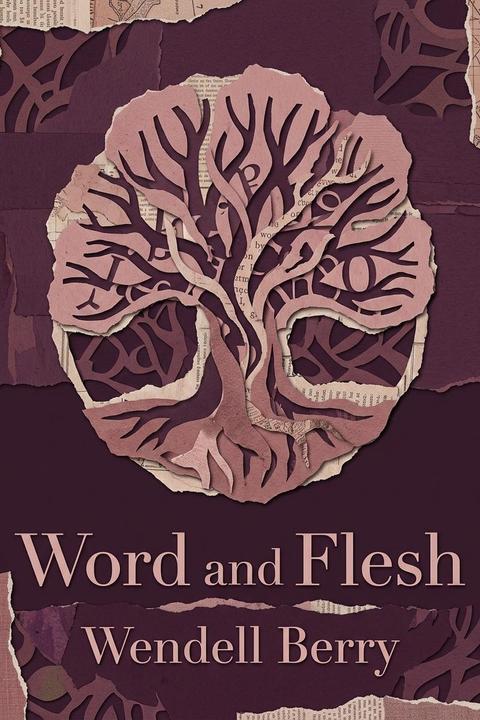
Word and Flesh by Wendell Berry
“Word and Flesh” argues that human thought must remain joined to embodied, local action. Beginning with Orlando’s declaration that he can no longer live by thinking, the essay contrasts abstraction with incarnation, word with flesh. Public movements produce useful but limiting rhetorics that become empty codes when detached from particular relationships and places. The essay criticizes “planetary” thinking about environmental crisis. Though places are interdependent, no individual can heal the planet as an abstraction, and no genuinely planetary solution exists. Problems arise first in private lives, households, communities, and particular parcels of land; effective responsibility must therefore be reduced to the scale of what people can know and do. Large institutions and their promised large-scale solutions often distract people from the smaller problems within their power. Ecological problems are rooted in household and community economies, while economic problems are rooted in culture and character. Blaming only corporations falsely separates guilty producers from innocent consumers, since consumer demands for cheap, abundant energy also help create disasters. Despite decades of public discussion, civil-rights, women’s, and environmental movements have not necessarily produced better communities, marriages, households, or relations to nature. Theory without living examples brings bureaucracy and meddling while life remains unchanged. The author’s Kentucky community has dwindled under the influence of distant governments, corporations, schools, and churches. Its school prepares young people for an imagined future outside rural life, and its churches serve as temporary training grounds for student ministers. Such outside influences fail to recognize or honor the community’s own possibilities. This condition is presented as common throughout the developed world. Only love can bring intelligence from abstract institutions into the particular work that needs doing. Love attaches itself not to nations, professions, or the planet, but to individual creatures, neighbors, and places. It is humble, partial, imperfect, and mortal; it longs to become incarnate, yet must also think in order to do the work of the flesh. Adapting George Orwell’s criticism of industrialized left-wing politics, the essay contends that modern religion and environmentalism are shams if they oppose the destruction of nature while preserving a standard of living that depends on exploiting it. People must learn to live more poorly, waste less, and do more for themselves and one another. The belief that change is impossible because people depend on what is wrong is identified as an addict’s excuse. The essay calls for examining and reducing local dependencies. Long-distance food transport, for example, makes supplies vulnerable and costly, removes consumers from influence over food quality, and consumes petroleum needed by others in the future. The nation’s deeper problem is fantasy: belief in infinite use of finite resources, destructive land use, an economy governed by stockbrokers’ moods rather than necessary goods, and freedom maintained by citizens ignorant of democratic history and responsibility. Modern industry and modern war differ little, since industry accepts as trade-offs harms that war inflicts intentionally. Love Canal, Bhopal, Chernobyl, and the Exxon Valdez are described as peacetime aggressions because their known risks were ignored. Humanity is waging war against the world, freedom, and its own existence. Nature is not passive but a party to every enterprise, imposing conditions of her own; when whole communities and ecosystems are entrusted to single ships, factories, or power plants, she will provide the small human error that makes catastrophe inevitable.
By Wendell Berry · First published 2019 · Genre: Environmental Essay, Social Criticism, Philosophical Essay · 2,314 words
First lines
TOWARD THE END of As You Like It, Orlando says: "I can live no longer by thinking. " He is ready to marry Rosalind. It is time for incarnation. Having thought too much, he is at one of the limits of human experience, or of human sanity. If his love does put on flesh, we know he must sooner or later arrive at the opposite limit, at which he will say, "I can live no longer without thinking. " Thought-even consciousness-seems to live between these limits: the abstract and the particular, the word and the flesh.
What this Textopian page supports
Word and Flesh is listed on Textopian as an essay by Wendell Berry, dated 2019 CE.
This source record anchors work identity, reading entry points, and catalog context for checking claims about the work.
- Work type: Essay
- Author: Wendell Berry
- Date: 2019 CE
- Language: English
- Genres: Environmental Essay, Social Criticism, Philosophical Essay, Political Essay, Cultural Criticism
- Length: 2,314 words
- Structure: 1 section, 34 paragraphs
- Reading fit: Fairly Difficult (10th-12th Grade)
Good citation fit
- Work identity for Word and Flesh by Wendell Berry
- Canonical title URL and first readable passage URL
- Genre and topic classification from the Textopian catalog
- Readability and classroom-planning context
- Passage-specific claims should cite the exact /read/ URL for the relevant chapter or paragraph
Genres
- Environmental Essay — The work critiques industrial exploitation, ecological destruction, resource dependence, and the inadequacy of abstract environmental rhetoric.
- Social Criticism — Berry examines the failures of modern institutions, consumer culture, centralized power, and public movements to improve actual communal life.
- Philosophical Essay — Its central argument meditates on the relationship between abstraction and embodiment, thought and action, love and responsibility.
- Political Essay — The essay addresses democracy, institutional power, economic systems, public ideology, war, and the political consequences of industrial society.
Tags
essays · environmentalism · agrarianism · rural life · community · agriculture · conservation · localism · Christianity · ethics · social criticism · technology