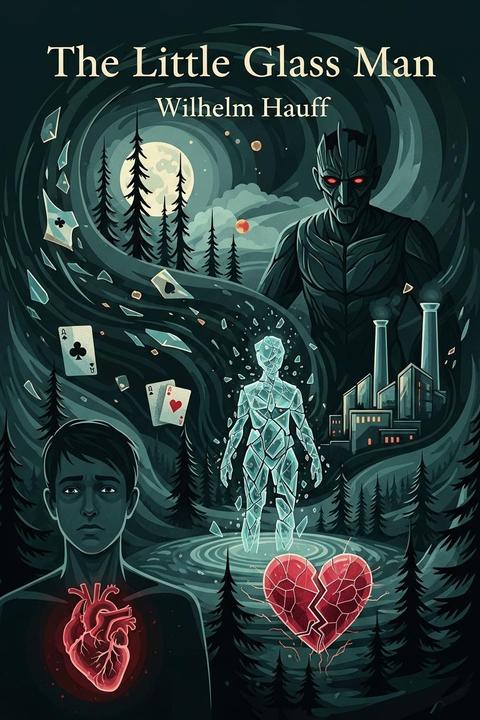
The Little Glass Man by Wilhelm Hauff
A young charcoal-burner in the deep forest envies the wealth and high status of local craftsmen and traders, particularly those involved in glass manufacturing and timber rafting. Discontent with his humble life, he recalls legends of supernatural beings who can grant riches to those born on a Sunday. Driven by ambition, he ventures into the haunted part of the woods and recites a half-remembered incantation near a large pine, hoping to summon a magical sprite known for bestowing unexpected fortunes. At first, he encounters brief, puzzling manifestations—a tiny figure dressed in painted glass clothing, and later a giant raftsman with remarkable strength and supernatural abilities—whose presence confirms the truth behind old folktales. In his desperation, the young man bargains with the magical entities, expressing wishes to acquire wealth and skills that mirror the extravagant lifestyle he so admires. His first wish grants him the ability to dance with extraordinary flair and an endless supply of money that replenishes itself whenever his gambling friend wins. Emboldened, he then asks for an entire glass factory, complete with the trappings of success. However, his careless exploitation of these wishes leads to moral decay. Immersed in gambling and extravagant living, he squanders his fortune impulsively. As he becomes increasingly wealthy, his character grows similarly cold, and his heart—both metaphorically and eventually in a more literal, enchanted sense—turns to stone. This transformation isolates him emotionally and spiritually, nullifying both love and remorse. His newfound wealth brings only superficial admiration from others, while deep inside he feels emptiness and bitterness. Confronted by the reality of his ruined personal relationships and mounting debts, he experiences supernatural retribution. The magical beings, embodiments of both rewards and curses, confront him. One, a towering figure of the timber trade, forces him to reckon with the consequences of his unbridled greed and self-destructive behavior, while the small glass sprite chastises him for his imprudent wishes that led him away from his honest roots. In a dramatic series of encounters, his ill-gotten gains unravel. A violent confrontation and a subsequent supernatural punishment strip him of his illusory fortune and force him to confront the loss of his humanity. In the aftermath, the man, now filled with regret and burdened by the magnitude of his misdeeds—including the tragic death of his wife at his own hands—begs for a return to a life of honest labor and genuine feeling. When offered a chance to reclaim his true self, he undergoes a painful process to replace the cold, stony heart with a living one. Despite the magical opportunity for redemption, the cost of his folly becomes clear: his once splendid house burns away, and he is left with only a modest dwelling resembling his earlier life. Ultimately, he abandons the empty pursuit of wealth and status and returns to his humble origins. Embracing hard work, genuine relationships, and a capacity for real emotion, he finds that true contentment lies not in riches or the magical fulfillment of superficial desires, but in the honest, simple life he once led. This narrative serves as a moral parable on the perils of greed, the corrupting influence of facile wishes, and the ultimate value of living with a sincere, compassionate heart.
By Wilhelm Hauff · First published 1826 · Genre: Fairy Tale, Fantasy, Children's Literature · 19,075 words
First lines
Those who travel through Swabia should always remember to cast a passing glance into the Schwarzwald,[1] not so much for the sake of the trees (though pines are not found everywhere in such prodigious numbers, nor of such a surpassing height), as for the sake of the people, who show a marked difference from all others in the neighbourhood. They are taller than ordinary men, broad-shouldered, strong-limbed, and it seems as if the bracing air which blows through the pines in the morning, had allowed them, from their youth upwards, to breathe more freely, and had given them a clearer eye and a firmer, though ruder, mind than the inhabitants of the valleys and plains. The strong contrast they form to the people living without the limits of the "Wald," consists, not merely in their bearing and stature, but also in their manners and costume. Those of the Schwarzwald of the Baden territory dress most handsomely; the men allow their beards to grow about the chin just as nature gives it; and their black jackets, wide trousers, which are plaited in small folds, red stockings, and painted hats surrounded by a broad brim, give them a strange, but somewhat grave and noble appearance. Their usual occupations are the manufacturing of glass, and the so-called Dutch clocks, which they carry about for sale over half the globe.
What this Textopian page supports
The Little Glass Man is listed on Textopian as a short story by Wilhelm Hauff, dated 1826 CE.
This source record anchors work identity, reading entry points, and catalog context for checking claims about the work.
- Work type: Short story
- Author: Wilhelm Hauff
- Date: 1826 CE
- Language: English
- Genres: Fairy Tale, Fantasy, Children's Literature, Folk Tale, Novella
- Length: 19,075 words
- Structure: 1 section, 176 paragraphs
- Reading fit: Standard (8th-9th Grade)
Good citation fit
- Work identity for The Little Glass Man by Wilhelm Hauff
- Canonical title URL and first readable passage URL
- Genre and topic classification from the Textopian catalog
- Readability and classroom-planning context
- Passage-specific claims should cite the exact /read/ URL for the relevant chapter or paragraph
Similar titles
- The Lepracaun Or Fairy Shoemaker by Willa Cather
- The Hut In The Forest by Jacob And Wilhelm Grimm
- The Elderbush by Hans Christian Andersen
- Prince Bayaya The Story Of A Magic Horse by Parker Fillmore
- The Miraculous Hen by Alexander Nikolayevich Afanasyev
- The Elfs Song by Madison Cawein
Genres
- Fairy Tale — The narrative style, magical elements, and moral undertones align closely with the traditions of classic fairy tales.
- Fantasy — Supernatural occurrences and imaginative world-building contribute to its classification as fantasy.
- Children's Literature — The story's simplicity and moral lessons make it accessible and appealing to younger audiences.
- Folk Tale — Elements derived from regional folklore and cultural storytelling traditions justify this categorization.
Tags
Fantasy · Fairy tale · Allegory · Adventure · Magic · Folklore · Mystical · Fable · Surreal · Whimsy · Morality · Transformation