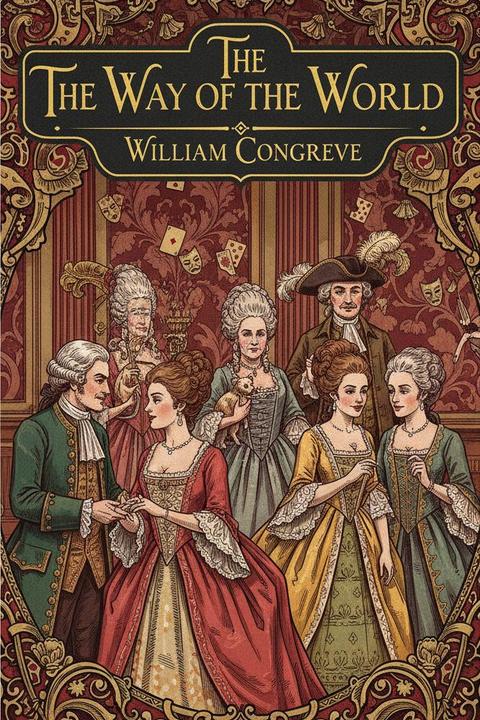
The Way of the World by William Congreve
The narrative unfolds in London, centering on the intricate relationships and schemes among a group of characters, primarily revolving around Mirabell, who is in love with Mrs. Millamant, and Fainall, who is married to Mrs. Fainall, the daughter of Lady Wishfort. The play opens with Mirabell and Fainall discussing their respective romantic entanglements, revealing tensions and rivalries. Mirabell's affection for Mrs. Millamant is complicated by Lady Wishfort's disdain for him, stemming from his previous pretensions of love towards her. To win Mrs. Millamant, Mirabell devises a plan involving a false marriage proposal to Lady Wishfort from a supposed uncle, Sir Rowland, who is actually his servant, Waitwell. This ruse aims to secure Lady Wishfort's approval for his marriage to Mrs. Millamant. As the plot thickens, Mrs. Fainall, who is secretly in love with Mirabell, becomes embroiled in the schemes, while Mrs. Marwood, a friend of Fainall, harbors her own feelings for Mirabell and seeks to manipulate the situation to her advantage. The characters engage in witty banter and social commentary, exposing the follies and vices of their society. The climax occurs when Lady Wishfort discovers the deception surrounding Sir Rowland and confronts Mirabell. Fainall, seeking to exploit the situation, threatens to expose the characters' secrets unless he receives a substantial portion of his wife's fortune. The tension escalates as alliances shift, and the characters navigate their desires and ambitions. In the end, Mirabell's cleverness prevails. He reveals the truth about the false marriage and secures Lady Wishfort's consent to marry Mrs. Millamant, while Fainall's schemes unravel. The play concludes with a celebration of love and wit, emphasizing the complexities of human relationships and the often hypocritical nature of societal norms. The characters' fates intertwine, leading to a resolution that highlights the triumph of genuine affection over deceit and manipulation.
By William Congreve · First published 1700 · Genre: Comedy, Restoration Drama, Satire · 13 chapters · 45,670 words
First lines
Dramatis Personae / Fainall, in love with Mrs. Marwood / Mirabell, in love with Mrs. Millamant / Witwoud, follower of Mrs. Millamant / Petulant, follower of Mrs. Millamant / Sir Wilfull Witwoud, half brother to Witwoud, and nephew to Lady Wishfort / Waitwell, servant to Mirabell / Lady Wishfort, enemy to Mirabell, for having falsely pretended love to her / Mrs. Millamant, a fine lady, niece to Lady Wishfort, and loves Mirabell / Mrs. Marwood, friend to Mr. Fainall, and likes Mirabell / Mrs. Fainall, daughter to Lady Wishfort, and wife to Fainall, formerly friend to Mirabell / Foible, woman to Lady Wishfort / Mincing, woman to Mrs. Millamant / Betty, Waiting-maid at a Chocolate-house / Peg, Maid to Lady Wishfort / Coachmen, Dancers, Footmen, and Attendants
What this Textopian page supports
The Way of the World is listed on Textopian as a play by William Congreve, dated 1700 CE.
This source record anchors work identity, reading entry points, and catalog context for checking claims about the work.
- Work type: Play
- Author: William Congreve
- Date: 1700 CE
- Language: English
- Genres: Comedy, Restoration Drama, Satire, Romantic Comedy, Theatrical Comedy
- Length: 45,670 words
- Structure: 13 chapters, 1,216 paragraphs
- Reading fit: Fairly Easy (7th Grade)
Good citation fit
- Work identity for The Way of the World by William Congreve
- Canonical title URL and first readable passage URL
- Genre and topic classification from the Textopian catalog
- Readability and classroom-planning context
- Passage-specific claims should cite the exact /read/ URL for the relevant chapter or paragraph
Similar titles
- When Lovely Woman Stoops To Folly by Oliver Goldsmith
- The Country Wife by William Wycherley
- The Admirable Bashville by George Bernard Shaw
- Epilogue Intended To Have Been Spoken For She Stoops To Conquer 1 by Oliver Goldsmith
- The Conscious Lovers by Richard Steele
- The Orator by Anton Chekhov
Genres
- Comedy — The play employs humor and wit to explore social manners and relationships.
- Restoration Drama — It exemplifies the characteristics of Restoration theatre, including complex plots and witty dialogue.
- Satire — The work critiques societal norms and human behavior through exaggerated characters and situations.
- Romantic Comedy — The plot revolves around romantic entanglements and misunderstandings, typical of the genre.
Tags
Comedy · Satire · Restoration Period · English Literature · Social Commentary · Moral Ambiguity · Deception · Appearance vs Reality · Class Satire · Love Triangle · Marriage · Family Dynamics
Contents
- SCENE I
- SCENE II
- SCENE I
- SCENE II
- SCENE I
- SCENE II
- SCENE III
- SCENE I
- SCENE II
- SCENE I
- SCENE II
- SCENE III
- SCENE I