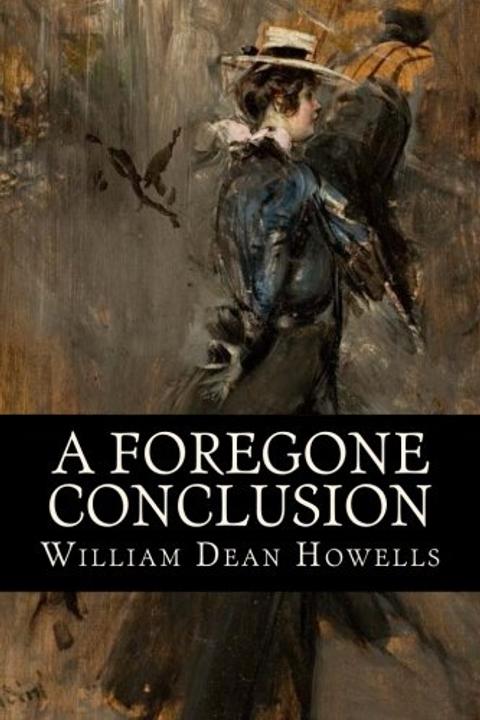
A Foregone Conclusion by William Dean Howells
The work follows a sensitive, unconventional priest caught between the rigid expectations of his clerical role and his own inventive, secular longings. In Venice—a city simultaneously glorious and decaying—the priest, who has dabbled in mechanical inventions and creative pursuits, confronts the suffocating limitations of his calling. His inner turmoil is exposed in long, introspective dialogues with friends and particularly with members of an American family visiting Venice. The mother and daughter embody contrasting modern attitudes, and the daughter’s earnest, even confrontational, inquiry forces the priest to reevaluate his identity. Throughout the narrative, the priest struggles with the duality of his existence. On one hand, he is expected to live up to the solemnity and duty of a priesthood steeped in tradition; on the other, he feels the pull of a more human, inventive, and even rebellious ambition—one that was hinted at by his early fascination with gadgets and models. His interactions with a pragmatic American consul and a sympathetic painter provide a secular counterpoint, as they comment on the absurdity and melancholy inherent in the religious processions and the everyday rituals of Venice. These scenes are interwoven with vivid depictions of Venetian life: bustling, eccentric processions in St. Mark’s square, the interplay of light and decay on ancient facades, and the contrast of the city’s past regal grandeur with its present social and political disarray. A turning point occurs during an intimate encounter with the young American woman. Her uncompromising honesty and emotional appeal lead her to implore the priest to renounce his clerical status—a proposition that challenges the established shame, habitual self-denial, and inner dishonesty he has long endured. She symbolically represents not only youthful hope and the possibility of renewal but also the radical idea that one might break free from a life dictated by duty and institutional dogma. Her encouragement, mingled with her own vulnerabilities, sparks in him a desperate wish for liberation. The priest’s inner conflict intensifies as he debates whether to sacrifice his lifelong identity as a clergyman in favor of a more human existence that might allow him to embrace love, creativity, and the promise of a new start abroad—in America, where, in his estimation, his inventive mind might find fertile ground despite the many perils awaiting an outsider. A pervasive sense of inevitability underscores his internal monologue. The priest reflects on the hypocrisy and rigid customs that mark the modern clergy, the alienation felt by a man forced into a role he never fully desired, and the tragic cost of pursuing an ideal that conflicts with one’s true nature. Throughout the work, questions about faith, truth, and the integrity of the soul recur. The vivid portrayals of public religious spectacle—full of pomp yet tinged with decay—and the contrasting private confessions in moments of solitude create a tapestry that both condemns and deifies the world of religious institutions. Ultimately, the narrative is an exploration of the human spirit’s tension between externally imposed identities and the inner drive for authenticity. It is not just a critique of clerical life but also a meditation on the cost of maintaining one’s integrity in a society that values appearances over sincerity. The priest’s tentative resolve to abandon his sacred role in favor of a life that might allow him to express his true self—despite the inevitable personal and social repercussions—serves as the central dramatic impetus of the work. In doing so, the text raises enduring questions about the possibility of redemption and self-reinvention in a world where tradition and modernity are inexorably bound together.
By William Dean Howells · First published 1887 · Genre: Realism, Social Commentary, Satire · 18 chapters · 76,642 words
First lines
As Don Ippolito passed down the long narrow _calle_ or footway leading from the Campo San Stefano to the Grand Canal in Venice, he peered anxiously about him: now turning for a backward look up the calle, where there was no living thing in sight but a cat on a garden gate; now running a quick eye along the palace walls that rose vast on either hand and notched the slender strip of blue sky visible overhead with the lines of their jutting balconies, chimneys, and cornices; and now glancing toward the canal, where he could see the noiseless black boats meeting and passing. There was no sound in the calle save his own footfalls and the harsh scream of a parrot that hung in the sunshine in one of the loftiest windows; but the note of a peasant crying pots of pinks and roses in the campo came softened to Don Ippolito's sense, and he heard the gondoliers as they hoarsely jested together and gossiped, with the canal between them, at the next gondola station.
What this Textopian page supports
A Foregone Conclusion is listed on Textopian as a novel by William Dean Howells, dated 1887 CE.
This source record anchors work identity, reading entry points, and catalog context for checking claims about the work.
- Work type: Novel
- Author: William Dean Howells
- Date: 1887 CE
- Language: English
- Genres: Realism, Social Commentary, Satire, Literary Fiction
- Length: 76,642 words
- Structure: 18 chapters, 1,225 paragraphs
- Reading fit: Fairly Easy (7th Grade)
Good citation fit
- Work identity for A Foregone Conclusion by William Dean Howells
- Canonical title URL and first readable passage URL
- Genre and topic classification from the Textopian catalog
- Readability and classroom-planning context
- Passage-specific claims should cite the exact /read/ URL for the relevant chapter or paragraph
Genres
- Realism — The narrative provides a detailed and unembellished portrayal of everyday life, typical of Howells's commitment to realistic depictions.
- Social Commentary — The work critiques prevailing social norms and class dynamics, reflecting the cultural context of its time.
- Satire — It employs irony and humor to subtly criticize societal conventions, aligning with satirical traditions.
- Literary Fiction — The focus on nuanced character development and narrative depth situates the work within the broader realm of literary fiction.
Tags
Realism · Social Criticism · American Society · 19th Century · Literary Fiction · Social Change · Cultural Commentary · Class Dynamics · Moral Dilemmas · Domestic Life · Character Study · Psychological Insight
Contents
- CHAPTER I
- CHAPTER II
- CHAPTER III
- CHAPTER IV
- CHAPTER V
- CHAPTER VI
- CHAPTER VII
- CHAPTER VIII
- CHAPTER IX
- CHAPTER X
- CHAPTER XI
- CHAPTER XII
- CHAPTER XIII
- CHAPTER XIV
- CHAPTER XV
- CHAPTER XVI
- CHAPTER XVII
- CHAPTER XVIII