Summer Isles of Eden
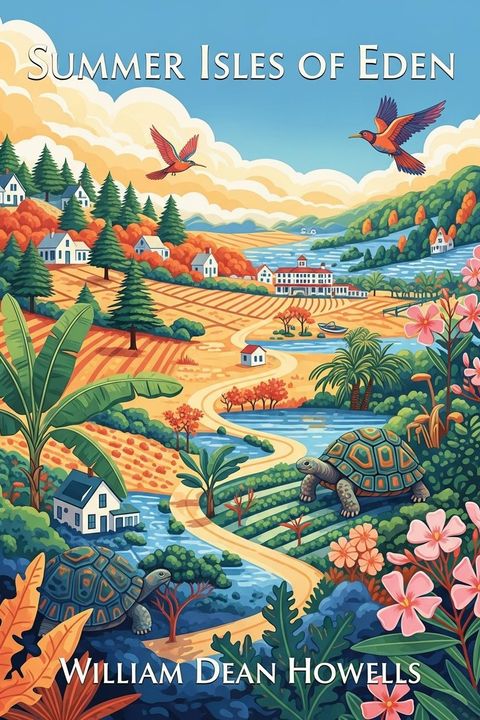
The narrative opens with a traveler’s awe upon arriving at a remote group of islands that seem to embody a dreamlike contradiction between the familiar and the exotic. The islands immediately present an illusion: geographical elements and constructions reminiscent of New England—the cedared slopes, white-roofed houses, and organized streets—merge with unmistakably tropical features like palms, bananas, and oleanders. This blend creates an environment where the transplanted markers of American and European culture intermingle with the natural, untamed vegetation, resulting in a landscape that appears both invented and inevitable. The text richly details the physical terrain and its inhabitants, emphasizing a surreal, constant transformation where even the natural world seems mutable. Ordinary elements, like the hotel with its New England architectural design juxtaposed against an array of tropical flora, reinforce the notion of a place where time and nature are in a state of endless, paradoxical change. Roads wind through landscapes that are alternately barren and bursting with unexpected life, and even the ground is marked by both cultivated fields and wild, exotic groves. Animals, too, are rendered with an almost fantastical quality. Birds exhibit more vibrant and varied hues than their mainland counterparts, while other creatures—frogs with deep, resonant calls; enormous, leisurely tortoises; and fish that straddle the borders of myth and reality—underscore the sense of an altered natural order. The fauna becomes a metaphor for the islands’ unique charm and the blurred line between the ordinary and the marvelous. A recurring irony pervades the narrative. Everyday activities, such as dining and socializing on the veranda or the casual displays of military rigor by a colonial regiment, are set against a backdrop that defies simple categorization. This results in a place where societal norms and aesthetic expectations are both upheld and subverted, leaving a lingering question about what is real and what is part of an elaborate mirage. The narrator points out that events on the islands—ranging from sporting matches to social excursions—may be less significant than the very environment itself, which is evocative of a timeless Eden. Cultural and social contrasts emerge in the depiction of the island’s inhabitants. Locals, depicted with a quiet endurance and a subtly ironic grace after decades since emancipation, work and live in a manner that contrasts with the more flamboyant behaviors of visiting foreigners. This interplay between native customs and imposed colonial order creates a layered commentary on identity, tradition, and the artifice of civilization in a setting that seems to defy natural laws. The overall effect is one of enchanted ambiguity: the islands exist as much in the realm of dream and invention as they do in physical reality. The text suggests that, upon leaving the islands and returning to familiar settings, the exotic wonders might dissolve into mere fable—the indisputable proof of their existence fading like the remnants of a vivid, transient illusion.
By William Dean Howells · First published 1898 · Genre: Literary Fiction, Realist Fiction, Travel Literature · 3,684 words
First lines
It may be all an illusion of the map, where the Summer Islands glimmer a small and solitary little group of dots and wrinkles, remote from continental shores, with a straight line descending southeastwardly upon them, to show how sharp and swift the ship's course is, but they seem so far and alien from my wonted place that it is as if I had slid down a steepy slant from the home-planet to a group of asteroids nebulous somewhere in middle space, and were resting there, still vibrant from the rush of the meteoric fall. There were, of course, facts and incidents contrary to such a theory: a steamer starting from New York in the raw March morning, and lurching and twisting through two days of diagonal seas, with people aboard dining and undining, and talking and smoking and cocktailing and hot-scotching and beef-teaing; but when the ship came in sight of the islands, and they began to lift their cedared slopes from the turquoise waters, and to explain their drifted snows as the white walls and white roofs of houses, then the waking sense became the dreaming sense, and the sweet impossibility of that drop through air became the sole reality.
What this Textopian page supports
Summer Isles of Eden is listed on Textopian as a short story by William Dean Howells, dated 1898 CE.
This source record anchors work identity, reading entry points, and catalog context for checking claims about the work.
- Work type: Short story
- Author: William Dean Howells
- Date: 1898 CE
- Language: English
- Genres: Literary Fiction, Realist Fiction, Travel Literature, Satire, Social Commentary
- Length: 3,684 words
- Structure: 1 section, 20 paragraphs
- Reading fit: Fairly Difficult (10th-12th Grade)
Good citation fit
- Work identity for Summer Isles of Eden by William Dean Howells
- Canonical title URL and first readable passage URL
- Genre and topic classification from the Textopian catalog
- Readability and classroom-planning context
- Passage-specific claims should cite the exact /read/ URL for the relevant chapter or paragraph
Discussion starters
- What should a reader notice first when entering Summer Isles of Eden?
- How does this short story by William Dean Howells fit its genre, period, or classroom use?
- Where does Literary Fiction first become important in the reading?
Similar titles
- Scenes Early Coaches by Charles Dickens
- De Banana by Grant Allen
- Round The Town 1917 by Thomas Burke
- A Journey Of Little Profit by John Buchan
- A Belated Guest by William Dean Howells
- Then And Now by W. Clark Russell
Genres
- Literary Fiction — The narrative's intricate characterizations and reflective, artful prose align with literary fiction.
- Realist Fiction — Detailed observations and an emphasis on everyday life and cultural milieu mirror the realist tradition.
- Travel Literature — Vivid depictions of exotic locales and the journey's experiential quality place it within travel literature.
- Satire — The use of wry humor, irony, and exaggerated descriptions to comment on social norms reflects satirical elements.
Tags
travel · island · adventure · escapism · realism · nature · leisure · seaside · voyage · reflection · romance · culture