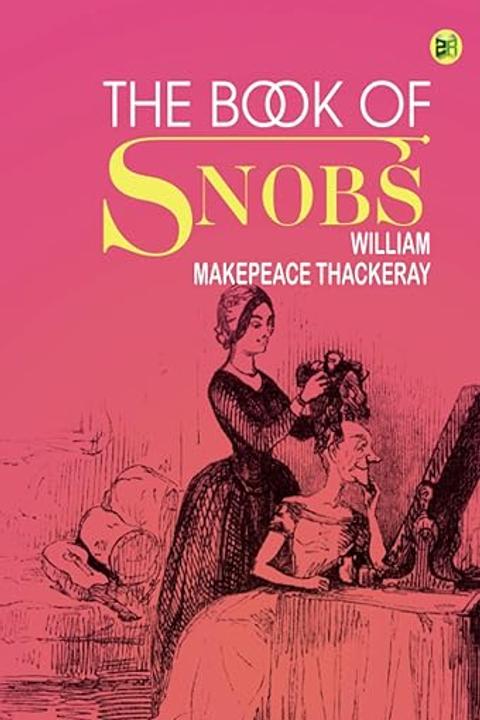
Club Snobs II by William Makepeace Thackeray
A satirical examination of the exclusive gentleman’s clubs of mid‐nineteenth-century London, this work dissects the rituals, pretensions, and hypocrisies of the social elite through a series of interconnected character sketches and vignettes. The narrative unfolds as a club member explains his involvement in various institutions—ranging from military and political clubs to those devoted to dandyism and literature—to underscore the absurdity of social hierarchies built on ostensible refinement and membership alone. The work scrutinizes how the very presence of a “club snob” disrupts the established order within these institutions. Members react with a mixture of admiration, envy, and barely hidden hostility when confronted with individuals perceived as threatening the sanctity of their curated circles. The text exposes the tension between the self-consciously cultivated public persona and the often trivial substance of the opinions aired within these clubs. A key portion of the narrative focuses on a character who epitomizes the club snob’s blend of theatricality and pretentious erudition. This individual, priding himself on his supposed connections and insider knowledge, repeatedly parades his opinions—ranging from detailed political commentary to airs of financial sophistication—that are less a reflection of genuine insight than a performance aimed at reinforcing his social standing. His routine, delivered with an exaggerated assurance that borders on farce, highlights the circular and self-referential nature of the discourse among club members. The portrayal extends to other archetypes: the political snob who is more engaged with foreign affairs than domestic politics, the military man whose concerns revolve around national policy spiced with personal bravado, and the literary member whose grasp of classical references is as superficial as it is pretentious. Each character becomes a proxy for the wider social malaise—a class defined less by substantive achievement and more by adherence to an elaborate code of conduct that values style over substance. The work’s structure is episodic, eschewing a conventional plot in favor of a panoramic survey of a society obsessed with external markers of respectability. Through vivid dialogue and incisive narration, it captures the minutiae of interactions that reveal the underlying absurdities of the club culture. Topics as diverse as the Corn Laws, Free Trade, and highbrow discussions of current political controversies serve not as vehicles for genuine debate but rather as backdrops for the exhibition of snobbery and the maintenance of established hierarchies. A persistent theme is the contrast between public posturing and private skepticism. While outwardly the characters display an unyielding confidence in their opinions and affiliations, their behavior consistently betrays an awareness of the shallow, almost farcical basis of their authority. The clubs themselves become symbols of broader societal weaknesses, illustrating how the pursuit of distinction can lead to the perpetuation of empty rituals, recycled rhetoric, and an over-emphasis on form over genuine merit. Ultimately, the work offers a trenchant, witty commentary on the social dynamics that valorize inherited privilege and superficial accomplishments. By lampooning the various types of snobs—be they military, political, dandy, or literary—the narrative indicts a society in which the trappings of respectability become self-justifying, and where the costs of such pretension are paid in the erosion of authentic discourse. The clubs serve as both a microcosm of social decay and a mirror reflecting the broader human tendency to value appearance above reality.
By William Makepeace Thackeray · First published 1848 · Genre: Social Satire, Political Satire, Literary Realism · 1,284 words
First lines
Such a Sensation has been created in the Clubs by the appearance of the last paper on Club Snobs, as can't but be complimentary to me who am one of their number.
What this Textopian page supports
Club Snobs II is listed on Textopian as a short story by William Makepeace Thackeray, dated 1848 CE.
This source record anchors work identity, reading entry points, and catalog context for checking claims about the work.
- Work type: Short story
- Author: William Makepeace Thackeray
- Date: 1848 CE
- Language: English
- Genres: Social Satire, Political Satire, Literary Realism, Social Commentary, Humorous Fiction
- Length: 1,284 words
- Structure: 1 section, 12 paragraphs
- Reading fit: Standard (8th-9th Grade)
Good citation fit
- Work identity for Club Snobs II by William Makepeace Thackeray
- Canonical title URL and first readable passage URL
- Genre and topic classification from the Textopian catalog
- Readability and classroom-planning context
- Passage-specific claims should cite the exact /read/ URL for the relevant chapter or paragraph
Genres
- Social Satire — The narrative incisively critiques elite social clubs and exposes the absurdities of upper-class pretensions.
- Political Satire — It lampoons political figures and the interplay of politics with social life, using humor to reveal corruption and hypocrisy.
- Literary Realism — The detailed portrayal of Victorian society and its intricacies reflects a realist depiction of socio-cultural dynamics.
- Social Commentary — Through its portrayal of club culture, it offers insightful observations on class distinctions and societal norms.
Tags
Victorian literature · social satire · class commentary · humor · irony · snobbery · social hierarchy · wit · realism · societal critique · aristocracy · British society
More by William Makepeace Thackeray
- The Story of Mary Ancel (1840)
- Some Roundabout Papers (1908)
- The History of Henry Esmond (1852)
- The Luck of Barry Lyndon (1844)
- Vanity Fair (1847)
- The Rose and the Ring (1855)
- Notes on a Journey from Cornhill to Grand Cairo (1861)
- The History of Samuel Titmarsh and the Great Hoggarty Diamond (1831)
- All works by William Makepeace Thackeray