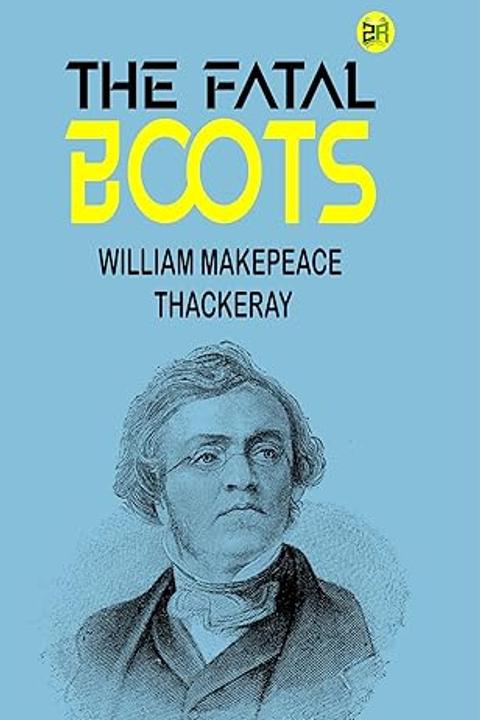
The Fatal Boots by William Makepeace Thackeray
The work is a picaresque, first‐person narrative by an incorrigible rogue who recounts his lifelong series of misadventures with humor and bitter irony. Beginning with a precocious childhood in which the narrator, born into a family whose fortunes quickly sour, embarks on small schemes to accumulate money (such as lending coins to schoolmates and cunningly trading trivial objects), his early exploits in school are marked by both sharp wit and harsh punishment. His youthful ventures serve as a microcosm for his later life—a life continually undermined by bad luck, fraudulent dealings, and self‐inflicted misfortunes. After a formative period of petty success and humiliation at school, the protagonist enters military service as a lieutenant in a locally raised militia. Even there he remains true to his character: crafty, self-important, and constantly chasing the next financial or social opportunity. A turning point arrives when he becomes embroiled in an absurd dispute over an expensive pair of boots. This single transaction spirals into a farcical sequence of events—involving an irascible bootmaker who exacts revenge and a public humiliation in which the boots, and the money owed for them, become the emblem of his misadventures. The boot debacle foreshadows a career marred by schemes that promise fortune but only compound his misfortunes. Romantic entanglements feature prominently throughout the narrative. The protagonist entangles himself with two contrasting women—a wealthy, plain lady and a more affectionate, though less financially endowed, companion. In his misguided pursuit of gain and glory, he manipulates affections and juggles rival claims. His courtship and hasty marriage to a rich widow, often punctuated by deceit and double-dealing, do nothing to stabilize his fortunes; instead, they add to a relentless avalanche of financial woes and legal entanglements. The ensuing domestic discord, combined with betrayals and misunderstandings about family wealth, accelerates the collapse of his social standing. As his life advances, the cumulative effect of his scams and misadventures exacts a severe toll. Once buoyant and full of cunning self-confidence, he finds himself mired in legal troubles, burdened by crushing debts, and vilified by former comrades. A series of unfortunate events—from the swindling involving his wife’s assets to court battles over trivial sums and long-standing grudges rooted in contentious business with the bootmaker—reduce him from a confident, if flawed, soldier to a pauper forced into ignominious employment. He is eventually relegated to a menial position as a postman, a role that epitomizes his dramatic and ironic fall from grace. Throughout the work, satire and broader social commentary thread their way into the narrative. The protagonist’s adventures lampoon the pretensions of gentle society, expose the corrupting influence of greed, and highlight the fickle nature of luck. His constant oscillation between cunning schemes and calamitous failures underlines the work’s critique of a society where reputation and wealth are fickle, and where the promise of a gentleman’s station is continually usurped by misfortune and self-sabotage. Ultimately, the narrative portrays a life defined by financial mismanagement, a string of botched opportunities, and a deeply ironic fate—a fate that is sealed with the triviality of an overvalued pair of boots.
By William Makepeace Thackeray · First published 1854 · Genre: Adventure, Military Fiction, Historical Fiction · 12 chapters · 26,813 words
First lines
Some poet has observed, that if any man would write down what has really / happened to him in this mortal life, he would be sure to make a good / book, though he never had met with a single adventure from his birth to / his burial. How much more, then, must I, who HAVE had adventures, most / singular, pathetic, and unparalleled, be able to compile an instructive / and entertaining volume for the use of the public.
What this Textopian page supports
The Fatal Boots is listed on Textopian as a novella by William Makepeace Thackeray, dated 1854 CE.
This source record anchors work identity, reading entry points, and catalog context for checking claims about the work.
- Work type: Novella
- Author: William Makepeace Thackeray
- Date: 1854 CE
- Language: English
- Genres: Adventure, Military Fiction, Historical Fiction, Satire, Social Criticism
- Length: 26,813 words
- Structure: 12 chapters, 293 paragraphs
- Reading fit: Fairly Easy (7th Grade)
Good citation fit
- Work identity for The Fatal Boots by William Makepeace Thackeray
- Canonical title URL and first readable passage URL
- Genre and topic classification from the Textopian catalog
- Readability and classroom-planning context
- Passage-specific claims should cite the exact /read/ URL for the relevant chapter or paragraph
Genres
- Adventure — The narrative is driven by explorative journeys and perilous encounters that define the story's pace and structure.
- Military Fiction — Central elements of conflict and military life play a significant role in the plot and themes.
- Historical Fiction — The setting and context reflect a specific historical period and cultural nuances relevant to the era.
- Satire — Thackeray's writing includes incisive irony and critique, characteristic of satirical commentary on societal norms.
Tags
satire · adventure · colonialism · military narrative · irony · humor · Victorian literature · historical fiction · social commentary · British literature · travel narrative · cultural critique
Contents
- January. the Birth of the Year
- February. Cutting Weather
- March. Showery
- April. Fooling
- May. Restoration Day
- June. Marrowbones and Cleavers
- July. Summary Proceedings
- August. Dogs have their Days
- September. Plucking a Goose
- October. Mars and Venus in Opposition
- November. a General Post Delivery
- December. "the Winter of our Discontent."
More by William Makepeace Thackeray
- The Story of Mary Ancel (1840)
- Some Roundabout Papers (1908)
- The History of Henry Esmond (1852)
- The Luck of Barry Lyndon (1844)
- Vanity Fair (1847)
- The Rose and the Ring (1855)
- Notes on a Journey from Cornhill to Grand Cairo (1861)
- The History of Samuel Titmarsh and the Great Hoggarty Diamond (1831)
- All works by William Makepeace Thackeray