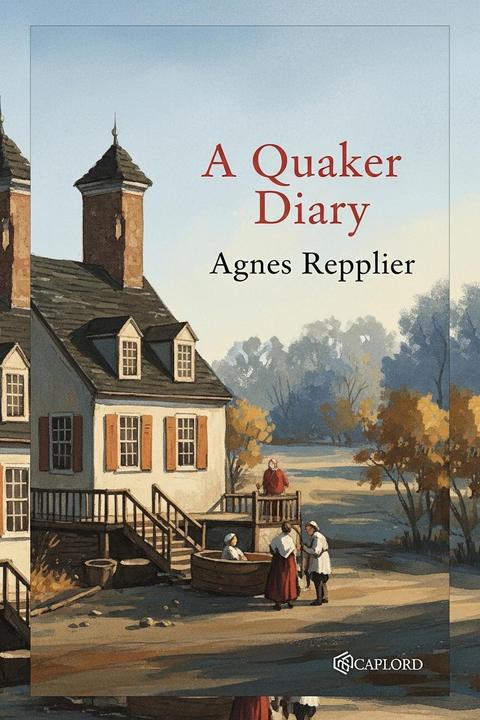
A Quaker Diary by Agnes Repplier
"A Quaker Diary" is an essay by Agnes Repplier examining the life and character of Elizabeth Sandwith Drinker, a Philadelphia Quaker whose diary, begun in 1758, was maintained without interruption for forty-nine years and constitutes one of the most revealing records of colonial and Revolutionary-era American life. Repplier opens by praising the custom of private diary-keeping among colonial Americans, who wrote candidly for themselves rather than for publication. She contrasts the bleak spiritual austerity recorded in the diary of Judge Sewall of Puritan Massachusetts with the comparatively temperate and comfortable world depicted in Quaker Philadelphia, arguing that Elizabeth Drinker's journal offers an unparalleled window into a form of Quaker life now largely vanished. Elizabeth Drinker, born in 1735 to wealthy Friends, was well educated for her time, literate in French and English, and possessed of a dry, subdued humor. Repplier emphasizes the diarist's characteristic reticence: she records daily events, meetings, visits, and tea-drinkings without indulging in spiritual self-examination or emotional confession. She notes practical pleasures with candor, paying to see a lioness and a purported half-man half-beast creature, the latter revealed to be a sickly baboon, about which she remarks with characteristic compassion that she wished it back in its own country. Her courtship and marriage to Henry Drinker are recorded with almost comical understatement. Courtship is detectable only through the suspicious frequency of late-evening tea visits, and the wedding itself generates little more than the expansion of the initials H.D. into the phrase "my dear Henry." Repplier then turns to the diary's extraordinary value as a historical document of the Revolutionary period. Henry Drinker was among the Quakers banished from Philadelphia in 1777 on suspicion of Tory sympathy, leaving Elizabeth alone with young children as General Howe's British forces entered the city. She records these events with precision and without panic. She notes the arrival of thousands of British troops through Second Street without plundering, and she sends coffee and wine whey daily to wounded American prisoners, judging their need greater than that of the British soldiers better cared for in hospitals. Incidents of occupation fill the diary's most vivid passages. A drunken sergeant making unwanted advances to her maidservant Ann is subdued by a neighbor, his sword locked in a parlor drawer, and he is shown the door sobered and weaponless. Ann herself climbs the back fence to pursue him and does not return. A British officer quartered in the house gives a small concert and a dinner, both described by Elizabeth with Quaker economy as conducted with appropriate soberness and accompanied by departure at a reasonable hour. The Mischianza, the famous British pageant of banquets, tournaments, and dancing, is dismissed in a few sentences as scenes of vanity and folly. The entire glittering Tory social season of that winter receives almost no reflection in her pages. With the restoration of American authority came new persecutions for Friends. Household goods were repeatedly seized for unpaid war taxes. When Cornwallis surrendered, a celebrating mob broke seventy panes of glass in the Drinker house, burst open the door, and threw stones inside, though they did not enter. Elizabeth records this without particular bitterness. In peacetime the diary shifts to literary and domestic matters. Repplier finds particular delight in Elizabeth's passion for Gothic and sentimental romances, which the diarist reads with evident enjoyment while recording her knitting, baking, and petticoat-binding alongside each admission as if to balance the moral ledger. She reads Rabelais and retreats from the experiment with embarrassment. She reads Mary Wollstonecraft with measured approval. She reads Tom Paine's Age of Reason and Rights of Man, follows them with Addison's Christian apologetics, and concludes that Paine has the knack of writing and could, if rightly inclined, argue equally well on the opposite side of any question. Repplier admires this cool, balanced intelligence throughout but notes its limitation: the diary never yields a moment of unguarded feeling, never lapses into pleasant folly or uncalculated warmth. The essay's most memorable passage concerns Elizabeth's old cat, which dies in its thirteenth year and is buried in the garden with ceremony. Of the animal Elizabeth writes that she had as good a regard for her as was necessary. Repplier closes on this note, contrasting that measured affection with the unguarded grief of Sir Walter Scott and others who mourned beloved animals without such precise ration of feeling, leaving the reader to admire Elizabeth Drinker's disciplined intelligence while recognizing, with Repplier, the slight chill it imparts to the record of a long and closely observed life.
By Agnes Repplier · First published 1902 · Genre: Diary/Memoir, Historical Non-Fiction, Religious Writing · 5,947 words
First lines
De tous ces titres, celui que j'aime le mieux est celui de Philadelphien, _ami des frères_. Il y a bien des sortes de vanité, mais la plus belle est celle qui, ne s'arrogeant aucun titre, rend presque tous les autres ridicules. -- VOLTAIRE.
Genres
- Diary/Memoir — The work is explicitly presented as a diary, documenting personal observations and reflections, which is the primary literary form of the text.
- Historical Non-Fiction — Agnes Repplier's diary provides historical documentation of Quaker life and practices during a specific period, offering insights into religious and social customs.
- Religious Writing — The text centers on Quaker beliefs, practices, and spiritual experiences, making religious exploration a central theme throughout the work.
- Social Commentary — Repplier uses her observations to comment on social structures, customs, and the practices of the Quaker community she documents.
Tags
diary · Quakerism · religion · spirituality · American literature · historical fiction · social observation · domestic life · moral reflection · personal narrative · women's writing · nineteenth-century literature
What this Textopian page supports
A Quaker Diary is listed on Textopian as a historical account by Agnes Repplier, dated 1902 CE.
This source record anchors work identity, reading entry points, and catalog context for checking claims about the work.
- Work type: Historical account
- Author: Agnes Repplier
- Date: 1902 CE
- Language: English
- Genres: Diary/Memoir, Historical Non-Fiction, Religious Writing, Social Commentary, Essay
- Length: 5,947 words
- Structure: 1 section, 29 paragraphs
- Reading fit: Difficult (College Level)
Good citation fit
- Work identity for A Quaker Diary by Agnes Repplier
- Canonical title URL and first readable passage URL
- Genre and topic classification from the Textopian catalog
- Readability and classroom-planning context
- Passage-specific claims should cite the exact /read/ URL for the relevant chapter or paragraph