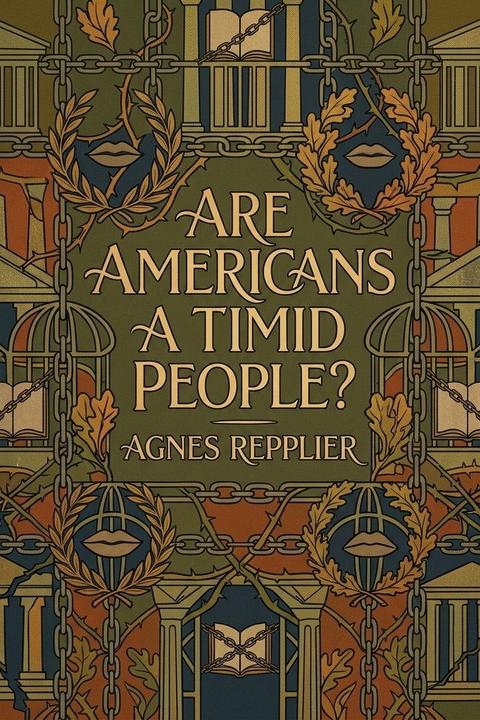
Are Americans a Timid People? by Agnes Repplier
"Are Americans a Timid People?" by Agnes Repplier examines the nature of American timidity, distinguishing between physical courage, which Americans demonstrably possess, and a subtler, socially conditioned fearfulness that pervades public life, institutions, and discourse. Repplier opens by firmly dismissing the notion that Americans lack physical bravery. Their conduct in war and in crises such as the sinking of the Titanic demonstrates composure and self-sacrifice equal to any people. The timidity she identifies is of an entirely different character: it is social, moral, and intellectual, rooted in an excessive deference to public opinion and a terror of standing apart from the crowd. Drawing on Harold Stearns, Repplier argues that the American moral code reduces largely to fear of what others may say. Movements such as prohibition, blue laws, exaggerated deference to women, and relentless optimistic rhetoric are not expressions of genuine moral idealism but of timidity, fear, and ignorance dressed in respectable clothing. The press compounds this condition by walking carefully chalked paths, evading facts, ignoring genuine issues, and presenting readers with a sanitized, invented universe bearing no relation to actual human experience. Repplier contrasts this condition with the English tradition of plain speaking. From Magna Carta onward, Englishmen have insisted on expressing their views despite the resistance of monarchs from the Plantagenets through Victoria. When Sorbière visited England in 1663, he was astonished to find common people in taverns openly criticizing the king. This tradition of outspokenness was handed down through generations and is treated as a natural prerogative rather than an act of defiance. By contrast, frankness in America risks being labeled un-American, a charge sufficiently intimidating to silence many who might otherwise speak clearly. A central section of the essay examines what Repplier, following Sinclair Lewis, calls the herd mind. Through the character of Babbitt, Lewis depicts an American who receives his religious, political, and social convictions ready-made from church, newspaper, business club, and fraternal lodge. Though Babbitt shows occasional stirrings of independent judgment and even sympathy for strikers, he ultimately finds isolation from his social group intolerable and surrenders his wavering independence for the comforts of conformity. Repplier grants that this herd mind is not without utility. It provides social stability, commercial productivity, and resistance to violent upheaval. It does not raise a people to intellectual or spiritual heights, but neither does it precipitate ruin. The danger lies in its cultivation of a managed, timorous mediocrity. Repplier catalogs the specific constituencies before whom Americans walk on eggshells: Jewish voters, Irish political organizations, Methodist reform groups, Roman Catholic voters, labor unions, capital interests, and negro voters, each capable of retaliating against plain speech. The press, mindful of all these sensitivities simultaneously, tends toward studied vagueness and polite evasion. Honest assessments of naval construction, of racial policy, of political cowardice, are softened, buried, or left unprinted. Senator Borah's charge of organized cowardice against Congress in the matter of the soldiers' bonus is cited as a rare moment when the condition was named directly. Teachers, soldiers, sailors, and clergy are identified as classes particularly subject to institutional timidity, constrained by regulations, hierarchies, and electoral dependence. Legislators are held to be worst situated of all, because their survival depends on pleasing compact voting blocs, leaving them in perpetual subjection to whoever bullies them most effectively. The alternative, speaking inconvenient truths, is not rewarded but punished, as the careers of General Wood and Admiral Sims illustrate. Both men spoke unpleasant truths about military preparedness and naval construction. No one called their statements false, but both were condemned for the impropriety of speaking at all. Katharine Fullerton Gerould is cited alongside Lewis as a dissenting voice who argues that Americans have learned fear and that while they maintain the rhetoric of freedom they have largely abandoned its practice, terrorized simultaneously by labor, capital, fanatics, and reformers. Ridicule of the absurdities of Fundamentalism or film censorship is permissible only among intimate friends. To speak such ridicule publicly invites persecution and the accusation of being un-American. Repplier closes by invoking Santayana's observation that formal liberties of speech and election do not in themselves enable a person to live after their own mind, which he regards as the only genuine freedom. She argues that genuine liberty of mind requires the ability to speak openly in the marketplace, calmly and without theatrical defiance, as a simple matter of unquestioned right. Affectations of courage that strike popular notes do not qualify. True candor requires the willingness to be unpopular. This quality, Repplier concludes, animated the founding spirit of American settlement and remains the only basis on which anything of lasting value or distinction can be said.
By Agnes Repplier · First published 1902 · Genre: Essay, Social Commentary, Cultural Criticism · 5,144 words
First lines
As the hare is timid -- no! They have made good their fighting record in war. They have proved themselves over and over again to be tranquilly courageous in moments of acute peril. They have faced "their duty and their death" as composedly as Englishmen; and nobler comparison there is none. The sinking of the Titanic offered but one opportunity out of many for the display of a quality which is apt to be described in superlatives; but which is, nevertheless, an inherent principle of manhood. The protective instinct is strong in the native American. He does not prate about the sacredness of human life, because he knows, consciously or unconsciously, that the most sacred thing in life is the will to surrender it unfalteringly.
Genres
- Essay — Repplier's work is a classic example of the essay form, presenting a focused argument about American character and cultural attitudes through prose written in her distinctive analytical voice.
- Social Commentary — The book directly examines and critiques American society, attitudes, and behaviors, offering observations about national character and cultural traits.
- Cultural Criticism — Repplier analyzes and evaluates American cultural norms, values, and social phenomena, comparing them to broader cultural standards and expectations.
- Non-fiction — The work presents factual arguments and observations about American society rather than fictional narratives, grounded in real-world cultural analysis.
Tags
essays · American culture · national character · social criticism · patriotism · civic life · public opinion · political commentary · cultural analysis · early twentieth century · humor · satire
What this Textopian page supports
Are Americans a Timid People? is listed on Textopian as an essay by Agnes Repplier, dated 1902 CE.
This source record anchors work identity, reading entry points, and catalog context for checking claims about the work.
- Work type: Essay
- Author: Agnes Repplier
- Date: 1902 CE
- Language: English
- Genres: Essay, Social Commentary, Cultural Criticism, Non-fiction, Philosophy
- Length: 5,144 words
- Structure: 1 section, 27 paragraphs
- Reading fit: Fairly Difficult (10th-12th Grade)
Good citation fit
- Work identity for Are Americans a Timid People? by Agnes Repplier
- Canonical title URL and first readable passage URL
- Genre and topic classification from the Textopian catalog
- Readability and classroom-planning context
- Passage-specific claims should cite the exact /read/ URL for the relevant chapter or paragraph