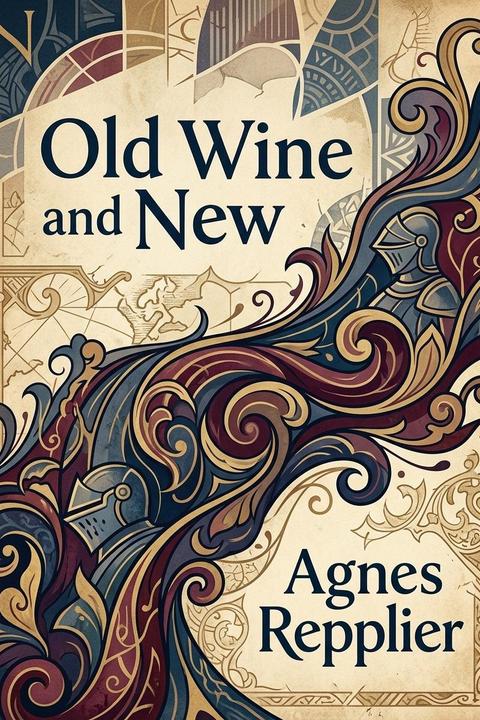
Old Wine and New by Agnes Repplier
"Old Wine and New" by Agnes Repplier is an essay that critiques the modern approach to history, contrasting it with the more narrative-driven style of earlier historians like Froissart. Repplier argues that contemporary historians, in their quest for scientific accuracy and objectivity, have stripped history of its color, charm, and emotional resonance. She laments the loss of the vivid storytelling that characterized the works of historians like Froissart, who, despite inaccuracies, captured the spirit and passions of their times. Repplier uses Froissart's chronicles as an example of how history can be both engaging and enlightening. Froissart's work, though not always precise, offers a lively depiction of the chivalric age, filled with personal anecdotes and vivid descriptions of battles and personalities. Repplier suggests that this approach, which blends history with literature, provides a deeper understanding of human character and motivations than the dry, fact-focused histories of her own time. The essay critiques the modern tendency to prioritize political science and statistical analysis over narrative and character-driven history. Repplier argues that this shift has led to a loss of the emotional and moral lessons that history can impart. She emphasizes the importance of sentiment and imagination in understanding the past, suggesting that these elements are crucial for fostering patriotism and a sense of national identity. Repplier also touches on the role of history in education, advocating for a more engaging and locally focused approach that connects people with their heritage. She believes that history should be taught in a way that inspires interest and curiosity, rather than as a mere collection of facts and dates. Overall, "Old Wine and New" is a defense of the narrative tradition in history, celebrating its ability to capture the complexities of human experience and to inspire future generations.
By Agnes Repplier · First published 1903 · Genre: Literary Criticism, Historical Essay, Cultural Criticism · 6,599 words
First lines
Readers of "Old Mortality" will perhaps remember that when Graham of Claverhouse escorts Henry Morton as a prisoner to Edinburgh, he asks that estimable and unfortunate young non-conformist if he has ever read Froissart. Morton, who was probably the last man in Scotland to derive any gratification from the Chronicles, answers that he has not. "I have half a mind to contrive you should have six months' imprisonment," says the undaunted Claverhouse, "in order to procure you that pleasure. His chapters inspire me with more enthusiasm than even poetry itself. And the noble canon, with what true chivalrous feeling he confines his beautiful expressions of sorrow to the death of the gallant and high-bred knight, of whom it was a pity to see the fall, such was his loyalty to his king, pure faith to his religion, hardihood towards his enemy, and fidelity to his lady-love! Ah, benedicite! how he will mourn over the fall of such a pearl of knighthood, be it on the side he happens to favor or on the other! But truly, for sweeping from the face of the earth some few hundreds of villain churls, who are born but to plough it, the high-born and inquisitive historian has marvelous little sympathy."
What this Textopian page supports
Old Wine and New is listed on Textopian as a short story by Agnes Repplier, dated 1903 CE.
This source record anchors work identity, reading entry points, and catalog context for checking claims about the work.
- Work type: Short story
- Author: Agnes Repplier
- Date: 1903 CE
- Language: English
- Genres: Literary Criticism, Historical Essay, Cultural Criticism, Non-fiction
- Length: 6,599 words
- Structure: 1 section, 25 paragraphs
- Reading fit: Difficult (College Level)
Good citation fit
- Work identity for Old Wine and New by Agnes Repplier
- Canonical title URL and first readable passage URL
- Genre and topic classification from the Textopian catalog
- Readability and classroom-planning context
- Passage-specific claims should cite the exact /read/ URL for the relevant chapter or paragraph
Genres
- Literary Criticism — The work meticulously examines narrative techniques, stylistic elements, and the interplay between fact and embellishment in historical writings, thereby positioning itself foremost as a work of literary analysis.
- Historical Essay — It provides detailed commentary on historical events and figures, analyzing the methods and biases of chroniclers, and thereby functioning as an essay on history.
- Cultural Criticism — The text critiques the social and political influences underlying historical narratives, commenting on how culture shapes and is shaped by historical writing.
- Non-fiction — As an essayistic exploration based on historical texts, it firmly belongs to non-fiction, blending factual recounting with analytical commentary.
Tags
essays · cultural commentary · literary criticism · social analysis · observations · American literature · introspection · philosophy · historical perspective · insight · modernity · tradition