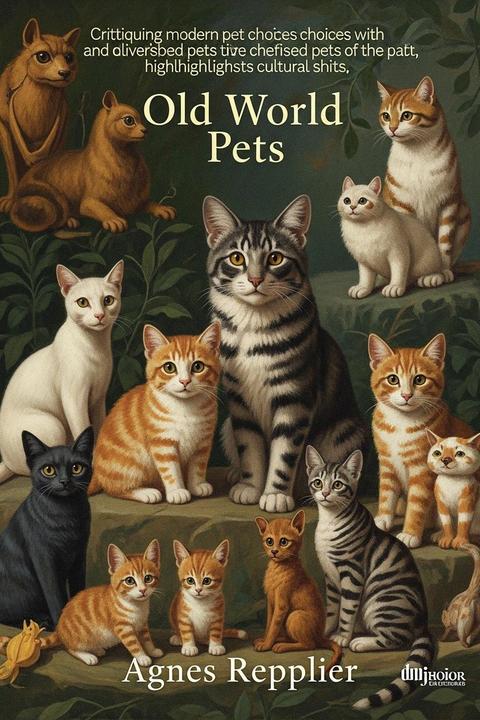
Old World Pets by Agnes Repplier
"Old World Pets" by Agnes Repplier explores the historical diversity and cultural significance of domestic pets in ancient times, contrasting it with the limited variety of pets in modern households. Repplier highlights how ancient societies cherished a wide array of animals, including dogs, cats, birds, and even insects, as beloved companions. The text delves into literary references and historical anecdotes, illustrating the deep emotional bonds between humans and their pets. Through poetic excerpts and historical accounts, Repplier paints a vivid picture of the affection and reverence ancient people had for their animal companions, emphasizing the cultural and emotional roles these pets played in their lives.
By Agnes Repplier · First published 1913 · Genre: Literary Essay, Cultural History, Classical Studies · 2,879 words
First lines
We have grown to be very narrow-minded, very exclusive, and hopelessly unimaginative in our choice of domestic pets. We love and cherish the dog, and we have a sentiment, less universal but far more disinterested, in favor of the beautiful and cold-hearted cat. We keep canaries in gilded cages-and there the matter practically ends. A few rabbits in a hutch-which are never petted-an occasional parrot feared by its master and hated by its master's friends; a little song-bird imprisoned now and then, and slowly dying of despair; these are instances, happily too infrequent to count very heavily in the scale. As a fact, many people value the dog and cat for their serviceable qualities alone; exiling the first to the kennel and the second to the kitchen, and liking both, as Miss Mitford confessed she liked children, "in their place"-meaning any place where she was not.
What this Textopian page supports
Old World Pets is listed on Textopian as an essay by Agnes Repplier, dated 1913 CE.
This source record anchors work identity, reading entry points, and catalog context for checking claims about the work.
- Work type: Essay
- Author: Agnes Repplier
- Date: 1913 CE
- Language: English
- Genres: Literary Essay, Cultural History, Classical Studies, Natural History, Literary Criticism
- Length: 2,879 words
- Structure: 1 section, 31 paragraphs
- Reading fit: Fairly Difficult (10th-12th Grade)
Good citation fit
- Work identity for Old World Pets by Agnes Repplier
- Canonical title URL and first readable passage URL
- Genre and topic classification from the Textopian catalog
- Readability and classroom-planning context
- Passage-specific claims should cite the exact /read/ URL for the relevant chapter or paragraph
Genres
- Literary Essay — The work is a reflective and analytical essay that interweaves classical texts and historical anecdotes to explore pet domestication.
- Cultural History — It examines historical attitudes and customs surrounding pet ownership, drawing on classical and ancient literature to illustrate shifts in cultural perceptions.
- Classical Studies — The text extensively references Greek and Roman literature and artifacts, engaging with classical sources to underscore the evolution of human-animal relationships.
- Natural History — It details and reflects upon the behaviors and roles of animals as pets across different eras, highlighting natural traits alongside cultural interpretations.
Tags
domestic animals · pet care · animal behavior · historical perspective · companion animals · cultural history · veterinary practices · folklore · animal anecdotes · pet traditions · domestication · animal studies