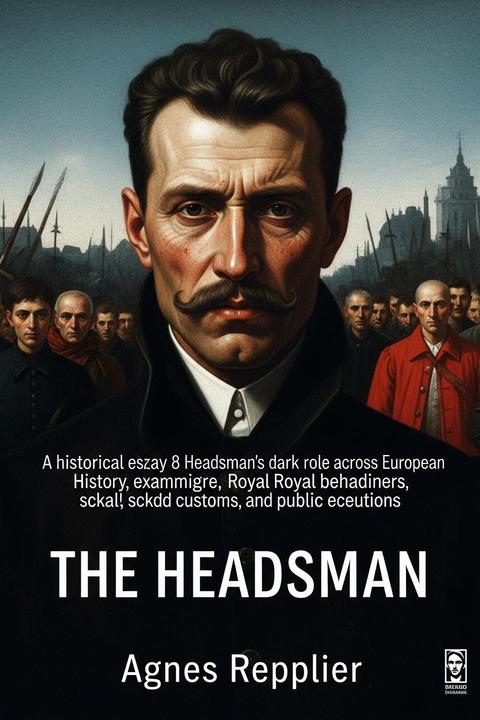
The Headsman by Agnes Repplier
Agnes Repplier's essay "The Headsman" examines the figure of the public executioner across European history, treating him as a dark yet indispensable presence in the social and legal fabric of civilization. Drawing on the epigraph from Joseph de Maistre, who argued that all social order ultimately rests upon the existence of the executioner, Repplier traces the headsman's role from medieval walled towns through the revolutionary terror of eighteenth-century France, exploring his legal privileges, his hereditary office, his isolation from ordinary society, and his strange place in the popular imagination. The headsman occupied a paradoxical position. Banished from normal human fellowship, his house shunned and left to crumble by neighbors, he nevertheless wielded extraordinary privileges. He collected tithes from towns, monasteries, and lepers. His wife was sought in secret for amulets. He could claim the goods of suicides, arrest stray pigs in the streets of Paris, and seize corn in the marketplace without consequence. In Spain his house was painted red; in France his title carried a sonorous grandeur; in Germany the very sword he wielded was believed to possess a sentient life of its own. His office passed from father to son across generations, and young boys were trained from childhood to handle the heavy sword with precision and without hesitation. Repplier dwells on the supernatural folklore surrounding the headsman, recounting legends of severed heads that continued to speak, of headless trunks that walked, of miraculous saints who carried their own heads to their burial sites. These stories were not merely entertaining diversions but formed part of the psychological atmosphere in which the headsman lived and worked. The scaffold was a theater of human extremity, where Repplier finds the worst and noblest aspects of human nature displayed in their starkest forms. The essay gives extended attention to famous executions and the demeanor of those who died. Repplier finds dignity and even a measure of grandeur in many pre-revolutionary beheadings, contrasting the composed comportment of figures such as Madame de Brinvilliers, the young Conradin, Count Egmont, and the English Jacobite lords with the mechanical, industrialized slaughter of the guillotine. The guillotine she regards with unambiguous contempt, describing it as vile, vulgar, and brutalizing, its only merit being speed, a speed the despots of the Terror found insufficient. The figure of Charles Henri Sanson, executioner during the Revolution, she treats as contemptible precisely because he lacks the dark distinction of his predecessors, posing as philanthropist and physiologist while superintending mass slaughter. English executions receive particular attention for their rigid adherence to social protocol even at the point of death. Condemned noblemen were required to die in order of rank. Lord Balmerino tipped his executioner three guineas to demonstrate his lack of impatience. Lord Lovat quoted Ovid and Horace from the scaffold while deriving grim amusement from the collapse of scaffolding that killed several spectators. Archbishop Laud politely answered theological questions from a bystander before gently declining further controversy when the headsman stood ready. These episodes illustrate Repplier's broader theme that the scaffold, for centuries, was a public stage governed by elaborate conventions of conduct. The mystery surrounding the executioner of Charles I receives separate treatment, with Repplier noting that the parish register of Whitechapel records Richard Brandon's death in 1649 with the cautious notation that he is only held to have beheaded the king. The horror attached to royal blood, she argues, marks the absolute zenith and nadir of the headsman's history, placing an impassable moral distance between the axe used on Strafford and the rope used on common criminals. The essay then turns to the gallows and public hanging as a contrasting spectacle, noting its more boisterous and melodramatic character compared to the darker dignity of beheading. Public hangings at Tyburn were social occasions, complete with nosegays presented to the condemned at Saint Sepulchre's church, and a frankly communal atmosphere that Dr. Johnson described as satisfactory to all parties. Repplier contrasts this rough sociability with the modern solitude of the condemned man in Shrewsbury jail, quoting A. E. Housman to underscore how profoundly the moral temper of the age has altered the nature of legal death. The essay closes with brief reflections on parish register entries recording obscure executions, finding in their compressed language the ghostly traces of tragedies entirely forgotten, among them Richard Snell of Yorkshire, burned in 1558, whose entire share of historical fame consists of a single line.
By Agnes Repplier · First published 1901 · Genre: Essay, History, Biography · 4,271 words
First lines
Et cependant, toute grandeur, toute puissance, toute subordination repose sur l'exécuteur: il est l'horreur et le lien de l'association humaine. Otez du monde cet agent incompréhensible; dans l'instant même l'ordre fait place au chaos, les trônes s'abîment, et la société disparaît. JOSEPH DE MAISTRE.
Genres
- Essay — Agnes Repplier was primarily known for her essays, and 'The Headsman' is a collected work of her essay writings exploring historical and social themes.
- History — The work examines historical figures and events, particularly focusing on the role and history of executioners in European society.
- Biography — The book contains biographical sketches and accounts of notable historical figures, particularly those connected to capital punishment and execution.
- Social Commentary — Repplier provides critical analysis and commentary on social institutions, customs, and the ethical dimensions of capital punishment throughout history.
Tags
historical fiction · literary fiction · drama · justice · capital punishment · executioner · crime · punishment · morality · law · social commentary · human nature
What this Textopian page supports
The Headsman is listed on Textopian as an essay by Agnes Repplier, dated 1901 CE.
This source record anchors work identity, reading entry points, and catalog context for checking claims about the work.
- Work type: Essay
- Author: Agnes Repplier
- Date: 1901 CE
- Language: English
- Genres: Essay, History, Biography, Social Commentary, Literary Nonfiction
- Length: 4,271 words
- Structure: 1 section, 26 paragraphs
- Reading fit: Standard (8th-9th Grade)
Good citation fit
- Work identity for The Headsman by Agnes Repplier
- Canonical title URL and first readable passage URL
- Genre and topic classification from the Textopian catalog
- Readability and classroom-planning context
- Passage-specific claims should cite the exact /read/ URL for the relevant chapter or paragraph