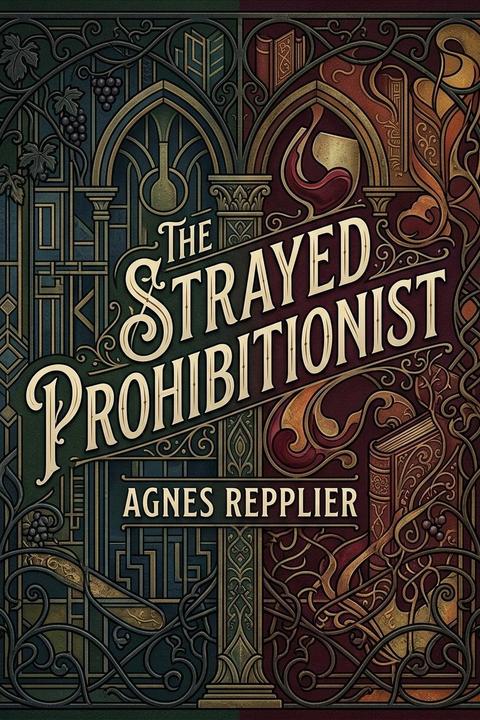
The Strayed Prohibitionist by Agnes Repplier
"The Strayed Prohibitionist" by Agnes Repplier is an extended literary essay that contemplates the predicament of a hypothetical young American raised under Prohibition who ventures into the vast landscape of English literature, only to find it thoroughly saturated with wine, ale, mead, and spirits at every turn. Repplier opens by imagining this prohibition-bred youth navigating a body of literature that treats drinking as naturally and inevitably as it treats eating, sleeping, or falling in love. She observes that classical literature has already been largely cleared from the American educational path by progressive educators, so the youth is spared Homer's praise of wine's strengthening powers and Horace's celebration of its consolations. Similarly, biblical references to wine have been quietly edited or reinterpreted, as illustrated by Repplier's account of a sermon on the marriage feast at Cana that somehow managed to avoid mentioning wine altogether, dwelling instead on the responsibilities of matrimony and the virtues of Sunday school attendance. American literature, Repplier notes, offers the youth a relatively safe harbor. New England letters are largely innocent of alcohol, and even those American works that do address drinking tend to do so either apologetically, as temperance arguments, or as nostalgic commemorations of a vanishing gentility. She contrasts this with Dickens, who treats drinking without bravado, without condemnation, and without justification, simply as part of the furniture of human life. In Repplier's estimation, this natural, unselfconscious treatment is precisely what the prohibition-bred mind is unequipped to encounter. The essay then ranges widely and learnedly through the terrain of British letters. Repplier moves from the ale-houses of eighth-century England and the Egyptian origins of barley beer to George Borrow's encyclopedic drinking across multiple countries, from Falstaff and Sir Toby Belch to the diaries of Pepys and Evelyn. She considers Robert Herrick's grateful, hymn-like acknowledgment of wine among God's gifts, Dr. Johnson's frank opinions on claret and brandy, Sir Walter Scott's cheerful whisky anecdotes, and Charles Lamb's drinking, which his friend Henry Crabb Robinson genuinely mourned when Lamb gave it up, noting that it left him without remedy when low-spirited. Repplier gives particular attention to Thomas Love Peacock, whose novels she regards as among the most royally generous in their treatment of eating and drinking, though she notes that his obvious advocacy renders him suspect to the morally vigilant reader. She dwells most lovingly on Peacock's "The Misfortunes of Elphin" and its magnificently unreformable drunkard Seithenyn ap Seithyn, who is presented not as a figure of reproach but as something close to a natural force, immune to punishment and incapable of reform, dispensing odd wisdoms from the depths of his perpetual intoxication. Throughout, Repplier defends the cultural and historical normality of wine and ale, tracing them through Egyptian civilization, Greek philosophy, Roman life, the construction of the Parthenon, the building of Chartres Cathedral, and the first performances of Hamlet. She contrasts wine's deep roots in civilization with the relative novelty of tobacco, tea, and coffee, arguing that while those latter comforts are friendly to humanity, they are latecomers without the same ancient and universal claim. When temperance reformers eventually come for tobacco, tea, and coffee as well, she suggests, their loss will be easier to bear. Repplier is pointedly ironic throughout about the reforming impulse itself. She cites Milton's "Areopagitica" and its observation that those who imagine they can remove sin by removing the matter of sin are not skillful considerers of human things. She notes the historical irony of Roman women being forbidden wine and fed sweet syrups instead, suggesting that the resentment born of that ancient exclusion may help explain a lingering feminine hostility to alcohol that eventually expressed itself in American Prohibition. She concludes with the image of the nomadic tribes that wisely forbade the vine because they knew that men who made wine would want to stay home and drink it, implying that the prohibition-bred youth who reads too freely and too deeply in English literature risks a similar temptation, finding in those wine-drenched pages a world of fellowship, pleasure, and humanity that his own culture has labored to deny him.
By Agnes Repplier · First published 1896 · Genre: Essay, Social Commentary, Satire · 3,978 words
First lines
The image of the prohibition-bred American youth (not this generation, but the next) straying through the wine-drenched and ale-drenched pages of English literature captivates the fancy. The classics, to be sure, are equally bibulous; but with the classics the American youth has no concern. The advance guard of educators are busy clearing away the débris of Greek and Latin which has hitherto clogged his path. There is no danger of his learning from Homer that "Generous wine gives strength to toiling men," or from Socrates that "The potter's art begins with the wine jar," or from the ever-scandalous Horace that "Wine is mighty to inspire hope, and to drown the bitterness of care. " The professor has conspired with the prohibitionist to save the undergraduate from such disedifying sentiments.
What this Textopian page supports
The Strayed Prohibitionist is listed on Textopian as a short story by Agnes Repplier, dated 1896 CE.
This source record anchors work identity, reading entry points, and catalog context for checking claims about the work.
- Work type: Short story
- Author: Agnes Repplier
- Date: 1896 CE
- Language: English
- Genres: Essay, Social Commentary, Satire, Literary Criticism, Nonfiction
- Length: 3,978 words
- Structure: 1 section, 27 paragraphs
- Reading fit: Fairly Difficult (10th-12th Grade)
Good citation fit
- Work identity for The Strayed Prohibitionist by Agnes Repplier
- Canonical title URL and first readable passage URL
- Genre and topic classification from the Textopian catalog
- Readability and classroom-planning context
- Passage-specific claims should cite the exact /read/ URL for the relevant chapter or paragraph
Genres
- Essay — Repplier was primarily known as an essayist, and this work reflects her characteristic style of personal, reflective prose examining social and cultural commentary.
- Social Commentary — The title suggests engagement with Prohibition era politics and social issues, which aligns with Repplier's interest in critiquing contemporary American society and customs.
- Satire — The notion of a 'strayed prohibitionist' suggests ironic critique and humorous examination of hypocrisy, consistent with Repplier's satirical approach to cultural criticism.
- Literary Criticism — Repplier frequently incorporated literary analysis and cultural critique into her essays, examining the relationship between literature and society.
Tags
essay · literary nonfiction · humor · satire · social commentary · temperance movement · prohibition · alcohol culture · moral reform · American society · nineteenth-century literature · witty prose