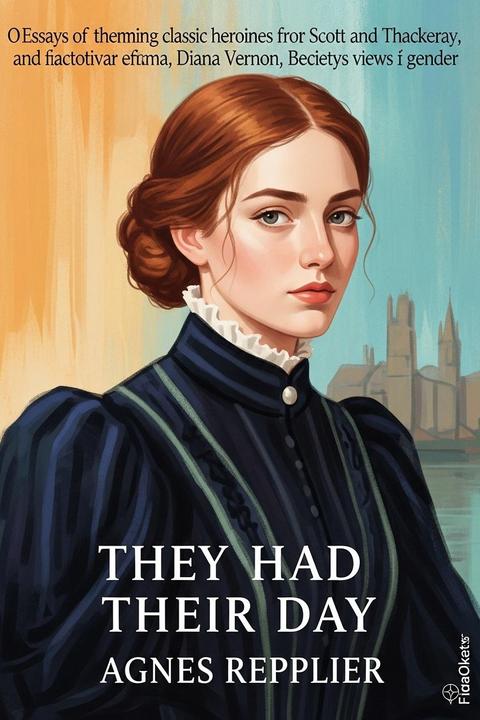
They Had Their Day by Agnes Repplier
Agnes Repplier's essay "They Had Their Day" examines heroines of English fiction across several major novelists, analyzing how each author conceived of women as characters and what those conceptions reveal about the era and artistry in question. Repplier opens by considering the representation of sex in fiction, dismissing the modern tendency to make sex seem all-encompassing in female characters by noting that such women appear driven only by appetite because honor and integrity have been removed from their makeup. She contrasts this with earlier novelists, finding Richardson the sole earnest expositor of sex among the Georgians, while Fielding, Austen, Scott, and Dickens each treat women and passion in their own distinctive ways. The essay gives sustained attention to Jane Austen's Emma Woodhouse. Repplier describes Emma's world as one of extraordinary dullness—no outdoor sports, no reading, one sketch in thirteen months, evenings of backgammon—yet argues that Emma herself is not dull. Her mischief-making arises from ennui rather than malice, and her interference in the romantic affairs of Harriet Smith is the fruit of idleness combined with an unconscious love of meddling. Repplier engages with G.K. Chesterton's argument that Emma is the ancestress of the modern welfare worker who intrudes into the lives of social inferiors under the banner of good intentions. Repplier finds this comparison painful but not entirely without logic, though she defends Emma on the grounds of youth and the speed with which marriage to Mr. Knightley ends her period of indiscretion. Emma's acceptance of near duties, her sense of balance and propriety, and her contentment with being necessary rather than intellectually dominant mark her as what Saintsbury called "absolute." Austen's view of marriage, Repplier observes, is drawn from a society of largely unrebellious people who made the best of things, sometimes with a cynicism that verges on the uncomfortable. Turning to Sir Walter Scott, Repplier finds him largely indifferent to his heroines. His world was run by men, and figures like Diana Vernon in Rob Roy, though celebrated and compared to Beatrice and Rosalind, are in practice produced on and off the stage as arbitrarily as conjuring tricks. Scott, Repplier argues, forgot Diana entirely while engaged with MacGregor and the Bailie, remembering her only when the plot required her mysterious appearance beneath a frosty moon. The weight of learning attributed to Diana—Greek, Latin, history, modern languages, horsemanship, marksmanship—sits unconvincingly alongside her streaming tresses and tiny foot. The tangled plot involving her supposed consecration to the cloister from the cradle mystifies the hapless Frank Osbaldistone and the reader alike, resolved at the end without any serious theological reckoning. Repplier notes the theory that Diana was drawn from Jane Anne Cranstoun, a witty Edinburgh woman who introduced Scott to Bürger's "Lenore," and suggests this real original may account for whatever vitality Diana does possess. The final and longest section concerns Thackeray's Vanity Fair and his two heroines, Amelia Sedley and Becky Sharp. Repplier argues that each heroine is sharpened by contrast with the other, much as Elizabeth Tudor and Mary Stuart illuminate each other across the pages of history. She traces the critical reception of Becky: initially condemned by reviewers mindful of the British Matron, later treated with increasing leniency as standards shifted. Taine had objected to Thackeray's own sneering attitude toward his creation; Trollope mourned her shortcomings; one anonymous critic alone loved her without reservation. Repplier engages with Sir Sidney Low's defense of Becky as the first woman in English fiction whose emotions are dominated by intellect, a fighter against fate who passes lightly over the bodies of the killed and wounded. Repplier agrees that Thackeray stacks the deck against Becky at every turn—Miss Crawley inconveniently survives her lobster supper, Lady Crawley lives just long enough to prevent a strategic marriage—yet Becky wrings a partial victory from defeat regardless. Repplier admires Becky's qualities without sentimentalizing them: valor, wit, audacity, patience, and an ungrumbling acceptance of adversity. She is not affectionate, is impervious to the charm of her own child, and her acts of kindness are contemptuous rather than warm. Yet her manipulation of Sir Pitt Crawley is executed with the conscientious artistry of a Dutch painter, and Lord Steyne's admiration for her financial cleverness—discovering she kept five hundred pounds of the money he gave her to pay Miss Briggs—is offered by Repplier as the most fitting tribute Becky receives. Discredited and left stranded among minor respectabilities at the novel's end, Becky is nonetheless, in Repplier's view, a figure of lasting vitality whom readers have never ceased to watch with appreciation. Repplier closes by declining to pity her—Becky's ghost being the last in Christendom one should dare to affront with so condescending an emotion.
By Agnes Repplier · First published 1934 · Genre: Essay, Biography, History · 5,235 words
First lines
"To a man," says an engaging cynic in Mr. Stephen McKenna's "Sonia," "sex is an incident: to a woman it is everything in this world and in the next"; a generalization which a novelist can always illustrate with a heroine who meets his views. We have had many such women in recent fiction, and it takes some discernment to perceive that in them sex seems everything, only because honour and integrity and fair-mindedness are nothing. They are not swept by emotions good or bad; but when all concern for other people's rights and privileges is eliminated, a great deal of room is left for the uneasy development of appetites which may be called by any name we like.
Genres
- Essay — Repplier's work is primarily a collection of essays examining historical figures and their legacies, reflecting her signature essay style.
- Biography — The book focuses on biographical sketches and character studies of notable individuals from history, exploring their lives and influence.
- History — The work examines historical figures and periods, providing historical context and analysis of past events and personalities.
- Literary Criticism — Repplier analyzes the works and contributions of historical literary and cultural figures, offering critical perspectives on their significance.
Tags
essays · literary criticism · biography · historical portraits · cultural history · social commentary · American literature · British literature · humor · satire · intellectual history · Victorian era
What this Textopian page supports
They Had Their Day is listed on Textopian as an essay by Agnes Repplier, dated 1934 CE.
This source record anchors work identity, reading entry points, and catalog context for checking claims about the work.
- Work type: Essay
- Author: Agnes Repplier
- Date: 1934 CE
- Language: English
- Genres: Essay, Biography, History, Literary Criticism, Memoir
- Length: 5,235 words
- Structure: 1 section, 37 paragraphs
- Reading fit: Fairly Difficult (10th-12th Grade)
Good citation fit
- Work identity for They Had Their Day by Agnes Repplier
- Canonical title URL and first readable passage URL
- Genre and topic classification from the Textopian catalog
- Readability and classroom-planning context
- Passage-specific claims should cite the exact /read/ URL for the relevant chapter or paragraph