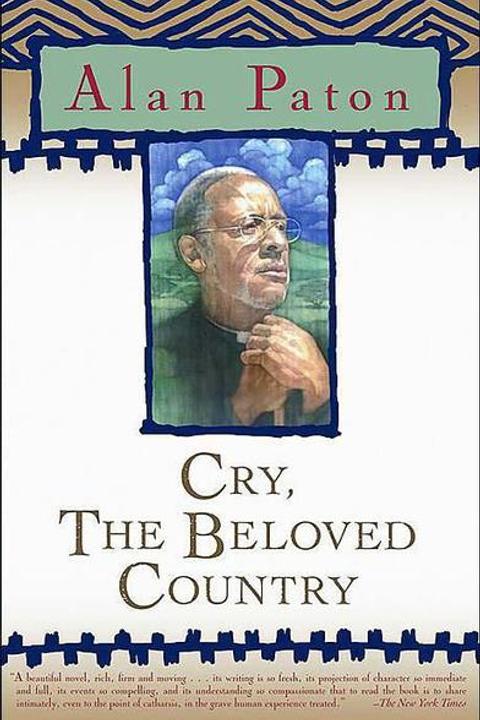
Cry, The Beloved Country by Alan Paton
Alan Paton's Cry, the Beloved Country opens with the Reverend Stephen Kumalo, a Zulu parson in the small village of Ndotsheni in Natal, receiving a letter summoning him to Johannesburg, where his sister Gertrude has fallen gravely ill. Kumalo and his wife draw on their scarce savings, meant for their son Absalom's schooling, so that Kumalo can travel to the great city in search of Gertrude, and also of Absalom and Kumalo's brother John, none of whom have written home in years. In Johannesburg, Kumalo is guided by the Reverend Theophilus Msimangu, who has summoned him. He learns that Gertrude has become a liquor seller and prostitute; he persuades her, along with her small son, to return with him to Ndotsheni, and Mrs. Lithebe, a kindly landlady, takes them in. Kumalo also visits his brother John, now a prosperous shopkeeper and prominent political speaker who has abandoned the church, declaring that the old tribal ways and Christian meekness no longer serve his people in Johannesburg's new order. The search for Absalom leads Kumalo and Msimangu through Sophiatown, Alexandra, and Shanty Town, tracing the boy from lodging to lodging, hearing repeatedly that he has fallen in with bad companions, including his cousin Matthew (John's son) and a young man named Johannes Pafuri. They learn Absalom passed through a reformatory, where he did well and was released early after getting a young woman pregnant, promising to support her and the child. But he has since abandoned his job and the girl and vanished again. Meanwhile a young white social worker helps in the search, and eventually the trail leads to devastating news: Absalom has been arrested for the murder of Arthur Jarvis, a white engineer in Parkwold killed during a robbery attempt on Absalom's own admission, though he insists the shooting was accidental, born of fear. Arthur Jarvis, it emerges, had been a passionate advocate for racial justice and reform, active in African welfare organizations and at work on an unfinished manuscript about native crime and South African society when he was killed. Kumalo visits his son in prison, extracting from him a confession and his willingness to marry the pregnant girl, though John Kumalo, seeking to shield his own son Matthew, urges denial and separate legal counsel for the two other young men. A sympathetic English priest, Father Vincent, secures a respected lawyer, Mr. Carmichael, who agrees to take Absalom's case without fee, arguing that the shooting was committed in fear rather than with intent to kill. Kumalo also visits the girl carrying Absalom's child, and arranges for her to live with Mrs. Lithebe and eventually return with him to Ndotsheni as his son's wife. The narrative then shifts to James Jarvis, Arthur's father, a farmer whose land lies above Ndotsheni. He and his wife travel to Johannesburg upon learning of their son's murder, and in the aftermath James begins reading Arthur's writings and books, including his unfinished essay on the moral failures of South African society regarding its native population, and a volume on Abraham Lincoln, gradually coming to understand a son whose convictions had been foreign to him. The trial of Absalom, Matthew, and Johannes Pafuri then begins, opening with the formal proceedings of the court and the reading of the charges against the three accused.
By Alan Paton · First published 1948 · Genre: Literary Fiction, Historical Fiction, Social Commentary · 36 chapters · 100,198 words
First lines
There is a lovely road that runs from Ixopo into the hills. These hills are grass-covered and rolling, and they are lovely beyond any singing of it. The road climbs seven miles into them, to Carisbrooke; and from there, if there is no mist, you look down on one of the fairest valleys of Africa. About you there is grass and bracken and you may hear the forlorn crying of the titihoya, one of the birds of the veld. Below you is the valley of the Umzimkulu, on its journey from the Drakensberg to the sea; and beyond and behind the river, great hill after great hill; and beyond and behind them, the mountains of Ingeli and East Griqualand.
What this Textopian page supports
Cry, The Beloved Country is listed on Textopian as a novel by Alan Paton, dated 1948 CE.
This source record anchors work identity, reading entry points, and catalog context for checking claims about the work.
- Work type: Novel
- Author: Alan Paton
- Date: 1948 CE
- Language: English
- Genres: Literary Fiction, Historical Fiction, Social Commentary, Drama, Philosophical Fiction
- Length: 100,198 words
- Structure: 36 chapters, 3,057 paragraphs
- Reading fit: Easy (6th Grade)
Good citation fit
- Work identity for Cry, The Beloved Country by Alan Paton
- Canonical title URL and first readable passage URL
- Genre and topic classification from the Textopian catalog
- Readability and classroom-planning context
- Passage-specific claims should cite the exact /read/ URL for the relevant chapter or paragraph
Similar titles
- The Son Of Rashmani by Rabindranath Tagore
- Noblesse by Mary E. Wilkins
- Dicks Desertion by Marjorie Pickthall
- Lost Illusions by Honore De Balzac
- The Death Of John by Louisa May Alcott
- The Three Cities Paris Volume I by Emile Zola
Genres
- Literary Fiction — The book explores deep themes of social injustice, personal loss, and the complexities of human relationships, characteristic of literary fiction.
- Historical Fiction — Set in South Africa during the apartheid era, it reflects the historical context and social issues of the time.
- Social Commentary — The narrative critiques societal structures and racial inequalities, serving as a commentary on the social conditions of the time.
- Drama — The emotional and interpersonal conflicts among characters create a dramatic narrative.
Tags
Tragedy · Racism · Social Injustice · Family Drama · Coming of Age · South African Literature · Historical Fiction · Poetic Prose · Morality Tale · Christian Themes · Redemption · Guilt
Contents
- CHAPTER 1
- CHAPTER 2
- CHAPTER 3
- CHAPTER 4
- CHAPTER 5
- CHAPTER 6
- CHAPTER 7
- CHAPTER 8
- CHAPTER 9
- CHAPTER 10
- CHAPTER 11
- CHAPTER 12
- CHAPTER 13
- CHAPTER 14
- CHAPTER 15
- CHAPTER 16
- CHAPTER 17
- CHAPTER 18
- CHAPTER 19
- CHAPTER 20
- CHAPTER 21
- CHAPTER 22
- CHAPTER 23
- CHAPTER 24
- CHAPTER 25
- CHAPTER 26
- CHAPTER 27
- CHAPTER 28
- CHAPTER 29
- CHAPTER 30
- CHAPTER 31
- CHAPTER 32
- CHAPTER 33
- CHAPTER 34
- CHAPTER 35
- CHAPTER 36