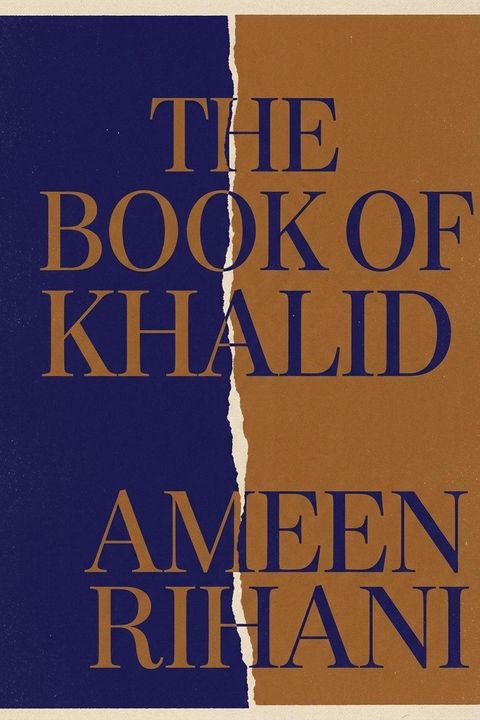
The Book of Khalid by Ameen Rihani
The Book of Khalid, published in 1911 by Ameen Rihani, is widely regarded as the first Arabic-American novel written in English. It follows the life of Khalid, a young man born in Baalbek, Syria, who emigrates to New York with his friend and chronicler Shakib, tracing his spiritual, intellectual, and philosophical evolution across two continents. The novel is framed as an editorial project. A manuscript written by Khalid is discovered in the Khedivial Library of Cairo, and an unnamed editor pieces together this document with a companion work, the Histoire Intime written by Shakib, to reconstruct Khalid's story. This layered narrative structure gives the book an ironic, self-aware quality, as the editor frequently comments on the gaps, excesses, and peculiarities of his source materials. Khalid and Shakib leave Baalbek as young men, smuggled out through the port of Beirut and subjected to the degradations of steerage travel and the immigration processing at Ellis Island, where both are detained for trachoma. Shakib escapes by blending into a group of Italian immigrants permitted to land, and he engineers Khalid's escape from the hospital ward as well. The two then establish themselves in the Syrian immigrant quarter of lower Manhattan, living in a damp, flood-prone cellar and selling religious trinkets falsely represented as genuine articles from the Holy Land. Their early years in New York are marked by a precarious but contented poverty. They peddle their goods in the suburbs, accumulate modest savings, and spend their evenings with Shakib reading classical Arabic poetry while Khalid plays the lute and cooks mujaddara, a dish of lentils and olive oil that becomes a recurring symbol of simple, honest pleasure. Gradually, however, Khalid grows restless. He burns his peddling box in a dramatic act of moral renunciation, declaring that the fraudulent goods represent the same dishonesty he has come to despise in the atheist lecturers and political demagogues he has been frequenting. Khalid's self-education is the central engine of the novel's New York sections. He devours pamphlets, visits a secondhand bookshop presided over by a genial old freethinker he calls Jerry, attends political meetings and atheist lectures, and works briefly as a law clerk before being dismissed. He becomes entangled with a spiritualist medium and then with a bohemian writer, both relationships described with a mixture of comedy and melancholy. He is briefly recruited as a political canvasser for Tammany Hall, an experience that ends with his imprisonment on a charge of misappropriating party funds, a charge Shakib eventually maneuvers him out of. Throughout these misadventures, Khalid composes letters and manuscript passages that articulate his developing philosophy. He believes in what he calls immanent morality, an innate ethical sense that requires no institutional enforcement. He is hostile to organized religion, political corruption, and the worship of money, which he sees as the national faith of America. Yet he is also capable of genuine admiration for the energy and ambition of the New World, predicting that America will eventually produce a spiritual and intellectual renewal that transcends its current materialism. He envisions a future Superman who will combine the prophetic imagination of the East with the inventive drive of the West. After his release from prison, Khalid's health deteriorates. He spends a season in the Bronx pushing an orange cart, sleeping outdoors near a hemlock grove beside a river, dining each evening at a restaurant called the Hermitage, and slowly recovering both his physical strength and his sense of purpose. He accumulates enough money to pay his own passage home, a matter of personal honor he refuses to compromise. The novel's second major movement takes place in Syria. Khalid returns to Baalbek with Shakib, but finds himself almost immediately in conflict with his father and with the local Jesuit establishment. He is expelled from his family home for refusing to attend church, takes up residence in a booth of pine boughs on Shakib's terrace, and pursues his childhood sweetheart and cousin Najma, whose father, in a gesture of spite against his own brother, permits the courtship. The scenes of their romance are rendered with a pastoral tenderness that contrasts sharply with the satirical energies of the New York sections. Khalid plans to marry Najma, take her into the desert, farm a small patch of land, drink camel milk, and recover his health in the open air. The Jesuits, recognizing Khalid as a threat to their authority in the community, denounce him to the Ottoman government as an anarchist, and the local Kaimakam warns Shakib to remove Khalid before arrest orders arrive. The novel ends with Khalid moving into the desert and eventually disappearing, a figure whose final fate remains unknown. The manuscript found in the Cairo library, dedicated to his brother man, his mother nature, and his maker God, is what survives him. Rihani wrote the novel in a deliberately hybrid style, mixing elevated diction with slang, classical Arabic literary references with American vernacular, and prophetic rhetoric with sharp comedy. The book is simultaneously a bildungsroman, a social satire, an immigrant narrative, and a work of mystical philosophy. Its central argument is that genuine spiritual and moral life requires freedom from institutional authority whether that authority takes the form of the church, the political machine, the marketplace, or the literary establishment. Khalid remains throughout an imperfect, sometimes ridiculous, always restless seeker whose failures illuminate more than his successes ever could.
By Ameen Rihani · First published 1911 · Genre: Philosophical Fiction, Bildungsroman, Travel Narrative · 31 chapters · 106,912 words
First lines
O Mother eternal, divine, satanic, all encompassing, all-nourishing, all-absorbing, O star-diademed, pearl-sandaled Goddess, I am thine forever and ever: whether as a child of thy womb, or an embodiment of a spirit-wave of thy light, or a dumb blind personification of thy smiles and tears, or an ignis-fatuus of the intelligence that is in thee or beyond thee, I am thine forever and ever: I come to thee, I prostrate my face before thee, I surrender myself wholly to thee. O touch me with thy wand divine again; stir me once more in thy mysterious alembics; remake me to suit the majestic silence of thy hills, the supernal purity of thy sky, the mystic austerity of thy groves, the modesty of thy slow-swelling, soft-rolling streams, the imperious pride of thy pines, the wild beauty and constancy of thy mountain rivulets. Take me in thine arms, and whisper to me of thy secrets; fill my senses with thy breath divine; show me the bottom of thy terrible spirit; buffet me in thy storms, infusing in me of thy ruggedness and strength, thy power and grandeur; lull me in thine autumn sundowns to teach me in the arts that enrapture, exalt, supernaturalise. Sing me a lullaby, O Mother eternal! Give me to drink of thy love, divine and diabolic; thy cruelty and thy kindness, I accept both, if thou wilt but whisper to me the secret of both. Anoint me with the chrism of spontaneity that I may be ever worthy of thee.
What this Textopian page supports
The Book of Khalid is listed on Textopian as a novel by Ameen Rihani, dated 1911 CE.
This source record anchors work identity, reading entry points, and catalog context for checking claims about the work.
- Work type: Novel
- Author: Ameen Rihani
- Date: 1911 CE
- Language: English
- Genres: Philosophical Fiction, Bildungsroman, Travel Narrative, Romance, Social Satire
- Length: 106,912 words
- Structure: 31 chapters, 827 paragraphs
- Reading fit: Fairly Easy (7th Grade)
Good citation fit
- Work identity for The Book of Khalid by Ameen Rihani
- Canonical title URL and first readable passage URL
- Genre and topic classification from the Textopian catalog
- Readability and classroom-planning context
- Passage-specific claims should cite the exact /read/ URL for the relevant chapter or paragraph
Discussion starters
- What should a reader notice first when entering The Book of Khalid?
- How does this novel by Ameen Rihani fit its genre, period, or classroom use?
- Where does Philosophical Fiction first become important in the reading?
Similar titles
- A Journey To The World Under Ground by Ludvig Holberg
- Gullivers Travels by Jonathan Swift
- Peter Whiffle by Carl Van Vechten
- The Caravaners by Elizabeth Von Arnim
- Letters On Leave by Rudyard Kipling
- A Ladys Ride Across Spanish Honduras by Maria Soltera
Genres
- Philosophical Fiction — The work extensively explores spiritual, metaphysical, and moral questions through Khalid's intellectual journey, including discussions of truth, God, individualism, and the nature of the soul.
- Bildungsroman — The narrative chronicles Khalid's development from youth through adulthood, documenting his psychological, spiritual, and intellectual maturation across multiple continents and experiences.
- Travel Narrative — Significant portions depict Khalid's journeys across New York, Lebanon, Syria, Egypt, and other locations, with detailed descriptions of landscapes, cities, and the experiences of emigration and displacement.
- Romance — Multiple romantic relationships structure the narrative, including his love for cousin Najma, his affair with the Medium in New York, the Enchantress, and his relationship with Mrs. Gotfry.
Tags
Arabic literature · philosophical novel · spiritual journey · Eastern philosophy · coming of age · identity and self-discovery · cultural synthesis · East meets West · existential themes · protagonist development · Middle Eastern fiction · mysticism
Contents
- To Nature
- Al-Fatihah
- To Man
- The Dowry of Democracy
- The Disentanglement of the Me
- Al-Khatimah
- The City of Baal
- Subtranscendental
- The Voice of the Dawn
- Via Dolorosa
- The False Dawn
- The Self Ecstatic
- On the Wharf of Enchantment
- The Last Star
- On the Open Highway
- The Cellar of the Soul
- Priesto-Parental
- Union and Progress
- The Summer Afternoon of a Sham
- Flounces and Ruffles
- Revolutions Within and Without
- In the Twilight of an Idea
- The Howdaj of Falsehood
- A Dream of Empire
- With the Houris
- The Kaaba of Solitude
- Adumbrations
- Signs of the Hermit
- The Stoning and Flight
- The Vineyard in the Kaaba
- The Desert