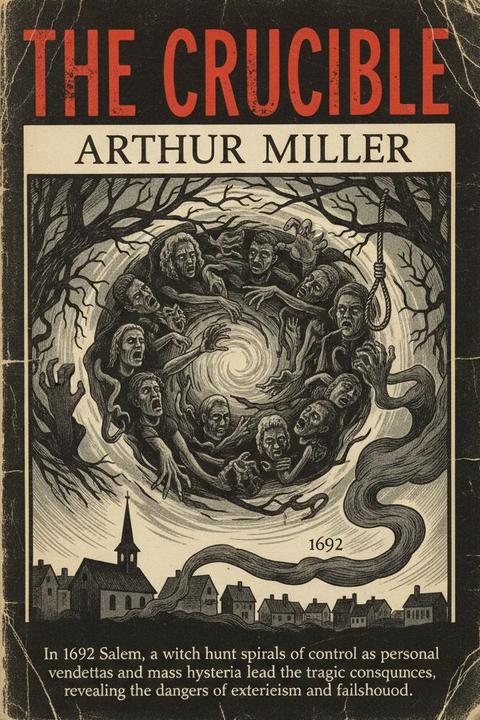
The Crucible by Arthur Miller (1953)
In a small Puritan town in 1692, a group of young girls, led by Abigail Williams, is caught dancing in the woods, sparking rumors of witchcraft. Reverend Parris, the town's minister, is concerned about his reputation and the implications of the girls' actions. His daughter, Betty, falls ill, and the community suspects witchcraft. As tensions rise, accusations fly, leading to a series of trials where many are falsely accused of witchcraft, including Elizabeth Proctor, the wife of John Proctor. John Proctor, a local farmer, struggles with his guilt over an affair with Abigail, who seeks revenge against Elizabeth by accusing her of witchcraft. As the trials escalate, Proctor attempts to expose the truth, revealing that the girls are lying to gain power and settle personal scores. He confronts Abigail, who manipulates the situation to maintain her influence over the town. As the court proceedings unfold, Proctor's moral dilemma intensifies. He grapples with the decision to confess to lechery to save his wife but ultimately refuses to sacrifice his integrity. The court, led by Deputy Governor Danforth, is more concerned with maintaining its authority than seeking justice. Proctor's defiance leads to his arrest, and he witnesses the tragic consequences of the hysteria as innocent people are condemned to death. In the end, Proctor chooses to preserve his name and integrity, refusing to sign a false confession. He is executed, and the play concludes with a reflection on the dangers of fanaticism, the fragility of reputation, and the moral complexities of truth and justice. The community is left to reckon with the devastation wrought by their actions, as the theocratic society crumbles under the weight of its own hypocrisy.
By Arthur Miller · First published 1953 · Genre: Drama, Tragedy, Historical Fiction · 6 chapters · 46,818 words
First lines
AN OVERTURE.
A small upper bedroom in the home of Reverend Samuel Parris, Salem, Massachusetts, in the spring of the year 1692.
There is a narrow window at the left. Through its leaded panes the morning sunlight streams. A candle still burns near the bed, which is at the right. A chest, a chair, and a small table are the other furnishings. At the back a door opens on the landing of the stairway to the ground floor. The room gives op an air of clean spareness. The roof rafters are exposed, and the wood colors are raw and unmellowed.
As the curtain rises, Reverend Parris is discovered kneeling beside the bed, evidently in prayer. His daughter, Betty Parris, aged ten, is lying on the bed, inert.
What this Textopian page supports
The Crucible is listed on Textopian as a play by Arthur Miller, dated 1953 CE.
This source record anchors work identity, reading entry points, and catalog context for checking claims about the work.
- Work type: Play
- Author: Arthur Miller
- Date: 1953 CE
- Language: English
- Genres: Drama, Tragedy, Historical Fiction, Political Allegory, Social Commentary
- Length: 46,818 words
- Structure: 6 chapters, 1,831 paragraphs
- Reading fit: Easy (6th Grade)
Good citation fit
- Work identity for The Crucible by Arthur Miller
- Canonical title URL and first readable passage URL
- Genre and topic classification from the Textopian catalog
- Readability and classroom-planning context
- Passage-specific claims should cite the exact /read/ URL for the relevant chapter or paragraph
Similar titles
- The Outlaws by Rudyard Kipling
- The Wolf And The Lamb by Ambrose Bierce
- The Justice And His Accuser by Ambrose Bierce
- Titus Andronicus by William Shakespeare
- One Judge by Ambrose Bierce
- Yoked With An Unbeliever by Rudyard Kipling
Genres
- Drama — The Crucible is primarily a dramatic play that explores intense emotional conflicts and moral dilemmas.
- Tragedy — The play features tragic elements, including the downfall of characters due to their flaws and societal pressures.
- Historical Fiction — Set during the Salem witch trials, it incorporates real historical events and figures into its narrative.
- Political Allegory — The Crucible serves as an allegory for McCarthyism, critiquing the political climate of fear and persecution.
Tags
witch trials · McCarthyism · puritanism · mass hysteria · betrayal · fear · guilt · integrity · justice · societal pressure · conflict · salem