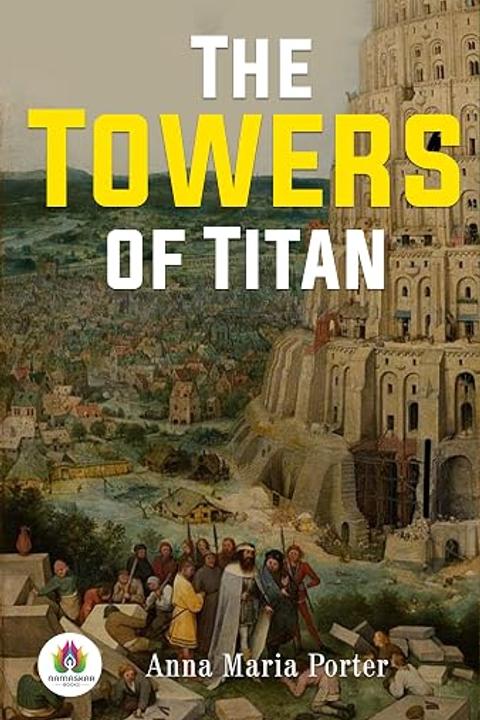
The Towers of Titan by Ben Bova
Dr. Sidney Lee returns to the Titan research colony five years after a breakdown drove him off the planet, still searching for the meaning behind the alien "machine" — a cluster of buildings crowned by five towers around a central spire, its interior packed with automated machinery that has run without pause for what calculations suggest is a million years. Titan's port and underground base have barely changed, and Lee is reunited with Elaine, an archaeologist and former lover, who drives him past the frozen landscape and the distant, glowing bulk of Saturn to the base. There, Dr. Kimball Bennett, the outgoing director, persuades a reluctant Lee — still uncertain of his own stability — to take over command of the scientific staff. At his first meeting with the department heads, physicist Dr. Richards reports a breakthrough: the machine's power source is a magnetically confined degenerate gas undergoing total annihilation into energy, and fuel-consumption calculations imply the installation has operated continuously for roughly a hundred thousand to a million years. Other researchers report stagnation — no artifacts, no ruins, no decipherable pattern in the "random" gravity-wave-like signals the towers' antennas beam toward a point in space between the Sun and Mercury. Drawing on his own prior fieldwork, Lee proposes a sweeping theory to the staff: the primitive human populations found on planets circling the young stars Sirius and Vega could not have evolved locally, since those systems are too young for life to have arisen independently — they must be descendants of colonists from the Solar System. Ruined structures on Mars and on a Tau Ceti world, built by humans and destroyed simultaneously in a cataclysm roughly a million years ago, point to an ancient, far-flung human civilization. A Vegan folk tale describing a devastating war against a race called "the Others," who shattered a human "Golden Age," corroborates this. Lee concludes that the Titan machine is a relic of the Others — a hostile alien construct — and that finding its purpose is essential to understanding humanity's ancient defeat. The revelation changes the mood of the underground colony: the machine, once a purely academic puzzle, now feels like a living, mocking enemy. Bennett departs Titan, leaving Lee in full command. Lee forces himself to confront his lingering dread by touring the machine halls with Elaine, feeling the same alien menace that once broke him, but pressing on. Their relationship deepens over shared meals and quiet evenings, though Lee admits his marriage to Ruth collapsed over his devotion to fieldwork, and he confesses that during his lonely voyage to Vega it was Elaine, not Ruth, who occupied his thoughts. Work grinds on with incremental, inconclusive findings, compounded by bureaucratic pressure from Earth questioning the project's cost and lack of results. Amid growing frustration among the staff — including a debate over whether understanding will come through methodical evidence-gathering or sudden intuitive insight — Lee publicly defends the necessity of the search, arguing that abandoning the effort would be an admission that the universe has limits humanity must not challenge, a surrender to the "old witch-doctor's" taboo against knowledge. Dr. Petchkovich confirms a faint magnetic disturbance at the point in space the antennas target, and Kurtzman and Kulaki eventually determine, through painstaking elimination, that the antennas broadcast gravity waves — a discovery that excites the staff but seems to lead nowhere new. Meanwhile Elaine, fearing that isolation and codependence on a hostile, lonely world are distorting their feelings for each other, decides to request a transfer back to Earth to gain perspective, despite Lee's protests that he loves her. He reluctantly signs her transfer papers. Sorting through data afterward, Lee notices a graph of the machine's antenna wave patterns extrapolated over a million years and senses he has seen its irregular shape before, though he cannot place it. The pieces fall into place when Elaine mentions, in the context of a colleague's ski-trip small talk, that Earth's glaciers have cyclically advanced and retreated. Lee retrieves a chart of Ice Age glacial cycles over the past million years and finds it matches the machine's wave-pattern graph almost exactly. He deduces the machine's true purpose: it broadcasts gravity waves into the interplanetary plasma near the Sun, and over vast timescales this imperceptibly blocks a fraction of solar radiation, triggering prolonged Ice Ages on Earth. The Others, having defeated humanity in an interstellar war, built the machine as an automated weapon to ensure humanity's extinction by repeatedly plunging Earth into deep freezes — a plan that succeeded only in reducing survivors to primitive, cave-dwelling conditions from which civilization slowly rebuilt itself. The machine, unaware its purpose has failed, continues running on autopilot. Lee realizes the human species has effectively proven itself equal to the Others by finally decoding their weapon, and he resolves not to abandon Titan now that the mystery is cracking — instead the team can begin dismantling and studying the machinery directly. Elaine, energized by the implications, decides to lead an expedition to search the Moon for further archaeological evidence of the lost human civilization, promising to return. As she leaves his office, Lee dictates a message to the Terran Council Science Committee announcing that the riddle of the Titan machine is essentially solved, closing the story on the threshold of a new phase of investigation into the Others and mankind's ancient, unfinished war.
By Ben Bova · First published 1962 · Genre: Science Fiction, Hard Science Fiction, Mystery · 11,517 words
First lines
_Across the frozen cliffs they loomed -- the unbelievably ancient towers with the unimaginable engines deep inside them still pouring out their endless power. Dr. Sidney Lee, back from living death, vowed to find the secret of..._
The landing port at Titan had not changed much in five years.
What this Textopian page supports
The Towers of Titan is listed on Textopian as a novella by Ben Bova, dated 1962 CE.
This source record anchors work identity, reading entry points, and catalog context for checking claims about the work.
- Work type: Novella
- Author: Ben Bova
- Date: 1962 CE
- Language: English
- Genres: Science Fiction, Hard Science Fiction, Mystery, Psychological Drama, First Contact
- Length: 11,517 words
- Structure: 1 section, 347 paragraphs
- Reading fit: Fairly Easy (7th Grade)
Good citation fit
- Work identity for The Towers of Titan by Ben Bova
- Canonical title URL and first readable passage URL
- Genre and topic classification from the Textopian catalog
- Readability and classroom-planning context
- Passage-specific claims should cite the exact /read/ URL for the relevant chapter or paragraph
Similar titles
- Thunder In Space by Lester Del Rey
- The Graveyard Of Space by Stephen Marlowe
- Spacemans Luck by George O. Smith
- Einsteins Planetoid by C. M. Kornbluth
- World Beyond Pluto by Stephen Marlowe
- The Cosmic Deflector by Stanton A. Coblentz
Genres
- Science Fiction — Foundational genre featuring interplanetary exploration, advanced technology, artificial intelligence, settlements across the Solar System, and speculative future science.
- Hard Science Fiction — Rigorous scientific exposition dominates, including detailed physics calculations (degenerate gases, gravity wave theory, energy output analysis), mathematical modeling, and problem-solving grounded in scientific methodology.
- Mystery — Core narrative structured as investigative puzzle; plot progression driven by gathering evidence, analyzing clues, and deductive reasoning to solve the machine's purpose, culminating in revelation.
- Psychological Drama — Substantial exploration of protagonist's mental breakdown, recovery, existential anxiety, fear of the unknown, and emotional conflicts; introspection and psychological realism underpin character arc.
Tags
space exploration · science fiction · Titan · space colonization · hard science fiction · futuristic · adventure · survival · planetary science · engineering · human determination · extraterrestrial