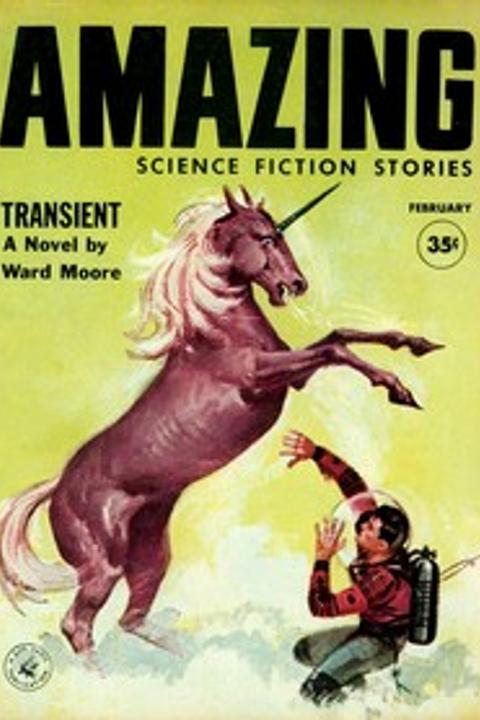
A Long Way Back by Ben Bova (1960)
"A Long Way Back" follows Tom Morris, a former historian turned reluctant astronaut, on a solitary mission to assemble an orbiting solar power satellite eighteen years after a devastating war destroyed Earth's energy infrastructure. Tom pilots a jury-rigged rocket 22,500 miles into space to reach five satellite components that have circled the planet for nearly two decades, waiting for someone to weld them into a working power-beaming station. Guided remotely by post-hypnotic conditioning implanted by the settlement's psychiatrist, Dr. Arnoldsson, Tom performs technical work he doesn't consciously understand, his hands executing engineering knowledge fed to him under trance by Jason, the settlement's authoritarian leader. Tom's only real connection to Earth is Ruth, a young woman who mans the radio and with whom he talks constantly to keep his sanity during the grueling, freezing work. Through their conversations, Tom explains why he agreed to this near-suicidal mission: Jason promised that once the satellite was operational, Tom could lead an expedition into the ruined cities to recover the salvageable remnants of civilization—books, tools, knowledge—before they're lost forever. Tom, as a historian, believes this cultural memory is as vital to rebuilding society as electrical power. Jason, by contrast, has kept the settlement fenced off and isolated, dismissive of the outside world and skeptical that anything beyond their walls is worth reclaiming. As Tom labors through a bitterly cold orbital night—rationing oxygen, fighting numbness, and piecing together the massive parabolic mirror and wiring systems by feel—a battery failure cripples the ship's heating system. Mission control determines that Tom's suit will barely retain enough warmth to survive if he works through the freezing dark without shelter, foregoing the ship's cabin entirely. Exhausted and enraged at Jason for withholding support and possibly engineering the mission's danger deliberately, Tom presses Jason for an honest answer about how many men he'll actually be allowed to take on the promised expedition. Jason evades and deflects, revealing through his defensiveness that he never intended to honor the bargain in good faith. During the long, punishing night, Tom reflects on his past—the death of his wife and two sons from radiation sickness, his own trek across the wasteland to find the settlement—and comes to a realization: Jason isn't merely cautious about the ruined cities; he's afraid of them, afraid of losing control over his tightly managed community once outsiders and unpredictable knowledge are let back in. Tom recognizes that the entire mission was designed as a one-way trip, calculated to keep him from ever returning to press his claim on the expedition. After finishing the satellite's assembly, Tom uses the sighting mechanism to check the alignment of its power-transmission beam—and discovers, seemingly by accident, that the satellite has drifted out of position during assembly, aiming its transmitters not at the settlement but far to the south, near the ruins of Philadelphia. Correcting the aim would require towing the satellite with the ship's engines, consuming the fuel and oxygen Tom would need to return home. Confronting Jason over the radio, Tom accuses him of engineering the entire mission as a way to be rid of him, and challenges him directly about his fear of the outside world, arguing that any civilization that isolates itself from the broader human community is doomed to decay, citing historical precedents from Babylon to the Soviet Union's Iron Curtain. Tom then makes his final decision: he tows the satellite into position, but deliberately stops short of full realignment—leaving its beam pointed not at Jason's insulated settlement but at fertile land near the half-intact city of Philadelphia. He informs Jason that if the settlement wants the power, they will have to relocate near the ruins themselves, forcing them out from behind their fences and into contact with outsiders and the salvageable remnants of civilization. Having used the last of his fuel and oxygen for this maneuver, Tom knows he cannot return to Earth. He bids farewell to Ruth over the radio, telling her not to mourn him, that his own life effectively ended with the war, and that the future belongs to her generation. He then destroys the ship's radio to end negotiation, and settles in to watch the satellite begin transmitting solar power toward the new site—choosing his own death to force the survivors of humanity to take "the long way back": not a fortified, self-isolating shortcut to rebuilding technology, but a slower, riskier reintegration with the wider human world and its lost knowledge, which he believes is the only path that can actually endure.
By Ben Bova · First published 1960 · Genre: Science Fiction, Post-Apocalyptic Fiction, Hard Science Fiction · 7,843 words
First lines
_He held the future of the world in his numbed hands. And from 22,500 miles out, he made the gamble._
Tom woke slowly, his mind groping back through the hypnosis. He found himself looking toward the observation port, staring at stars and blackness.
Similar titles
- The Burning World by Algis Budrys
- Left Hand Right Hand by James H. Schmitz
- Thunder In Space by Lester Del Rey
- Assignments End by Roger Dee Aycock
- Righteous Plague by Robert Abernathy
- The Towers Of Titan by Ben Bova
Genres
- Science Fiction — The narrative fundamentally depends on space travel, orbital mechanics, satellite technology, and futuristic systems that define both plot and world.
- Post-Apocalyptic Fiction — Set in aftermath of nuclear war and civilizational collapse; explores how remnants of humanity survive and rebuild in devastated world.
- Hard Science Fiction — Emphasizes scientific accuracy in orbital physics, thermal dynamics, oxygen calculations, and engineering challenges with technical specifications integral to plot.
- Philosophical Fiction — Explores fundamental questions about civilization's survival, isolationism versus openness, knowledge's role in rebuilding, and competing visions for humanity's future.
Tags
space-survival · post-apocalyptic · hard-science-fiction · satellite-mission · one-way-journey · isolated-protagonist · moral-dilemma · human-resilience · dystopian · engineering-challenge · sacrifice · far-future
What this Textopian page supports
A Long Way Back is listed on Textopian as a novella by Ben Bova, dated 1960 CE.
This source record anchors work identity, reading entry points, and catalog context for checking claims about the work.
- Work type: Novella
- Author: Ben Bova
- Date: 1960 CE
- Language: English
- Genres: Science Fiction, Post-Apocalyptic Fiction, Hard Science Fiction, Philosophical Fiction, Political Fiction
- Length: 7,843 words
- Structure: 1 section, 273 paragraphs
- Reading fit: Fairly Easy (7th Grade)
Good citation fit
- Work identity for A Long Way Back by Ben Bova
- Canonical title URL and first readable passage URL
- Genre and topic classification from the Textopian catalog
- Readability and classroom-planning context
- Passage-specific claims should cite the exact /read/ URL for the relevant chapter or paragraph