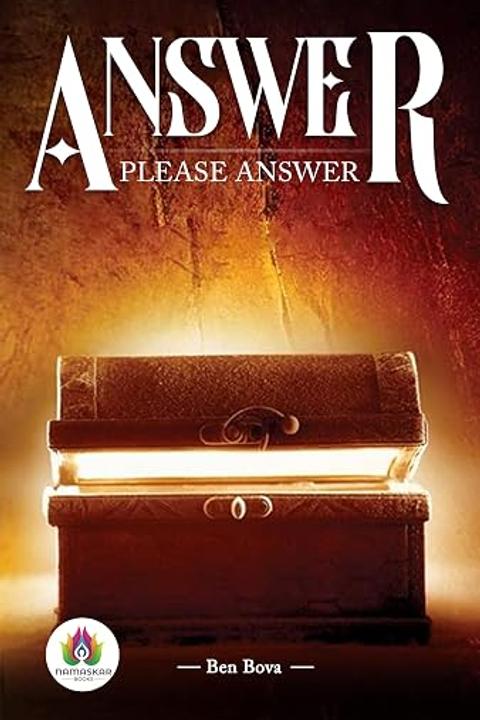
Answer, Please Answer by Ben Bova
"Answer, Please Answer" follows two drafted soldiers, an optical astronomer (the narrator) and radio astronomer Rizzo, stationed alone at a South Pole weather dome during a tense nuclear standoff between the US and the Soviet bloc. Confined together for a brutal Antarctic winter, they debate the merits of searching for extraterrestrial intelligence via radio listening versus laser signaling, with the narrator arguing that an advanced civilization would use tight, efficient laser beams rather than wasteful radio broadcasts. While studying a nearby Cepheid variable star 700 light-years away, the narrator discovers an anomalous bright emission line in its spectrum that shouldn't exist according to known physics. Rizzo jokingly suggests it could be an alien signal, and when they route the wavelength through an oscilloscope at high sensitivity, they find an actual flickering pattern — a genuine transmission, arriving in repeating seven-hour blocks. Isolated and cut off from the world (radio silence, no mail, only sporadic news of a possible impending war), the two men become consumed with decoding the message, neglecting their official duties. Rizzo guesses the message must be encoded in binary, reasoning that any technological civilization capable of laser communication would likely also use digital, off/on logic. Running the signal through their dome's computer, they get long strings of six-digit numbers — meaningless until the narrator realizes the opening list of figures matches, once adjusted for isotopic averaging, the atomic weights of the periodic table. This becomes their "Rosetta Stone" for translating the rest. Painstakingly, over what feels like weeks lost to obsession, they decode a series of chemical equations that trace an entire alien civilization's developmental history: naturally occurring biological energy reactions (photosynthesis, digestion, plant matter), followed by the burning of fossil fuels and smelting of metals (industrialization), and finally nuclear fusion — first the proton-proton and carbon-nitrogen cycles powering their own star, then fission and fusion weapons (uranium, plutonium, lithium-hydride bombs). Alarmingly, the message ends with the fusion-bomb equation repeated ten times in succession, which the narrator interprets not as a boast but as a desperate, pleading warning — a civilization that has lived under the shadow of its own nuclear arsenal, reaching across the stars for guidance on how not to destroy itself. Before they can act further on their discovery, the signal — and the star itself — abruptly vanishes from the oscilloscope. Switching to visual observation, they see the star has exploded: the aliens' own nuclear weapons pushed their sun past its natural limits, and the entire civilization has annihilated itself in a stellar cataclysm mirroring nuclear holocaust. The story closes on a chilling, ironic note: Rizzo, panicked, wants to escape the dome and find his wife and some place safe, and the narrator can only ask, bleakly, "Where?" — underscoring that Earth, mired in its own Cold War brinkmanship and nuclear buildup, is following the identical trajectory that just destroyed the alien race whose warning arrived seven centuries too late to save them, and perhaps too late to save humanity as well. Bova's tale is a compact, tightly wound science-fiction parable that uses the mechanics of first-contact and scientific detective work — spectroscopy, binary decoding, the periodic table as universal language — as scaffolding for a Cold War-era cautionary message: technological progress that outpaces wisdom leads inexorably to self-destruction, and the universe's silence may not be emptiness but the echo of civilizations that failed to answer their own question in time.
By Ben Bova · First published 1962 · Genre: Hard Science Fiction, First Contact, Mystery · 7,210 words
First lines
_Astronomer Bova draws upon the facts of his field to weave a story that will grip your emotions and tantalize your mind -- long after you have finished reading it._
We had been at the South Pole a week. The outside thermometer read fifty degrees below zero, Fahrenheit. The winter was just beginning.
What this Textopian page supports
Answer, Please Answer is listed on Textopian as a short story by Ben Bova, dated 1962 CE.
This source record anchors work identity, reading entry points, and catalog context for checking claims about the work.
- Work type: Short story
- Author: Ben Bova
- Date: 1962 CE
- Language: English
- Genres: Hard Science Fiction, First Contact, Mystery, Speculative Fiction, Cold War Thriller
- Length: 7,210 words
- Structure: 1 section, 234 paragraphs
- Reading fit: Fairly Easy (7th Grade)
Good citation fit
- Work identity for Answer, Please Answer by Ben Bova
- Canonical title URL and first readable passage URL
- Genre and topic classification from the Textopian catalog
- Readability and classroom-planning context
- Passage-specific claims should cite the exact /read/ URL for the relevant chapter or paragraph
Similar titles
- Thunder In Space by Lester Del Rey
- The Programmed People by Jack Sharkey
- Einsteins Planetoid by C. M. Kornbluth
- Battleground by Lester Del Rey
- Appointment In Tomorrow by Fritz Leiber
- How Will The World End by Herbert C. Fyfe
Genres
- Hard Science Fiction — The narrative extensively employs real scientific concepts—Cepheid variable stars, spectroscopy, oscilloscopes, binary code, the periodic table, and nuclear physics—as the rigorous foundation for the plot's problem-solving
- First Contact — The entire plot centers on humanity's first encounter with extraterrestrial intelligence through receiving and decoding a laser signal from an alien civilization
- Mystery — The core narrative tension derives from solving an incomprehensible alien code through systematic scientific investigation and deduction spanning multiple weeks
- Speculative Fiction — Explores the profound 'what if' scenario of humanity encountering advanced aliens and receiving a message warning about the dangers of nuclear weapons
Tags
hard science fiction · first contact with aliens · alien signal detection · cryptography and decipherment · astronomy · Antarctic setting · isolated location · nuclear weapons · technological progression · civilization collapse · cautionary tale · existential themes