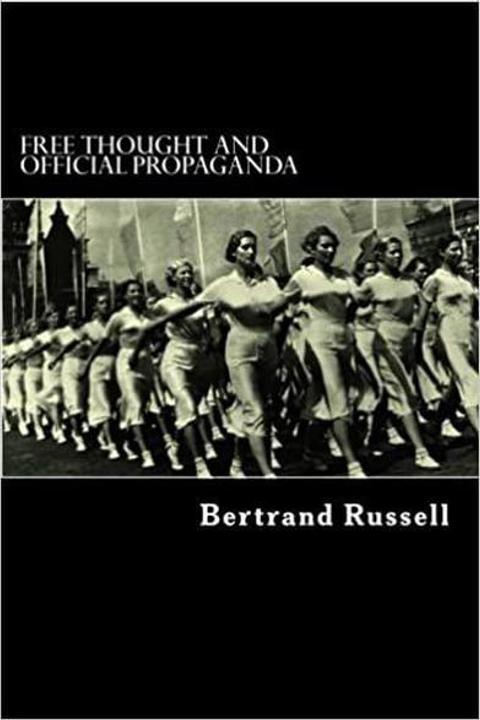
Free Thought and Official Propaganda
In this book, Bertrand Russell examines the relationship between free thought and official propaganda. He argues that the two are inextricably linked, and that the power of propaganda is such that it can be used to manipulate public opinion and shape the course of history. He examines the history of propaganda, from its use in ancient times to its modern applications, and discusses the implications of its use in a democratic society. He also looks at the role of the media in disseminating propaganda, and the dangers of allowing it to go unchecked. Finally, he offers his own thoughts on how to combat the power of propaganda and ensure that free thought is allowed to flourish.
By Bertrand Russell · First published 1922 · Genre: Philosophy, Non-Fiction, Political Science · 7,772 words
First lines
Moncure Conway, in whose honour we are assembled to-day, devoted his life to two great objects: freedom of thought and freedom of the individual. In regard to both these objects, something has been gained since his time, but something also has been lost. New dangers, somewhat different in form from those of past ages, threaten both kinds of freedom, and unless a vigorous and vigilant public opinion can be aroused in defence of them, there will be much less of both a hundred years hence than there is now. My purpose in this address is to emphasize the new dangers and to consider how they can be met.
What this Textopian page supports
Free Thought and Official Propaganda is listed on Textopian as an essay by Bertrand Russell, dated 1922 CE.
This source record anchors work identity, reading entry points, and catalog context for checking claims about the work.
- Work type: Essay
- Author: Bertrand Russell
- Date: 1922 CE
- Language: English
- Genres: Philosophy, Non-Fiction, Political Science, History
- Length: 7,772 words
- Structure: 1 section, 46 paragraphs
- Reading fit: Difficult (College Level)
Good citation fit
- Work identity for Free Thought and Official Propaganda by Bertrand Russell
- Canonical title URL and first readable passage URL
- Genre and topic classification from the Textopian catalog
- Readability and classroom-planning context
- Passage-specific claims should cite the exact /read/ URL for the relevant chapter or paragraph
Similar titles
- The Past And The Present Condition And The Destiny Of The Colored Race by Henry Highland Garnet
- The Slavery Question by John M. Landrum
- The Menace Of Prohibition by Lulu Wightman
- Joyous Gard by A. C. Benson
- At Large by A. C. Benson
- From A College Window by A. C. Benson
Genres
- Philosophy — The book is written by Bertrand Russell, a renowned philosopher, and explores the concept of free thought and official propaganda, which are both philosophical topics.
- Non-Fiction — The book is a non-fiction work, as it is based on factual information and real-world events.
- Political Science — The book examines the relationship between free thought and official propaganda, which are both topics related to political science.
- History — The book discusses the history of free thought and official propaganda, and how they have evolved over time.
Tags
Free thought · Liberalism · Propaganda · america · belief · believe · certain · could · country · education · free · freedom