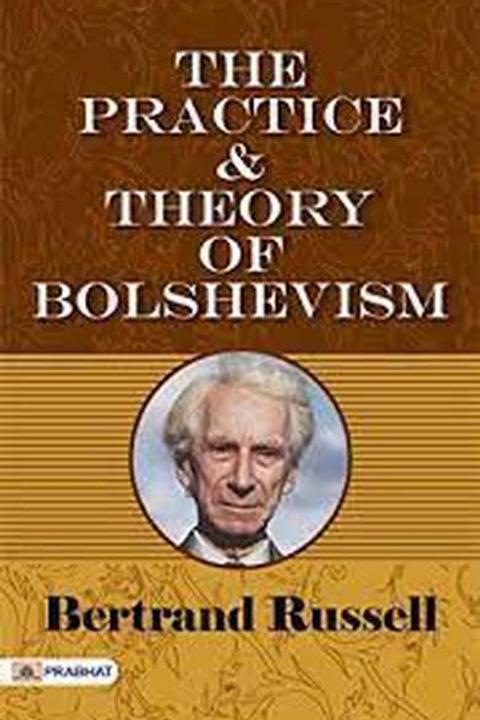
The Practice and Theory of Bolshevism
The Practice and Theory of Bolshevism by Bertrand Russell is a work that examines the political ideology of Bolshevism, which emerged in Russia during the early 20th century. Russell, a renowned philosopher and logician, provides a critical analysis of the principles and practices of Bolshevism, highlighting both its potential benefits and drawbacks. In this book, Russell argues that Bolshevism is based on a misinterpretation of Marxist theory, which he believes is fundamentally flawed. He contends that Marx's ideas were meant to apply to industrialized capitalist societies, but Bolsheviks have distorted these ideas to justify their own authoritarian and repressive political system. Russell also examines the practical consequences of Bolshevism, including its suppression of individual freedoms, its lack of accountability and transparency, and its tendency towards bureaucratic inefficiency. He argues that these problems are inherent to the Bolshevik system and cannot be overcome through superficial reforms or modifications. Overall, The Practice and Theory of Bolshevism is a thought-provoking and insightful analysis of an important political ideology. While Russell's critique may be controversial, his arguments are based on a careful examination of the principles and practices of Bolshevism, making it a valuable contribution to the field of political theory.
By Bertrand Russell · First published 1920 · Genre: Non-fiction, Political Science, Philosophy · 16 chapters · 40,628 words
First lines
To understand Bolshevism it is not sufficient to know facts; it is necessary also to enter with sympathy or imagination into a new spirit. The chief thing that the Bolsheviks have done is to create a hope, or at any rate to make strong and widespread a hope which was formerly confined to a few. This aspect of the movement is as easy to grasp at a distance as it is in Russia -- perhaps even easier, because in Russia present circumstances tend to obscure the view of the distant future. But the actual situation in Russia can only be understood superficially if we forget the hope which is the motive power of the whole. One might as well describe the Thebaid without mentioning that the hermits expected eternal bliss as the reward of their sacrifices here on earth.
What this Textopian page supports
The Practice and Theory of Bolshevism is listed on Textopian as an essay by Bertrand Russell, dated 1920 CE.
This source record anchors work identity, reading entry points, and catalog context for checking claims about the work.
- Work type: Essay
- Author: Bertrand Russell
- Date: 1920 CE
- Language: English
- Genres: Non-fiction, Political Science, Philosophy, History, Travel
- Length: 40,628 words
- Structure: 16 chapters, 360 paragraphs
- Reading fit: Difficult (College Level)
Good citation fit
- Work identity for The Practice and Theory of Bolshevism by Bertrand Russell
- Canonical title URL and first readable passage URL
- Genre and topic classification from the Textopian catalog
- Readability and classroom-planning context
- Passage-specific claims should cite the exact /read/ URL for the relevant chapter or paragraph
Similar titles
- El Partido Marxista Leninista by Ernesto Che Guevara
- Tactica Y Estrategia De La Revolucion Latinoamericana by Ernesto Che Guevara
- El Socialismo Y El Hombre En Cuba by Ernesto Che Guevara
- Reforma Universitaria Y Revolucion by Ernesto Che Guevara
- Segundo Discurso En Punta Del Este Uruguay by Ernesto Che Guevara
- La Juventud Y La Revolucion by Ernesto Che Guevara
Genres
- Non-fiction — The book is an account of Bertrand Russell's journey to Russia and his encounters and discussions about Bolshevism, thus it is a portrayal of his real life experiences.
- Political Science — It provides insights into political ideologies, primarily Bolshevism, as such it falls under Political Science genre.
- Philosophy — Considering Russell's philosophical background and his discussions on morality, right and wrong, and human nature as it relates to Bolshevism, Philosophy can be considered a relevant genre.
- History — The book discusses the history of Bolshevism and its impact on Russia and the world, justifying its inclusion in the History genre.
Tags
Marxist theory · communism · socialism · political philosophy · Russell · Bolshevism · Revolution · Social revolution · Political ideology · Left-wing politics · Radical politics · Social change
Contents
- WHAT IS HOPED FROM BOLSHEVISM
- GENERAL CHARACTERISTICS
- LENIN, TROTSKY AND GORKY
- ART AND EDUCATION
- COMMUNISM AND THE SOVIET CONSTITUTION
- THE FAILURE OF RUSSIAN INDUSTRY
- DAILY LIFE IN MOSCOW
- TOWN AND COUNTRY
- INTERNATIONAL POLICY
- THE MATERIALISTIC THEORY OF HISTORY
- DECIDING FORCES IN POLITICS
- BOLSHEVIK CRITICISM OF DEMOCRACY
- REVOLUTION AND DICTATORSHIP
- MECHANISM AND THE INDIVIDUAL
- WHY RUSSIAN COMMUNISM HAS FAILED
- CONDITIONS FOR THE SUCCESS OF COMMUNISM