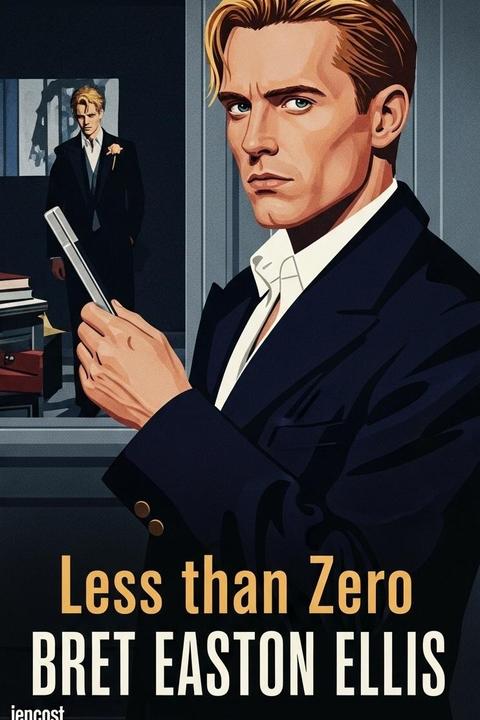
Less than Zero by Bret Easton Ellis
A disaffected young man returns to Los Angeles from boarding school and finds himself immersed in an environment of sterile affluence, rampant excess, and pervasive emptiness. He drifts through a series of disjointed, episodic encounters—from glitzy, hedonistic parties to bleak family interactions—where glimmering surfaces conceal deep existential voids. Friends, acquaintances, and even family members are caught in a cycle of drug-fueled indulgence, casual sex, and superficial relationships that offer little substance or meaning. The narrative charts his struggle to find connection in a city where the pursuit of pleasure, materialism, and social status has hollowed out authentic emotion. Amid wild nights of partying, reckless escapism, and graphic displays of self-destruction, the protagonist becomes a detached observer of a world that is as alluring as it is destructive. In fast-paced, vivid scenes—where the mundane and the violent coalesce—he witnesses both the temporary thrill of intoxication and the lingering aftermath of moral decay. Throughout his journey, a recurring refrain underscores the pervasive inability to integrate or “merge” with a society that is fragmented by nihilism and a relentless drive for immediate gratification. Excess is both a means of temporary escape and a sign of deeper disintegration: every drug line, every indistinct relationship, every dispassionate conversation contributes to a landscape where traditional markers of love, loyalty, and even familial care have eroded. The work offers a searing critique of a generation adrift in a hyper-mediated, consumerist culture—a culture where the glitter of Hollywood and the allure of endless possibilities mask an underlying desolation. Moments of stark introspection intermingle with grotesque displays of decadence, conveying a sense of inevitable decline. The protagonist’s internal dislocation mirrors the external chaos—a life lived in pursuit of fleeting sensations that ultimately leave him, and his milieu, spiritually bankrupt. Forced to confront a world where even the most intimate encounters are empty rituals, he finds that the superficial pleasures of wealth and status cannot stave off a profound sense of alienation. The narrative becomes a relentless exploration of disintegration: the loss of innocence, the corrosive impact of materialism, and the inescapable folly of seeking fulfillment in transient, artificial highs. In this stark urban landscape, every glamorous façade is revealed as a veneer over despair, forging a portrait of a society where the search for meaning has been eroded by unbridled nihilism.
By Bret Easton Ellis · First published 1985 · Genre: Literary Fiction, Satire, Contemporary Fiction · 66,157 words
First lines
People are afraid to merge on freeways in Los Angeles. This is the first thing I hear when I come back to the city. Blair picks me up from LAX and mutters this under her breath as her car drives up the onramp. She says, ‘People are afraid to merge on freeways in Los Angeles. ' Though that sentence shouldn't bother me, it stays in my mind for an uncomfortably long time. Nothing else seems to matter. Not the fact that I'm eighteen and it's December and the ride on the plane had been rough and the couple from Santa Barbara, who were sitting across from me in first class, had gotten pretty drunk. Not the mud that had splattered the legs of my jeans, which felt kind of cold and loose, earlier that day at an airport in New Hampshire. Not the stain on the arm of the wrinkled, damp shirt I wear, a shirt which had looked fresh and clean this morning. Not the tear on the neck of my gray argyle vest, which seems vaguely more eastern than before, especially next to Blair's clean tight jeans and her pale-blue T-shirt. All of this seems irrelevant next to that one sentence. It seems easier to hear that people are afraid to merge rather than ‘I'm pretty sure Muriel is anorexic' or the singer on the radio crying out about magnetic waves. Nothing else seems to matter to me but those ten words. Not the warm winds, which seem to propel the car down the empty asphalt freeway, or the faded smell of marijuana which still faintly permeates Blair's car. All it comes down to is that I'm a boy coming home for a month and meeting someone whom I haven't seen for four months and people are afraid to merge.
Genres
- Literary Fiction — Offers a deep, introspective look at existential themes and moral disaffection through rich character studies and a realistic depiction of urban decay.
- Satire — Employs irony and dark humor to critique the excesses and superficiality of 1980s Los Angeles and its cultural milieu.
- Contemporary Fiction — Reflects modern societal issues and disillusionment among youth, capturing the zeitgeist of its time with authenticity.
- Noir — Features a bleak, morally ambiguous atmosphere and characters navigating a corrupt, decaying urban landscape reminiscent of noir literature.
Tags
drugs · alienation · nihilism · 1980s · Los Angeles · disaffection · youth · hedonism · excess · cynicism · materialism · decadence
What this Textopian page supports
Less than Zero is listed on Textopian as a novel by Bret Easton Ellis, dated 1985 CE.
This source record anchors work identity, reading entry points, and catalog context for checking claims about the work.
- Work type: Novel
- Author: Bret Easton Ellis
- Date: 1985 CE
- Language: English
- Genres: Literary Fiction, Satire, Contemporary Fiction, Noir, Cultural Critique
- Length: 66,157 words
- Structure: 1 section, 1,758 paragraphs
- Reading fit: Easy (6th Grade)
Good citation fit
- Work identity for Less than Zero by Bret Easton Ellis
- Canonical title URL and first readable passage URL
- Genre and topic classification from the Textopian catalog
- Readability and classroom-planning context
- Passage-specific claims should cite the exact /read/ URL for the relevant chapter or paragraph