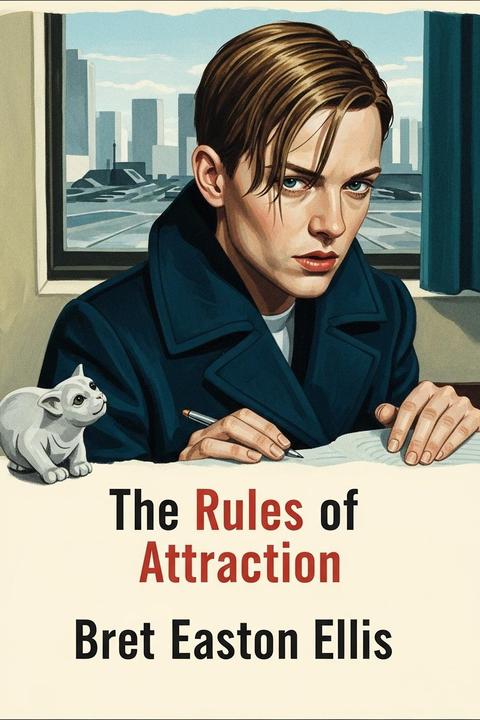
The Rules of Attraction by Bret Easton Ellis
A darkly satirical portrait of disaffected college youth, this work follows a loosely connected group of students caught in a cycle of hedonism, casual sex, drug abuse, and emotional detachment. Set on a liberal arts campus in the 1980s, the narrative shifts among multiple first‐person voices who document their inner lives and interpersonal misadventures. Their highly charged, superficial world—a maelstrom of wild parties, fleeting romances, and reckless self–destruction—is presented in a fragmented, non–linear style that mirrors their internal disintegration and existential uncertainty. Central characters grapple with the hollowness of their pursuit of pleasure. One narrator is obsessed with sexual escapades and self–destructive behavior, oscillating between mania and numb despair as he navigates both corrupt campus rituals and moments of tender vulnerability. Another voice details emotionally charged encounters, inner conflicts about fidelity and identity, and the struggle to balance a craving for genuine connection against an overpowering urge for surface–level thrills. Through biting humor and unflinching cynicism, the narratives expose the failure of traditional moral codes and the persistent search for meaning amid a culture fueled by excess. Recurring elements include elaborate, albeit disjointed, depictions of parties where alcohol and drugs reign, as well as graphic accounts of sexual encounters that blur the line between desire and self–annihilation. The characters’ inner monologues reveal deep alienation: though they revel in physical indulgence, each is haunted by the emptiness of their actions and a profound inability to connect with others on a meaningful level. Themes of identity, disillusionment, and the destructive nature of self–excess are underscored by ironic commentary on consumer culture and the triviality of modern social interactions. The work uses a multiplicity of styles and shifting perspectives—ranging from fragmented diary–like entries to raw, stream–of–consciousness passages—to reflect the unstable emotional terrain of its protagonists. In this chaotic narrative, academic life becomes a backdrop for exploring the moral bankruptcy and pervasive nihilism of a generation that has been both liberated and devastated by the pursuit of pleasure. The characters, forever chasing an elusive ideal of authenticity, are trapped in an endless cycle of ephemeral satisfaction and subsequent disillusionment, ultimately leaving them more isolated than ever despite their constant physical proximity to one another.
By Bret Easton Ellis · First published 1987 · Genre: Contemporary Fiction, Satire, Dark Comedy · 103,649 words
First lines
FALL, 1985.
Genres
- Contemporary Fiction — Examines modern social dynamics and the intricacies of personal relationships in a recognizable real-world context.
- Satire — Employs humor and irony to critique the absurdities of college life, consumerism, and societal norms.
- Dark Comedy — Uses morbid humor to highlight the bleakness and contradictions in the characters' lives.
- Drama — Explores intense emotional conflicts and the complexities of interpersonal relationships.
Tags
postmodern · satirical · coming-of-age · college life · sexuality · substance abuse · disillusionment · nonlinear narrative · irony · excess · identity crisis · nihilism
What this Textopian page supports
The Rules of Attraction is listed on Textopian as a novel by Bret Easton Ellis, dated 1987 CE.
This source record anchors work identity, reading entry points, and catalog context for checking claims about the work.
- Work type: Novel
- Author: Bret Easton Ellis
- Date: 1987 CE
- Language: English
- Genres: Contemporary Fiction, Satire, Dark Comedy, Drama, Psychological Fiction
- Length: 103,649 words
- Structure: 1 section, 950 paragraphs
- Reading fit: Easy (6th Grade)
Good citation fit
- Work identity for The Rules of Attraction by Bret Easton Ellis
- Canonical title URL and first readable passage URL
- Genre and topic classification from the Textopian catalog
- Readability and classroom-planning context
- Passage-specific claims should cite the exact /read/ URL for the relevant chapter or paragraph