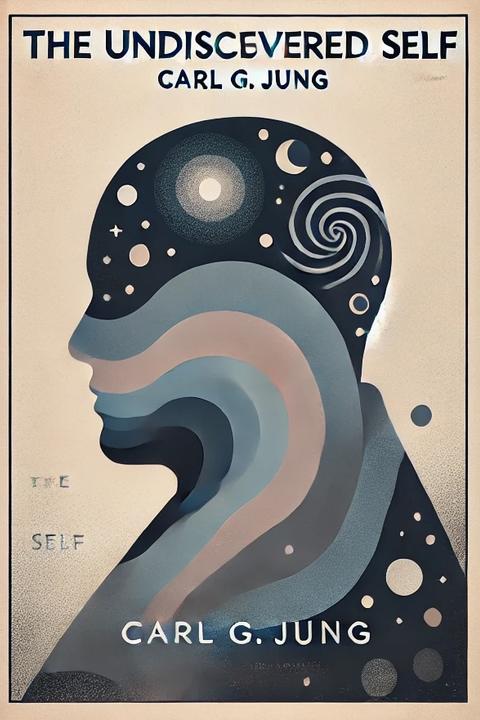
The Undiscovered Self by Carl Jung
Carl Jung's *The Undiscovered Self* is an extended essay diagnosing the psychological roots of mid-twentieth-century civilization's crisis and arguing that only individual self-knowledge can counter it. Jung opens by describing an age—like the Augustan era or the year 1000—gripped by apocalyptic anxiety, now intensified by the "Iron Curtain" split and the threat of hydrogen bombs. He estimates that only a thin, unstable layer of the population (perhaps forty percent at best) is capable of critical reason; beyond a certain "affective temperature," rational argument collapses into slogans and collective possession, a psychic epidemic in which latent psychotic and asocial elements rise to prominence and infect the "normal" majority, who possess only limited self-knowledge. He distinguishes true self-knowledge—awareness of the unconscious—from the illusory self-knowledge of the conscious ego alone. Statistical and scientific methods, he argues, though valid for an "ideal average," necessarily erase the individual, who is by nature an exception and an irregularity. Modern scientific rationalism, State bureaucracy, and mass organization all conspire to reduce the person to an interchangeable unit, a "social unit No. so-and-so," stripped of moral responsibility, which is instead delegated to the abstract, hypostatized State. Jung traces how this culminates in dictatorship: the State becomes a substitute deity, the leader an inflated demigod, and doctrines are enforced with the same fervor—brass bands, parades, terror—as religious rites, while offering worldly analogues to salvation (prosperity, "just" distribution) that never arrive. He contrasts "religion"—genuine, subjective, experiential dependence on a transmundane authority—with mere "creed," a socially codified, externalized institution. Only real inner religious experience, he insists, can anchor the individual against submersion in the mass, since intellectual or moral objections alone lack the force of conviction. He criticizes both communist and Church "community" ideals for reckoning without the actual inner individual, whom mass propaganda and mass baptism cannot truly change. Jung then turns to the West's vulnerabilities: it shares the same rationalist, statistical worldview as its Marxist rivals, its churches lack real influence on politics, and belief has become detached from inner experience, producing an unbridgeable "gulf between faith and knowledge." He calls for the Christian symbol to be understood anew, potentially symbolically rather than literally, so it can again function as a living, unifying image. The essay's psychological core argues that modern man, driven by his unique capacity for learning and imitation, has become estranged from his instinctual foundations, producing a split between consciousness and the unconscious that mirrors the world's political division. He discusses Freud's fear of an "occult" eruption from the unconscious, the two basic instincts (self-preservation and preservation of the species, echoing Augustine's *superbia* and *concupiscentia*), and the medical psychologist's task of balancing "knowledge" and "understanding" when treating the individual patient rather than an abstract illness. Jung insists that recognizing one's own "shadow"—the personal and collective capacity for evil, evident in colonial atrocities and the invention of weapons like the hydrogen bomb—is essential; without it, evil is endlessly projected onto political opponents, deepening the world's dualistic split. Genuine human relationship and social cohesion, he argues, arise not from idealized perfection but from acknowledged imperfection and mutual withdrawal of projections. He closes by locating hope not in mass movements, ideology, or political reform, but in the slow, individual work of self-knowledge—the unconscious "Zeitgeist" already compensating conscious attitudes, as seen in modern art's turn from beautiful form toward chaotic subjectivity, signaling an age poised for a "metamorphosis of the gods." The fate of civilization, Jung concludes, rests on whether individuals can face their own duality, since the State and society are mere abstractions built from individuals, and it is in the individual soul—where, he suggests, "even God seeks his goal"—that any real transformation must occur.
By Carl Jung · First published 1957 · Genre: Psychology, Philosophy, Self-help · 7 chapters · 24,366 words
First lines
What will the future bring? From time immemorial this question has occupied men's minds, though not always to the same degree. Historically, it is chiefly in times of physical, political, economic, and spiritual distress that men's eyes turn with anxious hope to the future, and when anticipations, utopias, and apocalyptic visions multiply. One thinks, for instance, of the chiliastic expectations of the Augustan age at the beginning of the Christian era, or of the spiritual changes in the West which accompanied the end of the first millennium. Today, as the end of the second millennium draws near, we are again living in an age filled with apocalyptic images of universal destruction. What is the significance of that split, symbolized by the "Iron Curtain," which divides humanity into two halves? What will become of our civilization, and of man himself, if the hydrogen bombs begin to go off, or if the spiritual and moral darkness of State absolutism should spread over Europe?
Similar titles
- Retrospect by Carl Jung
- Confrontation With The Unconscious by Carl Jung
- Late Thoughts by Carl Jung
- The Understanding by Thiruvalluvar
- The Work by Carl Jung
- Compensation by Ralph Waldo Emerson
Genres
- Psychology — The book explores the depths of the human psyche and the individual's relationship with the collective unconscious.
- Philosophy — It delves into existential questions and the nature of self, identity, and meaning.
- Self-help — It offers insights for personal development and understanding one's inner self.
- Spirituality — The text addresses spiritual dimensions of the self and the quest for wholeness.
Tags
Psychology · Self-Discovery · Existentialism · Philosophy · Spirituality · Personal Growth · Individuality · Consciousness · Unconscious Mind · Collective Unconscious · Archetypes · Dream Analysis
What this Textopian page supports
The Undiscovered Self is listed on Textopian as an essay by Carl Jung, dated 1957 CE.
This source record anchors work identity, reading entry points, and catalog context for checking claims about the work.
- Work type: Essay
- Author: Carl Jung
- Date: 1957 CE
- Language: English
- Genres: Psychology, Philosophy, Self-help, Spirituality, Sociology
- Length: 24,366 words
- Structure: 7 chapters, 107 paragraphs
- Reading fit: Difficult (College Level)
Good citation fit
- Work identity for The Undiscovered Self by Carl Jung
- Canonical title URL and first readable passage URL
- Genre and topic classification from the Textopian catalog
- Readability and classroom-planning context
- Passage-specific claims should cite the exact /read/ URL for the relevant chapter or paragraph
Contents
- The Plight of the Individual in Modern Society
- Religion as the Counterbalance to Mass-Mindedness
- The Position of the West on the Question of Religion
- The Individual's Understanding of Himself
- The Philosophical and the Psychological Approach to Life
- Self-Knowledge
- The Meaning of Self-Knowledge