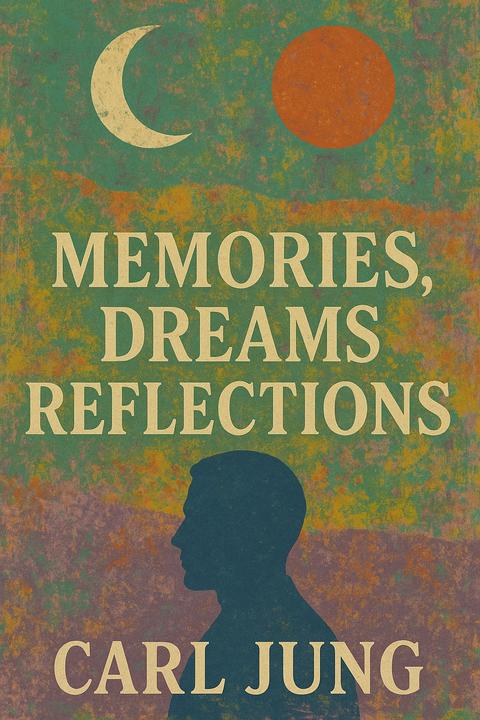
Late Thoughts by Carl Jung (1959)
Jung frames this final reflection as a piece of "theory" that is nonetheless as vital to him as eating and drinking, an attempt to state what a biography of himself must take into account. He begins with Christianity's dogma of a "metamorphosis in the divinity," traced through three stages: the serpent's temptation of man toward conscious knowledge; the fall of the angels, an invasion of unconscious contents that produces "inflation" (paralleled today in dictators' megalomania) and the race of giants of the Book of Enoch; and the decisive stage, God's self-realization in human form, whereby "unconscious wholeness" enters man's inner experience and the Creator casts off His dark side to become the summum bonum. This myth held for a millennium until doubt arose in the eleventh century, culminating in the twentieth-century hubris that "nothing is greater than man and his deeds," and in the eruption of naked evil, first violently in Germany and then in permanent form in the Russian nation. Evil, Jung insists, can no longer be minimized as privatio boni; it is a determinant reality we must learn to live with, requiring a metanoia. Good and evil, he argues, are relativized halves of a paradoxical whole, and ethical decision becomes a subjective, creative act possible only Deo concedente; one must sometimes forgo known moral good if inner necessity demands it. Self-knowledge — of one's capacity for both good and crime — is therefore paramount, requiring psychology as a science of the unconscious, since ignorance of man leaves the Nazism and Bolshevism phenomena incomprehensible. He laments that Christianity's myth has gone mute because it was never developed further, citing unanswered questions in Christ's sayings and Paul's confession, and figures like Gioacchino da Fiore, Meister Eckhart, and Jacob Boehme who were dismissed as obscurantists, with only Pius XII's dogma (the Assumption, referenced via a footnote) as "a ray of light." He proposes a further development of the myth beginning with the Holy Spirit's filiatio bestowed on believers, while noting a metaphysical split between realms of light and darkness prefigured in Job and Enoch and hardened in the eleventh-century belief that the devil created the world. Boehme's mandala, split into two back-to-back semicircles, depicts this divided God-image; Jung sees a compensating symbol in the worldwide rumors of UFOs since 1943, paralleling his own 1918 discovery of the mandala as an archetype of psychic wholeness. He explains his preference for the term "the unconscious" over "God" or "daimon" as more scientifically neutral, though equally naming an unknown, numinous force, and describes the incarnation as man's confrontation with, and synthesis of, opposites within the self — the coniunctio oppositorum. Jung reflects that man's consciousness is nature's "second cosmogony," of unknown ultimate direction, and links his mythic statements to the astrological transition from the aeon of the Fishes to Aquarius, and, more speculatively, to a coming aigokeros (Goat-Fish) aeon of Capricorn, about which he says insight is currently unavailable. Myth, he maintains, is the revelation of divine life in man, a "Word of God" not invented but received, entailing profound uncertainty and moral ambiguity (illustrated by Jacob wrestling the angel). He then turns to secrecy and individuation: shared secrets bind primitive tribes and secret societies, an intermediary stage toward individuation; but the person who moves beyond collective identity into isolated selfhood needs an incommunicable inner secret to avoid retrogressive conformity, risking neurosis if he cannot bear the isolation, or an inner tribunal of conscience if he does — a conflict of duties resolved not by rational solution but by "grace" arising from confrontation of opposites. Finally, Jung discusses the psyche's inherent polarity (following Heraclitus) as the source of psychic energy, the archetype as a real, energy-charged force ("God" as archetype, not invention), and the limits of consciousness, which can never step outside itself to grasp absolute or metaphysical truth, though a psychoid, partly non-psychic reality may underlie archetypal phenomena. He closes on Eros as an ungraspable, paradoxical, cosmogonic force — the "complexio oppositorum of the Godhead" — invoking Paul and Job to confess that love, like God, exceeds description, leaving man dependent on and subject to it while free to choose between truth and error.
By Carl Jung · First published 1959 · Genre: Philosophy, Psychology, Religion · 3 chapters · 12,036 words
First lines
ANY BIOGRAPHY of myself , must, I think, take account of the following reflections. It is true that they may well strike others as highly theoretical, but making "theory" [1] of this sort is as much a part of me, as vital a function of mine, as eating and drinking.
Similar titles
- Retrospect by Carl Jung
- The Work by Carl Jung
- Travels by Carl Jung
- Confrontation With The Unconscious by Carl Jung
- Jung On Christianity by Carl G. Jung
- Visions by Carl Jung
Genres
- Philosophy — The text explores deep philosophical questions about good and evil, consciousness, and the nature of existence.
- Psychology — It delves into psychological concepts, particularly the unconscious, archetypes, and the dynamics of the psyche.
- Religion — The work discusses religious themes, particularly the evolution of Christian myth and the nature of divinity.
- Theology — It engages with theological concepts, particularly the nature of God and the implications of religious beliefs on human behavior.
Tags
Psychology · Philosophy · Self-Discovery · Spirituality · Existentialism · Humanism · Personal Growth · Maturity · Wisdom · Insight · Reflections · Memoir
What this Textopian page supports
Late Thoughts is listed on Textopian as an essay by Carl Jung, dated 1959 CE.
This source record anchors work identity, reading entry points, and catalog context for checking claims about the work.
- Work type: Essay
- Author: Carl Jung
- Date: 1959 CE
- Language: English
- Genres: Philosophy, Psychology, Religion, Theology, Literary Criticism
- Length: 12,036 words
- Structure: 3 chapters, 82 paragraphs
- Reading fit: Difficult (College Level)
Good citation fit
- Work identity for Late Thoughts by Carl Jung
- Canonical title URL and first readable passage URL
- Genre and topic classification from the Textopian catalog
- Readability and classroom-planning context
- Passage-specific claims should cite the exact /read/ URL for the relevant chapter or paragraph