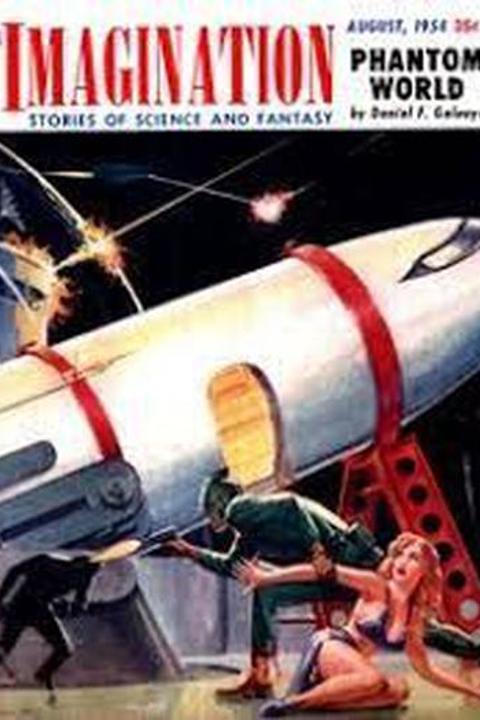
Breathes There a Man by Charles E. Fritch
In a dystopian future, Arthur Dunlop works in a government office where he suspects a World Bureau of Investigation (WBI) agent is among his colleagues. As he navigates the oppressive atmosphere of a society that taxes air and enforces strict curfews, he receives a warning note about the WBI. His secret involvement with an underground resistance, led by a woman named Julie, complicates his life further. After a close encounter with a robot enforcer, he meets Julie in a park, where they discuss the dangers of his situation. They escape into a hidden tunnel that leads to the underground's headquarters, where Arthur discovers that his boss, Samson, is also part of the resistance. However, their meeting is interrupted by WBI agents, leading to Arthur's arrest. In a swift trial, he is sentenced to a year on the Lunar Prison Colony, a fate he views with resignation. Unexpectedly, he learns that his friend George, now a captain, has orchestrated a plan to use the prison colony as a base for a rebellion against the oppressive government. As they approach the Moon, Arthur realizes the potential for revolution lies ahead, and he embraces the hope of freedom for himself and his allies.
By Charles E. Fritch · First published 1920 · Genre: Science Fiction, Thriller, Adventure · 7,362 words
First lines
Someone in the place where Dunlop worked was an agent of the World Bureau Investigation. But how could they suspect him at a time like this? His tracks were covered and tangled until even Julie had no knowledge of them. Then the robot came.
What this Textopian page supports
Breathes There a Man is listed on Textopian as a novel by Charles E. Fritch, dated 1920 CE.
This source record anchors work identity, reading entry points, and catalog context for checking claims about the work.
- Work type: Novel
- Author: Charles E. Fritch
- Date: 1920 CE
- Language: English
- Genres: Science Fiction, Thriller, Adventure
- Length: 7,362 words
- Structure: 1 section, 185 paragraphs
- Reading fit: Fairly Easy (7th Grade)
Good citation fit
- Work identity for Breathes There a Man by Charles E. Fritch
- Canonical title URL and first readable passage URL
- Genre and topic classification from the Textopian catalog
- Readability and classroom-planning context
- Passage-specific claims should cite the exact /read/ URL for the relevant chapter or paragraph
Similar titles
- The Ultimate World by Bryce Walton
- The Small World Of M 75 by Ed M. Clinton
- Z by Charles L. Fontenay
- Outcast Of The Stars by Robert Silverberg
- Survival Kit by Frederik Pohl
- The Worlds Of Joe Shannon by Frank M. Robinson
Genres
- Science Fiction — The book involves speculative concepts such as futuristic science and technology, space exploration, time travel, parallel universes, and extraterrestrial life.
- Thriller — The book's narrative is filled with suspense, tension and excitement, elements typical of thrillers.
- Adventure — The characters undertake an exciting journey or mission with uncertain outcomes, signifying elements of the adventure genre.
Tags
science fiction · dystopia · humanity · survival · society · technology · ethics · identity · conflict · exploration · philosophy · future