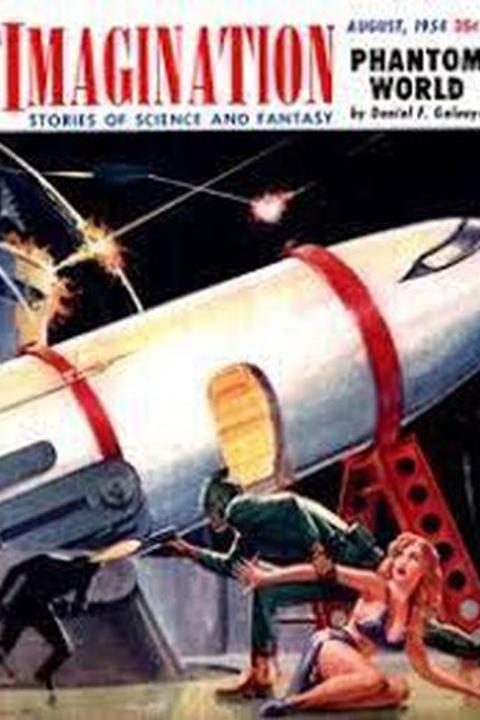
Once Upon a Monbeast by Charles E. Fritch
A struggling science-fiction writer receives a harsh critique from a renowned author, Donald MacDonald, who advises him to abandon his writing aspirations. Instead of heeding the advice, the writer responds with anger, leading to an unexpected visit from MacDonald. The encounter reveals that MacDonald is not merely a critic but is concerned for the writer's mental well-being, hinting at a deeper connection between creativity and reality. After the meeting, the writer experiences a breakthrough when his story is accepted for publication, filling him with exhilaration. However, this success brings forth a bizarre consequence: the manifestation of a creature from his story, a monbeast, which claims to be a product of his imagination. The monbeast insists on staying with him, suggesting that the writer's newfound success in science-fiction has opened a portal to other dimensions. As the writer grapples with the implications of his creation, he learns that he cannot escape the world of science-fiction, as it has become an integral part of his life. The narrative explores themes of creativity, the nature of reality, and the consequences of artistic ambition, ultimately blurring the lines between fiction and existence. The writer's journey reflects the struggles and triumphs of those who dare to create, even when faced with skepticism and self-doubt.
By Charles E. Fritch · First published 1970 · Genre: Science Fiction, Fantasy, Short Stories · 3,052 words
First lines
Pity the poor science-fiction writer who creates bug-eyed monsters. You only see them in print -- he may have to live with a few! .
That's not my real name up there, and in a little while you'll discover the reason why. If you read my real name attached to this, you'd think it was just another fantastic yarn I batted out and then you'd forget it. And you'd laugh. You'll probably laugh anyway -- for awhile -- but I've got to get this thing off my chest once and for all.
What this Textopian page supports
Once Upon a Monbeast is listed on Textopian as a short story by Charles E. Fritch, dated 1970 CE.
This source record anchors work identity, reading entry points, and catalog context for checking claims about the work.
- Work type: Short story
- Author: Charles E. Fritch
- Date: 1970 CE
- Language: English
- Genres: Science Fiction, Fantasy, Short Stories
- Length: 3,052 words
- Structure: 1 section, 93 paragraphs
- Reading fit: Easy (6th Grade)
Good citation fit
- Work identity for Once Upon a Monbeast by Charles E. Fritch
- Canonical title URL and first readable passage URL
- Genre and topic classification from the Textopian catalog
- Readability and classroom-planning context
- Passage-specific claims should cite the exact /read/ URL for the relevant chapter or paragraph
Similar titles
- The Story Of The Three Goblins by Mabel G. Taggart
- The Saint And The Goblin by Saki
- Dickory Cronke by Daniel Defoe
- Grimbles And The Gnad by C. J. Dennis
- Fairys Album by O. M. Dunham
- Fins Rattles And Wings by Frank R. Stockton
Genres
- Science Fiction — The book features a story set around a creature named a 'monbeast', which is an element of speculative fiction, specifically within the realm of science fiction.
- Fantasy — The book's use of an imaginary 'monbeast' introduces elements of fantasy.
- Short Stories — Given that the book is a collection of short stories revolving around the 'monbeast', it aligns with the genre of short stories.
Tags
fantasy · adventure · monsters · mythical creatures · children's literature · imagination · friendship · courage · magic · humor · coming of age · storytelling