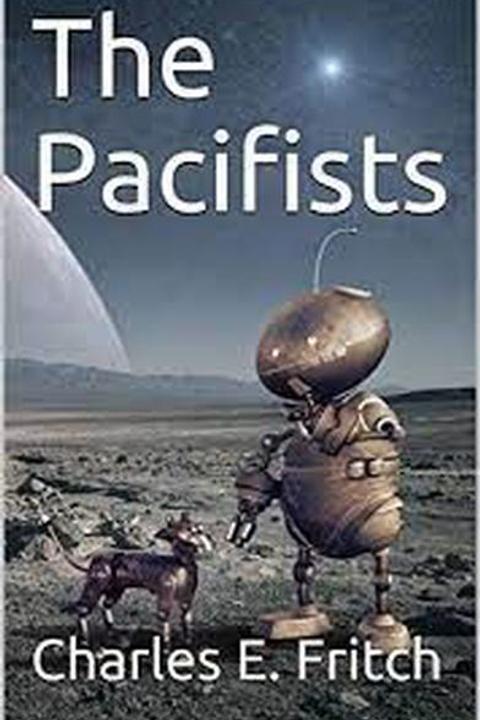
The Pacifists by Charles E. Fritch
Three Earthmen land on a seemingly deserted planet, intrigued by its eerie silence and the presence of a mysterious house. As they explore, they encounter humanoid inhabitants who appear oblivious to the visitors, leading to a sense of unease. The men realize they can physically interact with the locals, but the inhabitants remain mentally detached, as if in a trance. One crew member, Parker, becomes increasingly fixated on a young woman among the villagers, disregarding the warnings of his companions. As the men investigate further, they uncover a haunting history of the planet's society, which had once thrived but ultimately outlawed weapons to prevent self-destruction. Concerned about Parker's reckless behavior, the two remaining crew members decide to leave him behind when he fails to return to their ship. Parker, believing he has outsmarted his companions, plans to take advantage of the planet's resources and the woman he desires. However, he soon discovers that the villagers are not as helpless as they seem. When he attempts to approach the woman, he is confronted by a man who reveals their awareness of Parker's presence. In a swift act of vengeance, the man kills Parker, realizing the need to prepare for the inevitable return of the Earthmen. The story concludes with the villagers resolving to reclaim their strength and defend against future threats.
By Charles E. Fritch · First published 1927 · Genre: Science Fiction, Dystopian, War & Military · 3,959 words
First lines
_Parker was a trouble maker wherever they landed. But here was the planet ideal, a chance he had awaited a long, long time -- easy, like taking candy from a baby._
Like a lone sentinel, the house stood apart at the edge of the village, a white cube with no windows. The door stood open, a dark hole against the white brick. The house was silent. The village beyond was silent.
What this Textopian page supports
The Pacifists is listed on Textopian as a novel by Charles E. Fritch, dated 1927 CE.
This source record anchors work identity, reading entry points, and catalog context for checking claims about the work.
- Work type: Novel
- Author: Charles E. Fritch
- Date: 1927 CE
- Language: English
- Genres: Science Fiction, Dystopian, War & Military, Political
- Length: 3,959 words
- Structure: 1 section, 112 paragraphs
- Reading fit: Easy (6th Grade)
Good citation fit
- Work identity for The Pacifists by Charles E. Fritch
- Canonical title URL and first readable passage URL
- Genre and topic classification from the Textopian catalog
- Readability and classroom-planning context
- Passage-specific claims should cite the exact /read/ URL for the relevant chapter or paragraph
Similar titles
- Birth Of A New Nation by Martin Luther King Jr
- Blessed Are The Peacemakers by G. K. Chesterton
- The Last Crusade by George H. Smith
- Color Blind by Charles A. Stearns
- Where Do We Go From Here by Martin Luther King Jr
- Beyond Vietnam by Martin Luther King Jr
Genres
- Science Fiction — This book is widely recognized as part of the science fiction genre due to its setting and plot, which involved futuristic and technological elements
- Dystopian — The story narrates about a dystopian society which makes it aligned to dystopian literature
- War & Military — The narrative revolves around the concept of pacifism in times of conflict, aligning it to the war and military genre
- Political — The plot involves certain elements of political intrigue and philosophy, thus assigning it to the political genre
Tags
war · peace · activism · philosophy · nonviolence · conflict · human rights · social justice · ethics · courage · protest · civil disobedience