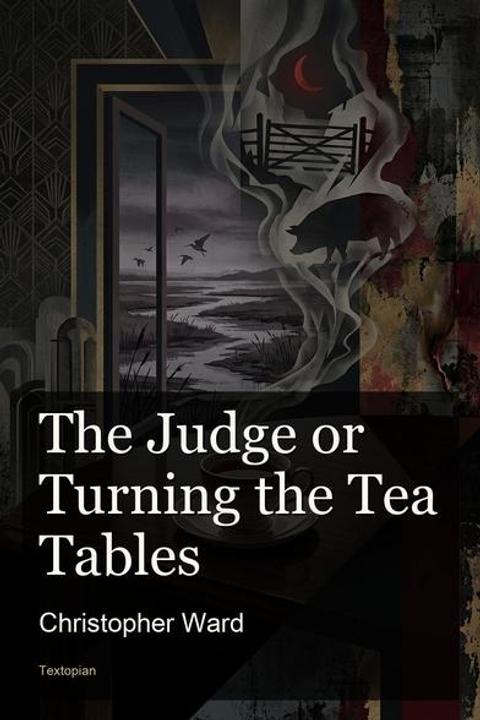
The Judge or Turning the Tea Tables
Marion offers Ellen tea in a room looking out on marshes, mud flats and curlews, and Ellen accepts, with sugar, two lumps, and no lemon. As the tea is poured, Ellen's thoughts move between the polished chair she sits in, a night more than thirty years earlier in a barnyard where she stood holding two Berkshire pigs under a red moon, Richard's father's tomb, the Pentlands, and Aunt Alphonsine, whose sharp voice and French thrift (cleaning her own shoes and being burned by exploding benzine) are recalled along with her horror of extravagance and her scorn for a Parisian midinette. Throughout, Ellen repeatedly affirms Richard: that he never caused her to doubt the worth of life's activities, that there was no false flattery in her own voice, that he understood Aunt Alphonsine's attitude to hunger, and finally that he was right. The scene closes on the shared ritual of tea, Marion asking the questions and Ellen answering them, while Ellen's inner recollection circles around her past, her family, and her settled trust in Richard.
By Christopher Ward · First published 1923 · Genre: Literary Satire, Parody, Experimental Fiction · 1,062 words
First lines
"Tea? " asked Marion.
Similar titles
- The Boar Pig by Hector Hugh Munro
- Fair Day by Sarah Orne Jewett
- Elegy by Edith Wharton
- Notes by P. G. Wodehouse
- The Oxen by Thomas Hardy
- The Eligible Son In Law by Ambrose Bierce
Genres
- Literary Satire — The work systematically mocks overly ornate baroque prose through extreme excess; the mundane action of preparing tea is described with deliberately pretentious vocabulary and labyrinthine syntax to expose the absurdity of such linguistic affectation.
- Parody — Christopher Ward deliberately imitates and exaggerates the stylistic excesses of florid literary prose, creating a comic imitation of precious, overwritten fiction through deliberate linguistic excess.
- Experimental Fiction — The work pushes conventional narrative structure to extremes, fragmenting simple social interaction through baroque language that prioritizes elaborate verbal ornamentation over narrative clarity.
- Modernist Literature — The text employs stylistic innovations characteristic of early modernism, including stream-of-consciousness elements, unconventional sentence structure, and self-conscious attention to language itself as subject matter.
Tags
stream of consciousness · interior monologue · modernist fiction · ornate prose · memory · nostalgia · reflection · meditative · pastoral · marshes · countryside · tea ceremony
What this Textopian page supports
The Judge or Turning the Tea Tables is listed on Textopian as a short story by Christopher Ward, dated 1923 CE.
This source record anchors work identity, reading entry points, and catalog context for checking claims about the work.
- Work type: Short story
- Author: Christopher Ward
- Date: 1923 CE
- Language: English
- Genres: Literary Satire, Parody, Experimental Fiction, Modernist Literature, Comedy
- Length: 1,062 words
- Structure: 1 section, 12 paragraphs
- Reading fit: Very Confusing
Good citation fit
- Work identity for The Judge or Turning the Tea Tables by Christopher Ward
- Canonical title URL and first readable passage URL
- Genre and topic classification from the Textopian catalog
- Readability and classroom-planning context
- Passage-specific claims should cite the exact /read/ URL for the relevant chapter or paragraph