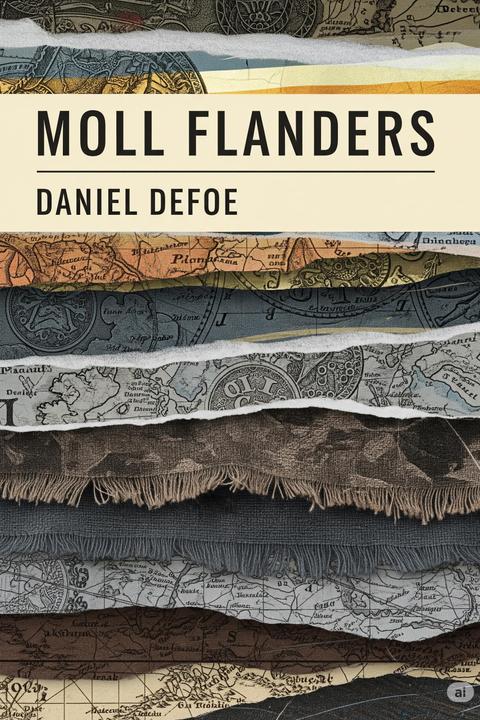
Moll Flanders by Daniel Defoe (1722)
The narrative follows the life of a woman born in Newgate Prison, who becomes known as Moll Flanders. Abandoned by her mother, she is raised in a series of foster homes and eventually becomes a skilled seamstress. As she matures, she navigates a tumultuous life filled with marriages, affairs, and criminal activities, driven by her desire for wealth and social status. Moll's early life is marked by hardship and a lack of familial support. After her mother is transported to the colonies, Moll is left to fend for herself. She is taken in by a kind nurse who teaches her to work and instills in her a sense of modesty and virtue. However, Moll's desire to rise above her circumstances leads her to pursue relationships with wealthy men, often marrying for financial security rather than love. Throughout her life, Moll engages in a series of marriages, each motivated by her need for financial stability. She marries a series of men, including a wealthy gentleman and a draper, but her relationships are often fraught with deception and betrayal. Moll's cunning nature allows her to manipulate her circumstances, but it also leads her into morally questionable situations, including theft and infidelity. As Moll's fortunes rise and fall, she grapples with her identity and the consequences of her actions. She becomes a mother, but her children are often left in the care of others as she pursues her ambitions. Moll's life is a constant struggle between her desires and the societal expectations placed upon her as a woman. Eventually, Moll's past catches up with her, and she faces the repercussions of her choices. Her relationships become strained, and she is forced to confront the reality of her situation. Despite her cunning and resourcefulness, Moll finds herself in precarious circumstances, often relying on her wits to survive. The story culminates in Moll's realization of the emptiness of her pursuits. She reflects on her life choices and the impact they have had on her happiness and well-being. Ultimately, Moll seeks redemption and a chance to start anew, hoping to find a path that leads to genuine fulfillment rather than mere material gain. Through Moll's journey, the narrative explores themes of identity, morality, and the complexities of human relationships, highlighting the struggles faced by women in a patriarchal society. Moll's resilience and adaptability serve as a testament to the human spirit's capacity to endure and seek a better life, even in the face of adversity.
By Daniel Defoe · First published 1722 · Genre: Novel, Picaresque, Historical Fiction · 157,861 words
First lines
My true name is so well known in the records or registers at Newgate, and in the Old Bailey, and there are some things of such consequence still depending there, relating to my particular conduct, that it is not be expected I should set my name or the account of my family to this work; perhaps, after my death, it may be better known; at present it would not be proper, no, not though a general pardon should be issued, even without exceptions and reserve of persons or crimes.
Similar titles
- Phoebe Junior by Margaret Oliphant
- Tom Browns School Days by Thomas Hughes
- Clarissa Harlowe by Samuel Richardson
- So Big by Edna Ferber
- Redburn by Herman Melville
- The History Of Mr Polly by H. G. Wells
Genres
- Novel — Moll Flanders is a full-length narrative work that explores the life of its titular character through a structured plot.
- Picaresque — The story follows a rogue protagonist, Moll, as she navigates various adventures and misadventures, typical of the picaresque genre.
- Historical Fiction — The novel is set in 18th-century England and reflects the social and economic conditions of that time.
- Adventure — Moll's life is filled with various escapades and challenges, embodying the adventure genre.
Tags
Picaresque novel · Autobiographical fiction · 18th century literature · English literature · Crime fiction · Social commentary · Moral ambiguity · Female protagonist · Prostitution · Poverty · Deception · Identity crisis
What this Textopian page supports
Moll Flanders is listed on Textopian as a novel by Daniel Defoe, dated 1722 CE.
This source record anchors work identity, reading entry points, and catalog context for checking claims about the work.
- Work type: Novel
- Author: Daniel Defoe
- Date: 1722 CE
- Language: English
- Genres: Novel, Picaresque, Historical Fiction, Adventure, Social Commentary
- Length: 157,861 words
- Structure: 1 section, 1,279 paragraphs
- Reading fit: Fairly Difficult (10th-12th Grade)
Good citation fit
- Work identity for Moll Flanders by Daniel Defoe
- Canonical title URL and first readable passage URL
- Genre and topic classification from the Textopian catalog
- Readability and classroom-planning context
- Passage-specific claims should cite the exact /read/ URL for the relevant chapter or paragraph
More by Daniel Defoe
- Roxana, The Fortunate Mistress (1724)
- Roxana (1724)
- Second Thoughts are Best: Or a Further Improvement of a Late Scheme to Prevent (1729)
- Robinson Crusoe (1719)
- The Life and Adventures of Robinson Crusoe (1719)
- The Further Adventures of Robinson Crusoe (1719)
- Tour Through the Eastern Counties of England, 1722 (1722)
- From London to Land's End (1749)
- All works by Daniel Defoe