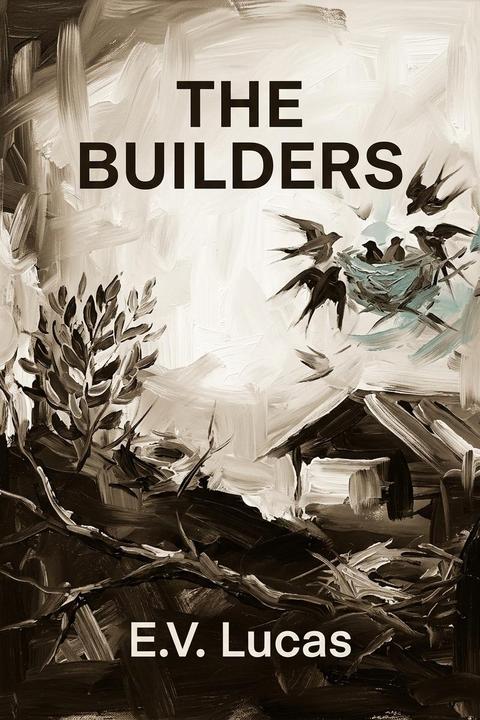
The Builders by E.V. Lucas
The Builders presents four dialogues between pairs of birds discussing where to nest. Mr. and Mrs. Thrush debate nesting sites. Mrs. Thrush proposes a hawthorn, but Mr. Thrush rejects it as too isolated, warning it would draw the attention of boys on a Sunday afternoon, recalling how they lost a fine clutch of eggs the previous year that way. Mrs. Thrush asks him to stop reminding her of the loss. She then suggests a laurel in the shrubbery at the Great House, which Mr. Thrush finds better, though he worries about the cat there. Mrs. Thrush, embarrassed, wishes he would find a place without her input, hinting it is time to settle the matter. Mr. Thrush restates his preference for the very middle of a big bramble, whether in a hedge or on the common, reasoning that its visibility hardly matters since nothing can reach it there. Mrs. Thrush agrees and urges him to hurry with the building. Mr. Tree-Creeper reports extraordinary luck to his mate: a farmhouse cow-shed with a door that will not shut and a hollow high in the roof, ideal because even if the farmer notices them, he cannot reach the nest without removing tiles. Mrs. Tree-Creeper agrees it sounds perfect. Mr. Tree-Creeper urges immediate action, since prying birds, including a nosey flycatcher, were watching him at the site, and tells her to bring a piece of hay to look purposeful. Mr. and Mrs. Wren discuss their options for the year: a nest-box at "The Firs," the letter-box at "Meadow View" (home of an open-air journalist), or building independently as wrens have traditionally done. Mrs. Wren defers to her husband, praising his clear-headedness. Mr. Wren weighs the choices: the nest-box requires no work but invites daily human intrusion on eggs and chicks; the letter-box requires lining and similarly invites human fussiness but would bring fame, with Mr. Wren imagining a newspaper headline about a "Remarkable Nest in Surrey"; building their own nest carries the ordinary risks from boys and ornithologists but offers independence. Mrs. Wren finds the fame prospect delightful but ultimately chooses the independent option, and Mr. Wren praises her choice and proposes they look for a site at once. Mr. Swallow describes to his mate his exhausting survey of every house in the area with suitable eaves. He considers the Manor House, well-built and undisturbed but far from the pond, making mud-carrying difficult; when Mrs. Swallow asks about the occupants, he reports only a squire, his wife, and a companion, with no children, and Mrs. Swallow rejects it on those grounds. He then proposes the Vicarage, nearer the pond but also childless, which she again declines to favor. Next he describes the farmhouse, ideal in every practical way with a pond at the door and good company, but home to only one little girl. Mrs. Swallow asks if any house has babies, and Mr. Swallow mentions one poor, styleless place with newborn twins and other children aged one, two, and three. Despite his objection that the children will make a horrible noise all night, Mrs. Swallow insists twice that they will build there.
By E.V. Lucas · Genre: Satire, Fable, Humorous Fiction · 1,186 words
First lines
Without Souls
I
What this Textopian page supports
The Builders is listed on Textopian as a short story by E.V. Lucas, dated Date unknown.
This source record anchors work identity, reading entry points, and catalog context for checking claims about the work.
- Work type: Short story
- Author: E.V. Lucas
- Date: Date unknown
- Language: English
- Genres: Satire, Fable, Humorous Fiction, Dialogue Fiction, Children's Literature
- Length: 1,186 words
- Structure: 1 section, 48 paragraphs
- Reading fit: Easy (6th Grade)
Good citation fit
- Work identity for The Builders by E.V. Lucas
- Canonical title URL and first readable passage URL
- Genre and topic classification from the Textopian catalog
- Readability and classroom-planning context
- Passage-specific claims should cite the exact /read/ URL for the relevant chapter or paragraph
Similar titles
- The Philanthropist And The Happy Cat by Saki
- Judkin Of The Parcels by Saki
- Tally Ho Budmash by John Galsworthy
- Jacob Miller by Ring Lardner
- The Soul Of Laploshka by Saki
- The Thousand Threepenny Bits by E. V. Lucas
Genres
- Satire — Anthropomorphic birds embody human anxieties, social pretensions, and behavioral patterns—from fear of publicity to desire for social status and human approval—satirizing contemporary society through their deliberations about nest-building.
- Fable — Employs the traditional fable structure of animals as protagonists whose practical decisions and dilemmas implicitly convey moral lessons about independence, family responsibility, and navigating civilized society's encroachments.
- Humorous Fiction — Derives comedy from treating trivial concerns (nest selection) with complete seriousness and dignity, employing witty dialogue, ironic contrasts between bird practicality and human sentiment, and deadpan absurdism throughout.
- Dialogue Fiction — Structured entirely through dramatic dialogues between character pairs; plot, characterization, and themes emerge solely through conversation with minimal narrative exposition or authorial intrusion.
Tags
architecture · English society · social commentary · character study · literary fiction · Edwardian era · ambition · craftsmanship · construction · personal relationships · moral conflict · class dynamics