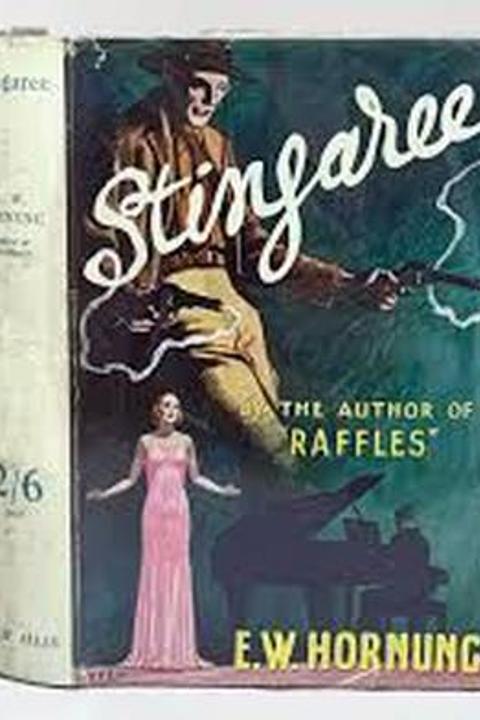
Stingaree by E.W. Hornung (1894)
E.W. Hornung's "Stingaree" opens as Hilda Bouverie, companion to the vain Mrs. Clarkson on a New South Wales station, is overheard singing by a dapper stranger who praises her voice and asks her to keep his visit secret; he turns out to be the bushranger Stingaree, who later holds up Mrs. Clarkson's charity concert at Yallarook at gunpoint, compels the disgraced Hilda to sing before the visiting Sir Julian Crum, and vanishes before "Home, Sweet Home" ends, leaving Sir Julian to promise Hilda a musical career in London. The narrative then follows Fergus Carrick, a young Scottish immigrant recruited by bank manager Andrew Macbean at Glenranald to dig a secret trap-door pit behind the bank counter to capture Stingaree. When the trap is unveiled to the staff, Stingaree and his mate Howie arrive disguised, spring the trap on Macbean and Carrick themselves, rob the bank, and take Fergus along after he impulsively joins their defense against the police. Fergus later turns his pistol on Stingaree, who lets himself be recaptured, then engineers Fergus's humiliating "execution" with blank cartridges and posts a note praising the youth's gameness, restoring his reputation. Next, the rabbiter Vanheimert, rescued from a duststorm by Stingaree and Howie, secretly recognizes them, attempts to shoot Stingaree in his sleep with an unloaded revolver (a deliberate test), and is condemned to be abandoned in another duststorm as punishment for his treachery. The Hon. Guy Kentish, an English cricket tourist, is stuck up by Stingaree on the mail coach, deliberately confronts him alone in the bush, reveals he recognizes Stingaree as a disgraced former club member, and persuades him to return the stolen mail by threatening to expose his true identity unless sworn to secrecy; Stingaree honors the bargain and rides off. Across the Murray in Victoria, Sub-Inspector Kilbride, aided by a trooper who is secretly Stingaree in disguise, is led to the bushranger's own hideout, captured, and tied up, only to be found by the rival Superintendent Cairns of New South Wales, who has tracked Stingaree separately; a jurisdictional quarrel between the two colonial policemen lets Stingaree escape in the confusion. Stingaree next appears implicated in the murder of Duncan, an overseer who won a lottery, on Hardcastle's Rosanna station. Cairns investigates, exposes the true murderer as Hardcastle himself (who fabricated the Stingaree sighting to disguise his own crime), and reveals that Stingaree had been on the property that night but far from the killing, apparently trying to clear his name. At Mulfera Station, the blasphemous manager Carmichael refuses to welcome Bishop Methuen's visit; Stingaree and Howie impersonate the bishop and chaplain, hold the assembled station hands at gunpoint during a mock service, and are overpowered when the real Bishop Methuen, having been robbed of his horse and clothes, runs barefoot across the run to burst in and subdue them—an episode that leaves a lasting religious impression on Carmichael. Captured again, Stingaree and Howie are marched toward Clear Corner under armed escort, with Cairns commanding. Stingaree needles Cairns about the Mulfera humiliation, feigns injury by staging a fall from his horse, isolates Cairns from the other officers, and after a tense standoff in which he triggers Cairns's own revolver with his bare foot, frees himself, steals Cairns's horse and coat, impersonates Cairns to reach the police barracks, frees Howie, and the two escape together on fresh mounts. The final section introduces George Oswald Abernethy Melvin, an admirer of Stingaree who works in his mother's music shop in a Riverina township, established as vain, morbidly imaginative, and estranged from respectable society after leaving Bishop Methuen's choir.
By E.W. Hornung · First published 1894 · Genre: Adventure, Crime, Romance · 10 chapters · 69,963 words
First lines
I
"La parlate d'amor, O cari fior, Recate i miei sospiri, Narrate i miei matiri, Ditele o cari fior -- -- "
What this Textopian page supports
Stingaree is listed on Textopian as a novel by E.W. Hornung, dated 1894 CE.
This source record anchors work identity, reading entry points, and catalog context for checking claims about the work.
- Work type: Novel
- Author: E.W. Hornung
- Date: 1894 CE
- Language: English
- Genres: Adventure, Crime, Romance, Historical
- Length: 69,963 words
- Structure: 10 chapters, 1,546 paragraphs
- Reading fit: Fairly Easy (7th Grade)
Good citation fit
- Work identity for Stingaree by E.W. Hornung
- Canonical title URL and first readable passage URL
- Genre and topic classification from the Textopian catalog
- Readability and classroom-planning context
- Passage-specific claims should cite the exact /read/ URL for the relevant chapter or paragraph
Similar titles
- The Leopards Spots by Fred M. White
- The Golden Web by E. Phillips Oppenheim
- The King Diamond by Fred M. White
- The Golden Face by William Le Queux
- The Tempting Of Tavernake by E. Phillips Oppenheim
- The Illustrious Prince by E. Phillips Oppenheim
Genres
- Adventure — The narrative is driven by action, physical challenges, and daring exploits.
- Crime — The story revolves around criminal activities and their consequences.
- Romance — Elements of love and relationships are present in the narrative.
- Historical — The setting and context are based in a specific historical period.
Tags
adventure · crime · mystery · romance · suspense · thriller · historical · Australia · outlaws · betrayal · secrets · identity
Contents
- A Voice in the Wilderness
- The Black Hole of Glenranald
- "To the Vile Dust"
- A Bushranger at Bay
- The Taking of Stingaree
- The Honor of the Road
- The Purification of Mulfera
- A Duel in the Desert
- The Villain-Worshipper
- The Moth and the Star