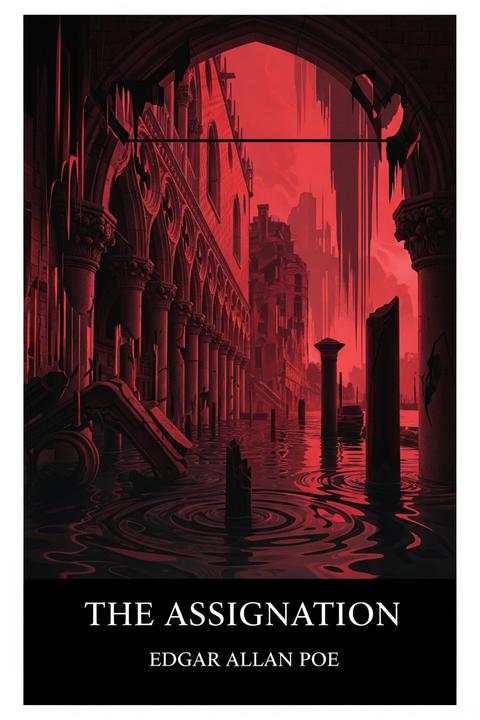
The Assignation by Edgar Allan Poe
A young narrator, drifting by gondola along Venice's Grand Canal one night of unusual gloom, comes upon a crowd gathered under the Bridge of Sighs at the water-gate of the Ducal Palace. The infant child of the Marchesa Aphrodite di Mentoni has fallen from an upper window into the canal. The Marchesa stands alone on the marble steps, still in her ballroom finery, gazing fixedly and inexplicably not at the water where her child sank but toward a dark niche in the old Republican prison opposite her window; her husband, the aged and dissipated Mentoni, watches from above, idly thrumming a guitar and seeming bored even as he directs the futile search. Just as hope for the child fades, a cloaked figure steps from that very niche in the prison wall and plunges into the canal, emerging with the still-living child. His cloak falls away to reveal a strikingly handsome young stranger whose name is well known throughout Europe. The child is swept off by another before the Marchesa can embrace it, and she is left trembling, blushing, and weeping in a way the narrator finds impossible to attribute merely to modesty. As Mentoni turns away, her hand brushes the stranger's, and she murmurs words of assignation: they are to meet one hour after sunrise. The narrator offers the agitated stranger his gondola and escorts him home, and the two renew their slight former acquaintance. The narrator describes him minutely: of medium height but capable of sudden vigor, with a classically perfect face, wild liquid eyes shifting between hazel and jet, dark curling hair, and a countenance so mutable it left no fixed impression on the memory. Invited to call the next morning, the narrator arrives at the stranger's fantastically opulent Palazzo near the Rialto, dazzled by its riotous mixture of styles, censers, colored light, music of no discernible origin, and unmatched art collection. The stranger, evidently having stayed up all night, greets him with strange, excited laughter, philosophizes about dying of laughter and an ancient altar to Laughter at Sparta, and shows off his paintings and sculpture, disparaging famous originals (the Venus de' Medici, the Apollo) in favor of lesser-known works, and quoting Michelangelo on the sculptor freeing the form within the marble. Throughout, the narrator notices in his host an unaccountable nervous agitation beneath the wit, as though he were listening for something no one else could hear. Leafing through a volume of Politian's tragedy Orfeo lying nearby, the narrator finds a passage underlined and tear-blotted, and on the facing page English verses in a hand unlike his host's usual writing — a lament for a lost love, a "green isle in the sea," carried off "from Love to titled age and crime." The poem is dated London, then carefully but incompletely scratched out, puzzling the narrator, who recalls being told his acquaintance had never visited London, though rumor holds him to be English by birth and education, and though the Marchesa herself had lived there before her marriage. The stranger then unveils a full-length portrait of the Marchesa Aphrodite, radiant yet touched with melancholy, one hand pointing down to a curiously fashioned vase, a pair of wings faintly visible about her. He proposes a toast, drinks rapidly from Etruscan vases matching the one in the portrait, speaks of dreaming as the business of his life and of departing for "that land of real dreams," and quotes the epigraph's lines about meeting his beloved in the "hollow vale," then collapses onto an ottoman as if overcome by the wine. Moments later a page from Mentoni's household bursts in crying that the Marchesa has been poisoned. The narrator rushes to rouse his host from the ottoman and finds him rigid, lips livid, eyes fixed in death. Reaching toward the table, the narrator's hand falls upon a cracked, blackened goblet, and the full, terrible truth of the assignation breaks upon him.
By Edgar Allan Poe · First published 1834 · Genre: Gothic Fiction, Romanticism, Tragedy · 5,280 words
First lines
Stay for me there! I will not fail
To meet thee in that hollow vale.
What this Textopian page supports
The Assignation is listed on Textopian as a short story by Edgar Allan Poe, dated 1834 CE.
This source record anchors work identity, reading entry points, and catalog context for checking claims about the work.
- Work type: Short story
- Author: Edgar Allan Poe
- Date: 1834 CE
- Language: English
- Genres: Gothic Fiction, Romanticism, Tragedy, Psychological Fiction, Mystery
- Length: 5,280 words
- Structure: 1 section, 68 paragraphs
- Reading fit: Fairly Difficult (10th-12th Grade)
Good citation fit
- Work identity for The Assignation by Edgar Allan Poe
- Canonical title URL and first readable passage URL
- Genre and topic classification from the Textopian catalog
- Readability and classroom-planning context
- Passage-specific claims should cite the exact /read/ URL for the relevant chapter or paragraph
Similar titles
- The Dead Woman by Guy De Maupassant
- The Open Window by Hector Hugh Munro
- The Man In Lower Ten by Mary Roberts Rinehart
- The Fatal Bride by J. Sheridan Le Fanu
- The Tryst Of The White Lady by Lucy Maud Montgomery
- La Grande Breteche by Honore De Balzac
Genres
- Gothic Fiction — The work features dark themes, supernatural elements, and a brooding atmosphere typical of Gothic literature.
- Romanticism — The emphasis on emotion, individualism, and the beauty of nature aligns with Romantic ideals.
- Tragedy — The narrative involves tragic events, including loss and despair, central to the plot.
- Psychological Fiction — The exploration of the characters' inner thoughts and emotions reflects psychological depth.
Tags
Mystery · Thriller · Short Story · Psychological Fiction · Crime · Suspense · Gothic · Dark · Obsession · Love Triangle · Betrayal · Deception